At six o'clock on the morning of January 10, 1863, steam trains began carrying the public beneath London from Paddington toward Farringdon Street. Workmen were among the first passengers. By nine, demand had outrun the Metropolitan Railway's locomotives and carriages; the company borrowed equipment from the Great Western Railway to absorb the crowd.[3] The world's first underground passenger railway opened not as a sealed new species of transport, but as a railway so interoperable that another company's rolling stock could be summoned into its tunnels.
Thirty-three years later, on May 2, 1896, Budapest opened continental Europe's first underground railway. Its small electric motor cars ran from the city center beneath Andrássy Avenue toward City Park, where the national Millennium Exhibition was receiving visitors. The line had been built in 21 months after city authorities rejected rails on the surface of their ceremonial boulevard.[4][6]
The pair is often arranged as a simple sequence of firsts: London opened the first underground; Budapest brought the form to continental Europe with electricity from the outset. That chronology is accurate but shallow. Both systems were built largely by opening a street, constructing a roof over the railway, and restoring the surface. Yet the shared method produced two different machines because each city defined the street differently. London buried a main-line connector; Budapest buried a tram so that an avenue would not have to look like a tramway.
London began with a railway-network problem
By the 1840s, London's great railways reached the metropolis but stopped at separate termini around its central districts. Bringing more lines inward promised convenience and threatened enormous demolition. In a House of Commons debate on March 19, 1846, MPs confronted proposals for stations at Farringdon Street, Holborn, Cornhill, and elsewhere. Taken together, the schemes first submitted or discussed would have occupied 200 acres and required the removal of between 9,000 and 10,000 houses. Parliament's immediate response was not a master plan but a commission: metropolitan railway projects had become too consequential to judge one bill at a time.[1]
The Metropolitan Railway that finally opened in 1863 answered a narrower version of the problem. Its route connected the Paddington, Euston, and King's Cross railheads with Farringdon and the edge of the City. London Museum describes a capital in which main-line stations had arrived before connections between them; the underground supplied the missing urban link.[2]
That purpose explains the first line's railway character. Wooden carriages ran behind steam locomotives. The route carried passengers toward work, but it also belonged to the wider main-line system rather than to a self-contained urban technology. The borrowed Great Western equipment on opening day was more than emergency capacity. It exposed the operating assumption beneath the project: trains already in the national railway world should be able to enter the metropolitan one.[3]
London therefore did not begin by asking what an ideal underground vehicle might be. It asked how an existing railway could pass through a city that had made surface access to its center politically and physically expensive.
Cut-and-cover moved the conflict; it did not erase it
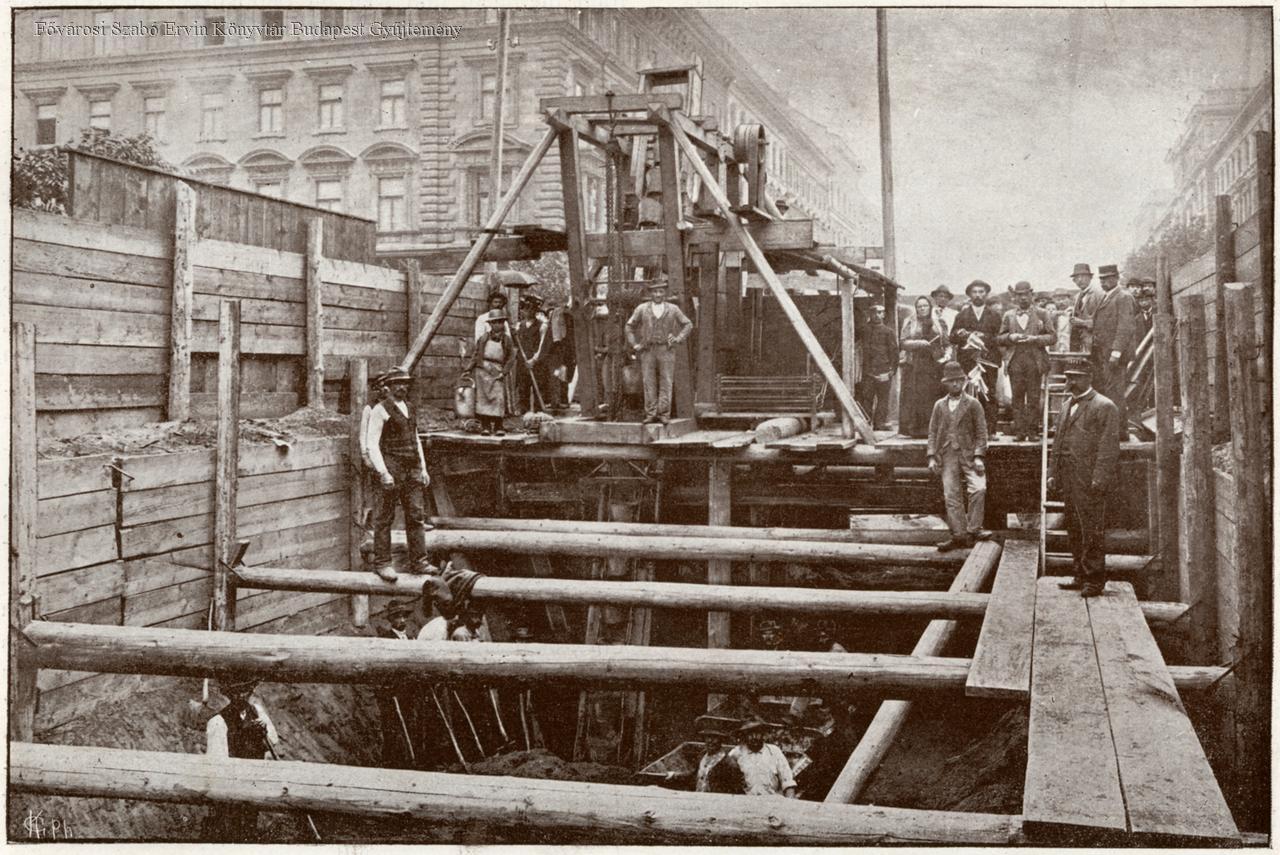
The answer was to follow streets and dig down from them. Tracks were laid in an open trench and covered with a brick roof before the road was restored—the method later named “cut-and-cover.” It avoided driving an entirely new surface railway through central London, but it did not make construction invisible. Streets became worksites for years, houses were demolished, and laborers moved earth beneath steam cranes. London Museum's photographic record of the next underground line, the Metropolitan District Railway, shows how thoroughly this supposedly subterranean technology occupied the surface.[2]
Nor did the roof isolate the street from the railway after opening. Steam demanded openings and ventilation; stations announced themselves above ground; smoke and heat entered the passenger experience. The same system that kept tracks out of ordinary traffic returned some of its costs as fumes, demolition, and vents. “Underground” described the level of the rails, not the disappearance of their urban consequences.
Londoners used it anyway. The Guardian's preserved opening-day report describes stations filling faster than trains could clear them and passengers being admitted in sections.[3] That immediate crowd does not prove that every social cost was accepted fairly. It does establish what counted as the line's first public success: movement through a bottleneck. The Metropolitan had made separated railways and the City feel contiguous.
Budapest began with a street it refused to surrender
Budapest's problem emerged from a different urban composition. Buda, Pest, and Óbuda unified in 1872–73.[7] Andrássy Avenue—built between 1872 and 1885—gave the new capital a formal route from central Pest to City Park. UNESCO treats the avenue and the railway beneath it as one planning ensemble: a representative boulevard above, modern infrastructure just below.[7]
That pairing was a decision, not an aesthetic inevitability. Budapest's Public Works Council repeatedly opposed surface rails on Andrássy Avenue. A ministerial order in July 1893 rejected an electric tram at street level because the avenue's intended character was considered incompatible with it. The transport demand remained. City Park would host Hungary's 1896 national Millennium celebration, commemorating the Magyar conquest and settlement of the Carpathian Basin, and existing omnibuses and horse trams could not plausibly carry the expected crowds without adding congestion to the very route officials wanted to protect.[4][5]
Two competing tramway companies submitted a joint underground proposal on January 22, 1894. The licensing process accelerated that spring and summer; authorization arrived in August, and work began the next day. Siemens & Halske supplied electrical expertise and capital alongside the Budapest companies. From first excavation to inauguration, the project took about 21 months.[4][5]
The deadline mattered, but so did the institution enforcing it. Officials had defined the unacceptable outcome before engineers finalized the acceptable one: Andrássy could carry mass transit, but the rails could not govern the boulevard's surface. The underground alternative was therefore both a capacity project and a rule about what a prestigious street should look like.
Electricity became a way to stay shallow
Budapest did not merely replace London's locomotive firebox with a motor. It organized the whole line around a low ceiling. The original tunnel was about six meters wide but only 2.85 meters high.[4] Its flat roof rested on iron and steel supports rather than a high brick vault. To fit below it, the 2.75-meter-tall cars used a dropped, “gooseneck” underframe; electric motors sat in the bogies, and the cars could be driven from either end. Lighting and traction were electric from the outset.[4][6]
Those choices formed one system. Electric traction avoided the combustion problem that had made ventilation inseparable from London's steam railway. The low motor cars reduced the vertical space that had to be excavated. A flat roof kept the works close beneath the avenue. Shallow stations shortened the journey from pavement to platform. Budapest's line was not deep tunneling in miniature. It was an electric tram made subterranean with unusual precision.
The route reinforced the distinction. Its approximately 3.75 kilometers and 11 stops joined the downtown terminus at Gizella Square to City Park; nine original stops were below ground and two lay on a short surface section near the park.[4] London had used the underground to stitch main-line terminals to the City. Budapest used it to preserve the public face of a single ceremonial corridor while moving exhibition traffic along that corridor. One sought connection across a railway geography; the other sought capacity without a visible concession on the avenue.
This is also why it would be misleading to call Budapest simply a refined copy of London. Engineers inherited the cut-and-cover family, but they were working with mature electric traction, a municipal prohibition on surface rails, a compact tram route, and a fixed national deadline. The borrowed idea became different because the governing constraints were different.
The openings measured success in different ways
London's first morning became a capacity test. The line opened for ordinary service, commuters arrived immediately, and the railway discovered that curiosity plus daily travel exceeded its planned supply. Its proof was the crowd: more engines and carriages were needed.[3]
Budapest's opening also carried ordinary passengers, but the Millennium celebration made the railway an exhibit of the capital as well as a route to an exhibition. Contemporary coverage emphasized speed, electric equipment, decorated cars, and the wonder of a city wired above and tunneled below. On May 8, 1896, Emperor Franz Joseph rode a specially appointed car to City Park and permitted the railway to bear his name.[4][5] Its proof operated in two registers at once: the cars moved a public, and the line performed technical modernity for the monarchy and international visitors.
Neither register was pure. London's privately built underground system transformed the city while the later Metropolitan District Railway demolished working-class housing along its works.[2] Budapest's protected avenue was a grand piece of state-backed urbanism, not a neutral public room.[7] But the contrast remains useful because it identifies what each project was designed to demonstrate. London showed that a railway could penetrate the metropolis without ending at its edge. Budapest showed that mass electric transport could be subordinated—physically and visually—to a planned streetscape.
Their afterlives preserved the original bargains
London's underground expanded and electrified. The founding Metropolitan route survived by losing the technological feature that had defined its first day: steam. The railway connection was durable; its original traction was not.
Budapest's line kept a more visibly bounded identity. The railway was rebuilt and extended entirely below ground in 1972–73, and its historic stations were restored in the 1990s. In 2002, the Millennium Underground joined Andrássy Avenue within Budapest's World Heritage property.[5][7] That designation recognizes a relationship, not just an old train: boulevard and railway remain evidence of a city treating surface and subsurface as a single composition.
The relationship was never frozen. Ornate entrance pavilions once made the underground conspicuous on the avenue, but most were removed between 1911 and 1925 because they were judged overdecorated or obstructive. Even Budapest's “invisible” tram kept renegotiating how much of itself could appear above ground.[4]
That complication brings the comparison back to earth. Cut-and-cover was not a universal answer that cities simply adopted in turn. It was a way of moving an argument vertically. London placed rails below the street but accepted a steam railway's clearances, smoke, and connective ambitions. Budapest placed a tram below the street and redesigned vehicles, roof, power, and stations around the demand that Andrássy Avenue resume its ceremonial life overhead.
The historical lesson is not that one city invented and the other improved. It is that infrastructure takes its final shape from what a city is willing to interrupt, what it insists on preserving, and which existing system it hopes to extend. London and Budapest both dug trenches. What they put inside them were two different definitions of the modern city.
Sources
- UK Parliament, “Railway Termini in the Metropolis,” Hansard, March 19, 1846 — primary debate on central railway proposals, demolition exposure, metropolitan termini, and the demand for coordinated review.
- London Museum, “Building a Victorian underground railway” — institutional account and photographic record of terminal connections, cut-and-cover work, street disruption, housing loss, labor, and early ridership.
- The Guardian, “Opening of the Metropolitan Railway to the public,” January 11, 1863 — contemporary opening-day report on service hours, workmen passengers, station crowds, and borrowed Great Western rolling stock.
- Budapest City Archives, Csiffáry Gabriella, “Fotómesék: 125 éve épült a Millenniumi Földalatti Villamosvasút,” 2021 — archive-led history of the rejected surface tram, approvals, construction sequence, dimensions, rolling stock, opening, pavilions, and later reconstruction.
- Hungarian Museum of Transport, Ágnes Medveczki, A millenniumi földalatti vasút, 1975 — institutional monograph based on municipal files and technical records, covering the surface-versus-underground proposals, exhibition deadline, engineering, finance, and operation.
- Péter Kádár, “No. 1 Metro — Line No. 1 in Budapest,” IEEE HISTELCON 2015 — technical history of the shallow tunnel, electric traction, motor cars, construction quantities, and 21-month delivery.
- UNESCO World Heritage Centre, Budapest, the Banks of the Danube and the Buda Castle Quarter: Andrássy Avenue and the Underground, nomination dossier — the avenue's planning, 1893–96 railway, urban relationship, comparative context, and continuing function.
- Metropolitan Ervin Szabó Library, Budapest Picture Archive, Picture ID AN048280 — György Klösz's June 6, 1895 photograph of an electric excavator working on the Millennium Underground at Andrássy Avenue and Gyár Street.