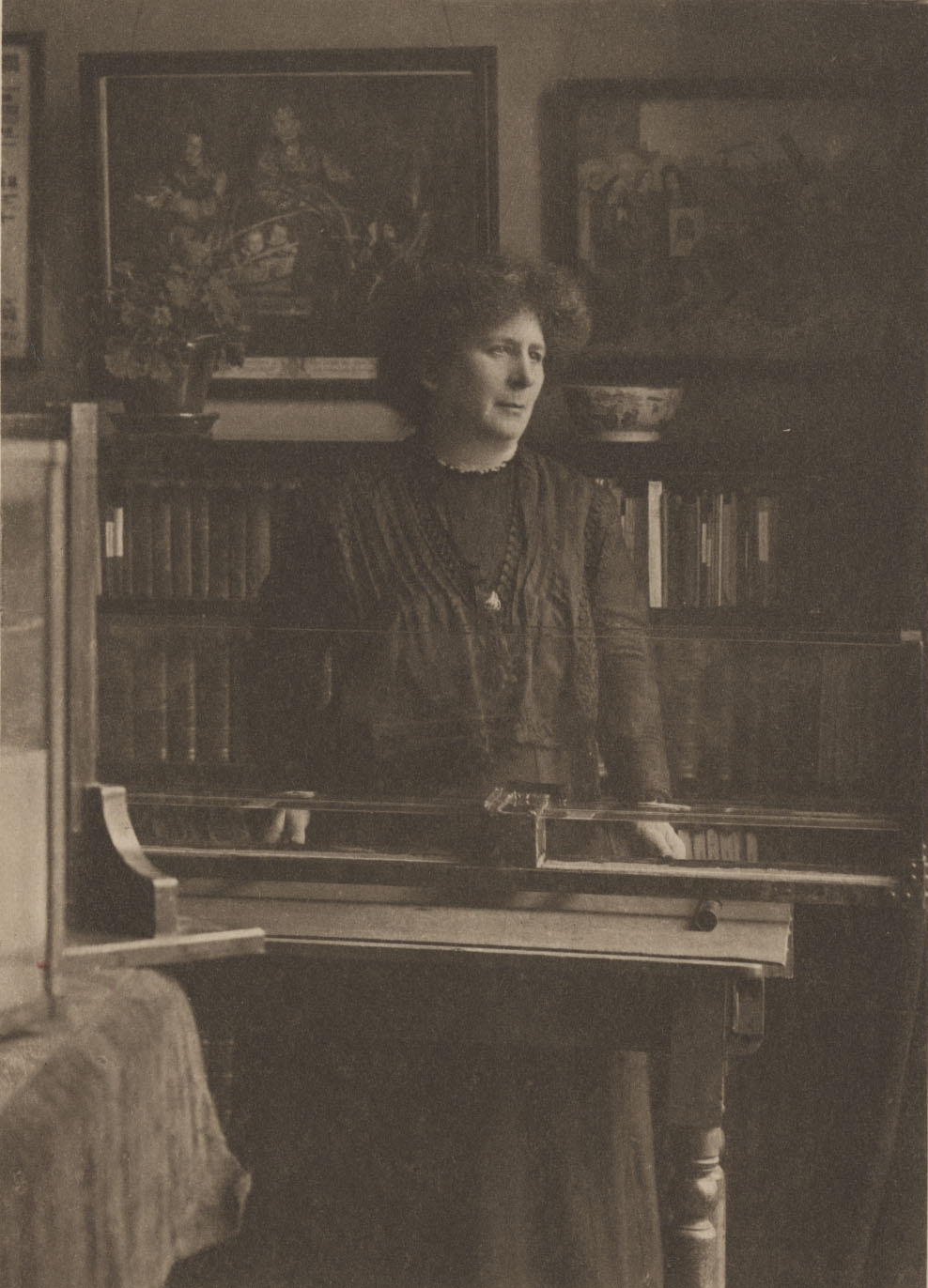
The glass tank occupies the foreground. Behind it stands Hertha Ayrton, surrounded by books and framed pictures in the drawing room of her London home. The Royal Society dates the portrait to 1906 and associates it with the award of her Hughes Medal. It identifies the apparatus as the ripple tank she used to investigate sand and moving water.[1]
The photograph gives experiment a domestic address. There is no grand laboratory doorway to announce where ordinary life ends and scientific work begins. A piece of apparatus makes that distinction. Ayrton has arranged a small world in which a movement can be repeated, observed, and questioned.
Within a decade, she would try to carry what she had learned about moving fluids into a battlefield device. Her anti-gas fan raises a question that a medal cannot answer: what happens when an experiment must work in somebody else's hands?
Learning to isolate a cause
Ayrton's reputation already rested on a practical nuisance. Electric arc lamps produced brilliant light between carbon rods, but their hissing signaled unstable operation. She investigated how changes at the carbon's end exposed a crater to oxygen. The sound had a physical cause that experiment could identify. In 1899, she presented her findings to the Institution of Electrical Engineers, which elected her its first woman member.[2]
This was an engineer's achievement with an unusually clear chain of reasoning: notice an unwanted behavior, isolate the conditions producing it, and make the explanation available to people using the equipment. It also supplied experience in demonstrating a phenomenon before an audience that could question the result.
Recognition remained uneven. Her 1902 nomination to the Royal Society failed after legal advice held married women ineligible for fellowship. In 1904, however, she presented her ripple research there in person; the Hughes Medal followed two years later. Elizabeth Bruton's study of Ayrton's surviving records places those achievements beside the continuing institutional exclusion.[4]
Membership, permission to speak, and recognition of an experiment were separate decisions. Ayrton could encounter an open door and a closed one within the same institution. That history matters when reading the later dispute over her fan, though it cannot by itself decide whether a particular device worked.
Bringing the beach indoors
According to the University of St Andrews' MacTutor biography, Ayrton's interest in sand ripples began during a 1901 visit to Margate while her husband was ill. Back in London, she investigated the relationship between the ridges and the water moving over them. Her observations connected the formation and development of ripples to vortices, the swirling movements associated with obstacles and changing currents.[3]
MacTutor also preserves engineer A. P. Trotter's description of her apparatus: glass tanks containing water above a shallow bed of sand, mounted so they could move backward and forward. Some were driven by motors. It distinguishes the quality of her experiments from shortcomings in her mathematical explanation.[3]
That distinction gives the tank its importance. A convincing observation can survive a flawed account of why it happens. Repetition allows another investigator to inspect the effect without first accepting every sentence of the theory. The sand provides a visible record of motion that would otherwise disappear when the water settles.
Seen this way, the portrait is more than an image of a distinguished woman beside an invention. It records the scale at which she could control a problem: a bounded vessel, an arranged movement, a surface left available for inspection. Those conditions helped produce knowledge. They would become harder to reproduce outside the room.
A fan goes to war
In May 1915, following the German gas attack at the Second Battle of Ypres, Ayrton began developing a way to move contaminated air. Bruton describes early tests with smoke from burning brown paper in her drawing room and a model tried in fellow suffragette Ernestine Mills's garden. Ayrton eventually described the device in a scientific paper published in 1919.[4]
A surviving example at the Australian War Memorial makes the proposal tangible. Its khaki cloth is stiffened with cane rods; hinged sections fold for carrying. A webbing restraint limits the wooden handle's motion so the fan pushes in the intended direction. The object was meant both to oppose an approaching gas cloud and to clear gas accumulated in trenches or dugouts.[6]
The fan therefore asked its operator to become part of the apparatus. A motor could keep a laboratory tank moving; a soldier had to supply the fan's repeated effort. Success now depended on a body, its equipment, and surrounding air that the inventor could not arrange as she arranged a vessel of water.
Portability was a real design accomplishment, visible in the folding cloth and cane. Yet carrying a device to the place of danger and making it useful there were different achievements. The preserved object lets us see how seriously Ayrton treated the first problem. The accounts of its use force us to examine the second.
Whose test counts?
Ayrton's 1923 Times obituary, reproduced by St Andrews, records a substantial deployment: 104,000 fans supplied, with the first issue in April 1916. It also recalls her complaint in the newspaper in 1920 about official indifference, delivery delays, and failure to ensure that soldiers used the fans properly.[5]
This is evidence for her diagnosis of the problem. She believed the passage from invention to service had failed at identifiable points: attention, supply, instruction. The obituary preserves that argument, but it supplies no measured comparison of casualties or gas concentrations. Its production total establishes the scale of an undertaking; it cannot tell us how much protection an individual fan provided.
The Australian War Memorial's account supplies a harder assessment from the receiving end. It reports poor popularity, considerable exertion, and little apparent effect on gas clouds. It also quotes British gas commander Charles Foulkes's retrospective claim that the divisional gas officers he consulted found no protective value in retaining the fans.[6]
Bruton's archival study shows that this disagreement was public by May 1920. Major H. J. Gillespie supported Ayrton, while Major Sisson attributed the rejection to field experience. The sources preserve competing explanations, not a single agreed verdict.[4]
Neither sympathetic remembrance nor a commander's dismissal provides a controlled trial. To resolve the disagreement more firmly, we would need results tied to particular conditions: the fan version, wind, training, duration of use, and whether the task was clearing an enclosed space or confronting an advancing cloud. Those distinctions matter because the claims describe different kinds of work.
The photograph offers a fitting place to leave Ayrton. Her tank shows the patience of making motion observable. The fan shows the ambition of putting that knowledge into another person's hands. A fair account can recognize the research, acknowledge the barriers she faced, and still ask exactly what happened when the apparatus left her room.
Sources
- Royal Society Picture Library, “Portrait of Hertha Ayrton,” RS.12958: dating, photographer, drawing-room setting, ripple tank, and publication in Evelyn Sharp's 1926 memoir.
- Anne Locker, “Making Marks: the ripple of a STEM pioneer,” IET Archives blog (March 5, 2026): arc-lamp research, IEE membership, and the archival laboratory photograph used here.
- J. J. O'Connor and E. F. Robertson, “Phoebe Sarah Hertha Marks Ayrton,” MacTutor, University of St Andrews (updated August 2016): Margate, ripple experiments, and Trotter's description of the tanks.
- Elizabeth Bruton, “The life and material culture of Hertha Marks Ayrton (1854–1923),” Science Museum Group Journal (November 14, 2018): archival research on recognition, fan development, and the competing 1920 press accounts.
- The Times, “A distinguished woman scientist,” obituary of Hertha Ayrton (1923), transcribed by MacTutor, University of St Andrews: first issue, supply total, and Ayrton's complaints about adoption.
- Australian War Memorial, “Ayrton Fan: Lieutenant Colonel J. B. St Vincent-Welch, 13 Field Ambulance, AIF,” RELAWM06267: the surviving object's construction and the military criticism of its use.