Martin Luther King Jr.’s Letter from Birmingham Jail is often remembered through three portable quotations. Read as a full historical document, its center of gravity is sharper than that memory suggests.
The letter is not mainly an abstract plea for kindness. It is an argument about political time: who gets to set the clock, who benefits from delay, and why appeals to order can become a way of preserving injustice.[1][2][3]
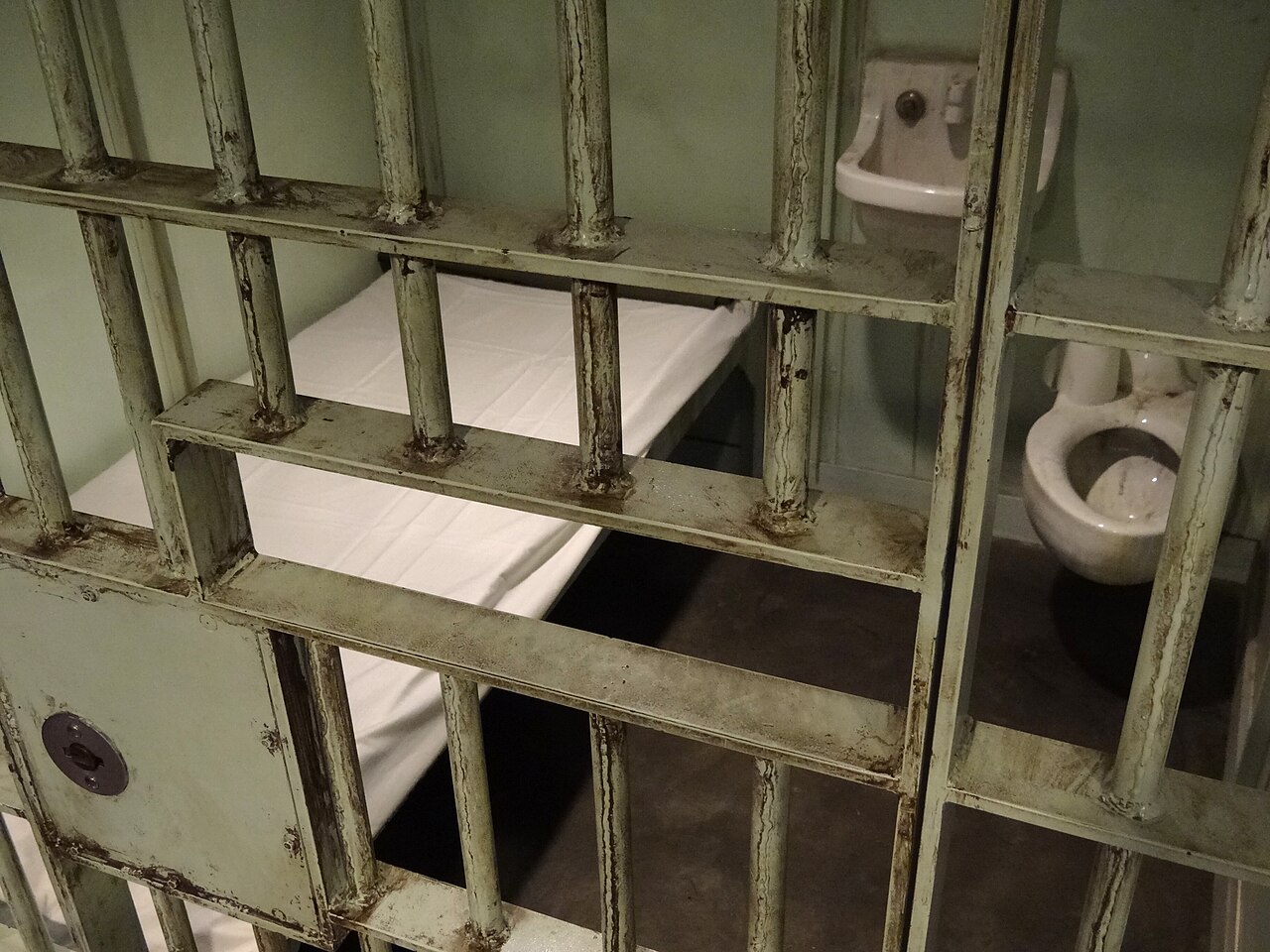
Image context: The hero image shows a recreation of King’s Birmingham jail cell at the National Civil Rights Museum. It is used here because this essay centers on the text’s carceral setting and the pressure logic formed inside that confinement, rather than on later memorial myth alone.
Timeline anchors: how the document entered the crisis
- 1963-04-03: the Birmingham campaign begins with coordinated nonviolent protest against segregation in one of the most rigidly segregated cities in the United States.[5][6]
- 1963-04-10: an Alabama court issues an injunction against demonstrations, parading, and picketing.[5]
- 1963-04-12: King is arrested on Good Friday; on the same date, eight white Alabama clergymen publish A Call for Unity, criticizing the protests as “unwise and untimely” and objecting to “outsiders.”[1][4][5]
- 1963-04-16: King dates his reply from the Birmingham city jail.[1][2]
- 1963-04-20: he is released on bail as the campaign continues to escalate pressure on business and civic leadership.[5][6]
- 1963-05-10: Birmingham business leaders and movement representatives announce a desegregation agreement, showing that the conflict King described as “tension” was not rhetorical flourish but bargaining leverage.[5][6]
This sequence matters because the letter is inseparable from campaign mechanics. It was written inside an active struggle over whether negotiation should happen only after public pressure disappeared, or because public pressure made delay more expensive.
The first move: King refuses the “outsider” clock
King opens by answering the clerical criticism that he is an outsider meddling in local affairs. The answer is organizational, moral, and geographic at once. He says he is in Birmingham because he was invited by an affiliated organization, and “more basically” because “injustice is here.”[1]
The familiar line that follows—“Injustice anywhere is a threat to justice everywhere”[1]—is often treated as a portable moral slogan. Inside the letter, though, it performs a narrower historical job. It denies that local authorities may control the timetable simply by labeling unwanted pressure as external interference.
That is the first structural claim of the document: segregation is not only a local custom; it is a national civic problem, so the demand for waiting on local convenience has no neutral standing.
Why “wait” is the load-bearing word in the letter
The most important argumentative target is not hatred but moderation organized as delay.
King writes that one of the basic points in the clergymen’s statement is that the movement’s action is “untimely.” He then turns the issue inside out. The problem, in his telling, is not premature action but the political use of waiting itself. “For years now I have heard the word ‘Wait!’” he writes, adding that it “has almost always meant ‘Never.’”[1]
That sentence is the hinge of the whole document.
Why? Because it translates procedural patience into power analysis. In the letter’s logic, delay is not an empty pause between reason and reform. Delay is an operating advantage for the side already protected by law, police power, custom, and commercial routine.
King makes the point harder a few lines later: “justice too long delayed is justice denied.”[1] This is not just a moral aphorism. It is a historical claim about lived sequence. If the cost of waiting is borne mainly by the oppressed, then “calm,” “timing,” and “order” are not neutral words. They are distributional words.
King immediately grounds that claim in bodily sequence: lynchings, police violence, humiliating signs, nights spent sleeping in the car because no motel will admit you, and the moment a child has to be told that the amusement park is closed to her because she is Black.[1] That long accumulation matters formally. It turns “wait” from a procedural civics virtue into an order to keep absorbing injury on schedule.
Direct action is presented as negotiation technology, not anti-negotiation theater
One of the most misread parts of the letter is the section on direct action. King explicitly says the movement has already moved through “collection of the facts,” negotiation, self-purification, and then direct action.[1] He is not rejecting negotiation. He is arguing that previous negotiation attempts had already been exhausted or broken, including merchants’ promises that were later reversed.[1][5]
Then comes the document’s most precise mechanistic sentence: “Nonviolent direct action seeks to create such a crisis and foster such a tension that a community which has constantly refused to negotiate is forced to confront the issue.”[1]
That line matters because it rescues the campaign from two false readings at once:
- It is not spontaneous disorder. The letter presents direct action as a sequenced tactic after failed bargaining and preparation.
- It is not negotiation’s enemy. It is the instrument for making negotiation unavoidable.
Put differently, King’s theory is not “pressure instead of dialogue.” It is pressure as the precondition for real dialogue when institutions benefit from stalling.
Law is not dismissed; legitimacy is ranked
The letter’s legal section is remembered for the distinction between just and unjust laws. Historically, the more interesting feature is that King does not discard legality as such. He ranks different forms of obligation.
On one level, he is answering the claim that disputes should be left to the courts.[4] On another, he is showing why court-directed patience can become circular in a regime whose institutions already normalize exclusion.[1][5]
That is why the document’s civil-disobedience argument lands with unusual force. If a law degrades personality and blocks a group from meaningful participation, then simple compliance is no longer civic maturity. It becomes complicity in an already rigged timetable.[1][2]
In this sense, the letter is less a romantic defense of protest than a disciplined critique of legalism without remedy.
The hardest sentence in the document may be about the “white moderate”
Near the end, King says he is more frustrated with the “white moderate” than with the outright segregationist, because the moderate is “more devoted to ‘order’ than to justice” and prefers “a negative peace which is the absence of tension to a positive peace which is the presence of justice.”[1]
This is the line that gives the letter its afterlife.
It does so because it identifies a recurring political type: someone who admits the goal in principle but rejects the pace, venue, or pressure required to reach it. The letter’s historical bite lies here. It treats moderation not as a virtue automatically, but as a position that must be judged by what its preferred tempo actually preserves.
That claim is why the document still reads as contemporary. It offers a test that extends beyond Birmingham in 1963: when someone calls for patience, whose costs fall due during the waiting period, and who keeps governing on favorable terms while others are told to mature?
Working assessment
Read closely, Letter from Birmingham Jail is best understood as a document that reorganizes three things at once:
- time: “wait” is exposed as a political instrument, not a neutral civic virtue;
- pressure: nonviolent direct action is defined as the method that converts ignored grievance into unavoidable negotiation;
- legitimacy: order and legality are judged by whether they move justice forward or merely stabilize delay.
That is why the letter has survived as more than a movement artifact. It does not merely denounce segregation. It explains how respectable institutions can absorb moral criticism, rename it impatience, and ask the injured side to keep living on someone else’s schedule.
What would change this assessment
- Documentary evidence that the Birmingham campaign had not in fact attempted prior negotiation would weaken the letter’s sequencing claim.
- Archival evidence showing that the clergy’s “wait” position was tied to a rapid, enforceable desegregation timetable would soften the delay-as-preservation reading.
- Campaign records demonstrating that public pressure reduced, rather than increased, the probability of bargaining success in Birmingham would weaken the letter’s theory of nonviolent tension.
The available record points the other way: broken promises, injunction, arrest, escalating confrontation, and then negotiated concession all support King’s basic argument that in Birmingham, delay was not a neutral civic pause. It was part of the system being contested.[1][4][5][6]
Sources
- University of Pennsylvania African Studies Center, Letter from a Birmingham Jail (King, Jr.) (full text mirror)
- Encyclopaedia Britannica, Letter from Birmingham Jail (work overview and significance)
- Encyclopaedia Britannica, Martin Luther King, Jr. (biographical and movement context)
- Wikipedia, A Call for Unity (publication date, authors, and response context)
- Encyclopedia of Alabama, Birmingham Campaign of 1963 (campaign sequence, actors, and settlement context)
- Wikipedia, Birmingham campaign (timeline overview and campaign escalation summary)
- Wikipedia, Letter from Birmingham Jail (composition details and image context page)
- Wikimedia Commons image source, Recreation of Martin Luther King's Cell in Birmingham Jail - National Civil Rights Museum - Downtown Memphis - Tennessee - USA