The Gulf of Tonkin is often told as a single causal sentence: two attacks, then a congressional mandate, then U.S. escalation. That version is tidy, but the archive is not. If we read the episode as a historiography problem instead of a morality fable, three different questions have to be kept separate:
- What happened on August 2, 1964?
- What happened on August 4, 1964?
- How did uncertainty and urgency move through the intelligence-to-policy chain between those dates and the August 7 Gulf of Tonkin Resolution vote?
Once those questions are separated, the debate becomes much clearer—and much harder to flatten into either “total fabrication” or “total certainty.”
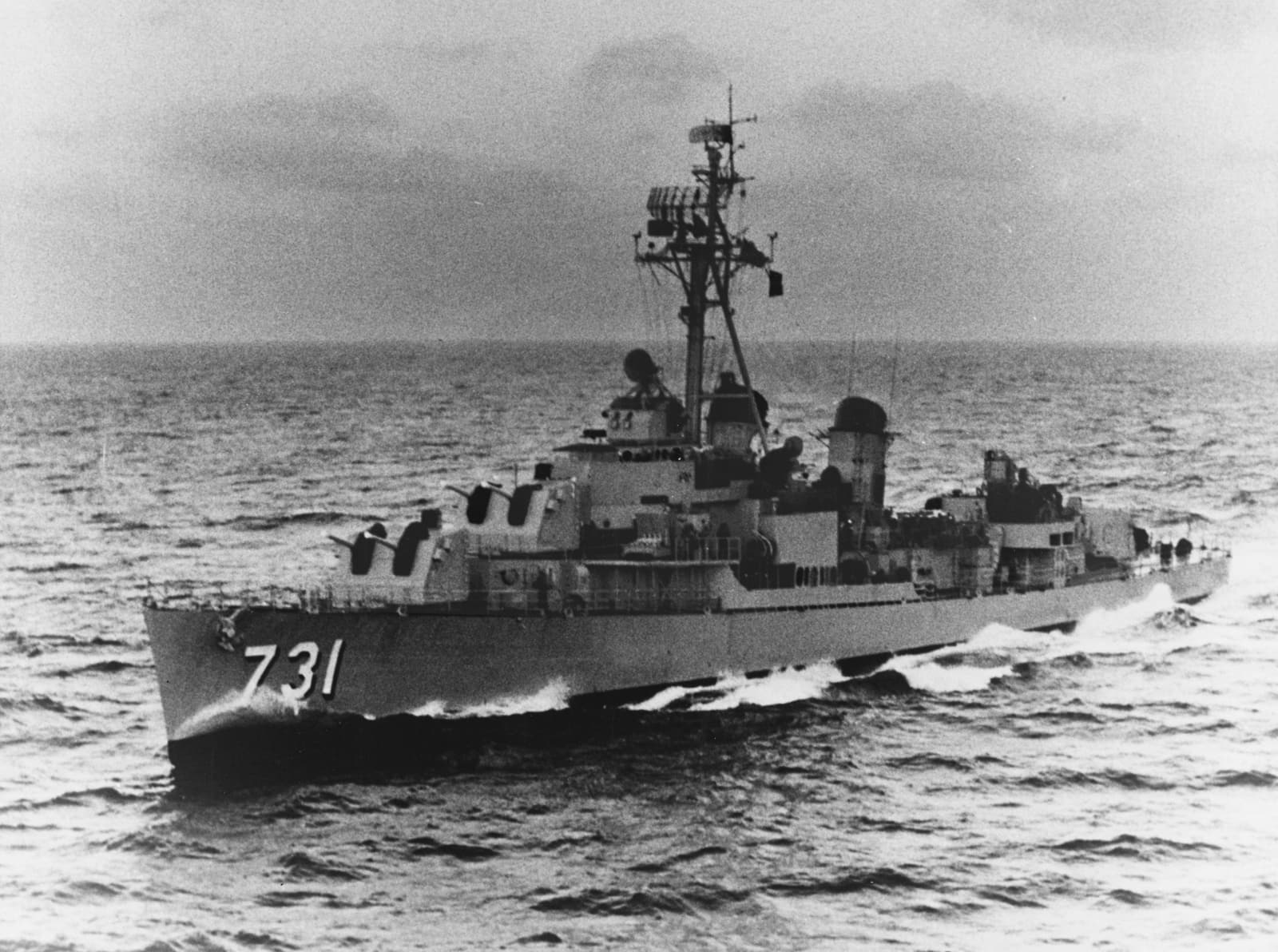
Image context: the cover image shows USS Maddox before the Tonkin crisis; it helps locate the vessel in the story, but the article’s central dispute concerns the August 4 reporting and interpretation chain, not what the photo itself proves.
What the broad record agrees on
There is little serious dispute that a naval engagement occurred on August 2, 1964 involving USS Maddox and North Vietnamese torpedo boats.[1][5] U.S. official retrospective material still treats that first clash as real, while also acknowledging that later doubt emerged over the reported second attack on August 4.[1]
There is also little dispute on the political sequence:
- report of a second attack on August 4;
- rapid Washington deliberation and strike planning the same day, visible in FRUS chronology records and related documents;[2][3]
- congressional passage of the Tonkin Gulf Resolution on August 7 (House 414–0, Senate 88–2), followed by presidential signature on August 10.[4][8]
So the central dispute is narrower than public memory suggests. Historians are not mainly arguing over whether there was tension or conflict in the Gulf. They are arguing over whether the August 4 event, as understood in Washington, was an actual attack, a battlefield misread, or a policy-convenient interpretation of fragmentary signals.
Interpretation A: the orthodox 1964 reading (two attacks, then proportional response)
This was the administration’s immediate framing in August 1964 and the legal-political foundation for requesting congressional authority. FRUS traffic from the crisis hours captures the official posture as a “deliberate and unprovoked attack” requiring a limited but firm response.[3]
The strength of this interpretation is temporal proximity: decision-makers were reacting in real time to incoming reports, poor weather, and combat-system ambiguity. In that setting, acting on a pattern of hostile indicators can look like prudent command behavior rather than deception.
The weakness is evidentiary durability. The August 4 claim did not age well as archives opened. The orthodox interpretation can still explain why leaders believed they had to move fast, but it struggles to explain why confidence stayed high in public messaging while private uncertainty signals existed in parallel records.[2][5][7]
Interpretation B: the post-declassification revision (August 2 real, August 4 not confirmed)
This is now the dominant scholarly synthesis in many histories: the first clash happened; the second was likely misinterpreted or never occurred in the form presented to Congress. National Security Archive releases, including published intercept-related materials and later commentary on declassified NSA records, reinforced that conclusion and highlighted analytic distortion risks.[5][6][7]
Its strength is cumulative documentary layering:
- declassified signals-intelligence reassessments,
- retrospective chronology work,
- and contradiction between early certainty and later evidentiary review.
Its weakness is that “no confirmed second attack” still leaves open a range of mechanisms: sensor error, command confusion, analytic selection, or mixed bureaucratic incentives. Revisionist confidence is highest on the outcome claim (the August 4 attack case is weak), but lower on single-cause intent claims (who knew exactly what, when, and with what degree of certainty).
Interpretation C: structural-escalation reading (the attack question mattered, but policy momentum mattered too)
A third school, increasingly common in teaching and synthesis, treats Tonkin as a hinge event inside a broader escalation trajectory rather than a standalone trigger. In this view, the incident did not create Vietnam policy from zero; it accelerated an already developing intervention architecture by supplying legal and rhetorical compression at exactly the right moment.[1][4][5]
The strength here is explanatory scope. It can accommodate both facts that sit uneasily together:
- uncertainty around August 4,
- and the very real policy consequences of acting as if certainty existed.
Its weakness is falsifiability. If stretched too far, “structural momentum” can become a catch-all explanation that underweights specific agency choices, including who framed uncertainty up or down in the final decision window.
Where the evidence boundary actually sits
A useful map for readers is this:
- High confidence: August 2 clash occurred; Washington moved rapidly on August 4; Congress passed broad force authority on August 7; that authority then supported wider war conduct.[1][3][4]
- Medium confidence: key actors received and transmitted mixed-quality reporting under severe time pressure, while public framing emphasized clarity.[2][5][6]
- Lower confidence / still contested: whether any senior official had a fully integrated view of contradictory signals before the final public line hardened, and whether selection bias was mainly cognitive, bureaucratic, or political.[6][7]
This boundary matters because debates often collapse two different accusations into one. Claiming that the August 4 case was weak is not the same as proving a unified preplanned fabrication. Historiographically, those are separate burdens of proof.
What would materially change the debate now?
Three evidence upgrades could still shift weighting among interpretations:
- Full recovery of missing or partial intercept chains tied to the August 4 reporting window, including original-language handling notes and timing metadata.
- More complete command-level communication logs that connect field uncertainty to White House and Pentagon message selection minute by minute.
- Cross-archive reconciliation work (U.S. operational logs, intelligence traffic, and Vietnamese-side records) at finer timestamp granularity than currently standard in survey accounts.
If those records showed that uncertainty was explicitly understood as disqualifying but publicly suppressed, Interpretation B would harden toward intentional distortion. If they showed genuine belief persistence under noisy data, Interpretation A would regain some explanatory ground on intent while still conceding evidentiary failure.
Why this historiography is still operationally relevant
Tonkin is not only a Vietnam War chapter. It is a case study in how democratic systems convert ambiguous tactical reporting into strategic authorization. The critical mechanism is not one radar return; it is the speed and filtering logic of the intelligence-to-legislation pipeline.
That is why the August 4 question remains central in 2026: not because historians enjoy reopening old files, but because the episode shows how quickly uncertainty can be repackaged as mandate when policy windows are short, stakes are high, and institutional incentives reward decisiveness over evidentiary drag.
Sources
- U.S. Department of State, Office of the Historian — Milestones: U.S. Involvement in the Vietnam War: the Gulf of Tonkin and Escalation, 1964
- U.S. Department of State, Office of the Historian — FRUS 1964–1968, Vol. I, Document 273 (Editorial Note on August 4 chronology)
- U.S. Department of State, Office of the Historian — FRUS 1964–1968, Vol. I, Document 279 (Telegram on response planning)
- U.S. National Archives — Tonkin Gulf Resolution (1964)
- National Security Archive (GWU) — Electronic Briefing Book No. 132: The Gulf of Tonkin Incident, 40 Years Later
- National Security Archive (GWU) — John Prados, 40th Anniversary of the Gulf of Tonkin Incident
- National Security Archive (GWU) — Newly Declassified NSA History Questions Early Vietnam War Communications Intelligence (with links to Hanyok material)
- Encyclopaedia Britannica — Gulf of Tonkin Resolution (1964)