Lend-Lease is often remembered in the language of rescue: Britain was short of cash, the United States opened the arsenal, and ships, aircraft, food, and fuel began to move across the Atlantic. That memory is true, but it is not the sharpest way to read the law itself. As a document, the Act of March 11, 1941 did something more precise. It turned aid to others into a category of American self-defense.[1][4]
The title already gives the game away. Congress did not call H.R. 1776 a bill to subsidize Britain, to enter the European war, or to save democracy abroad. It called it "An Act to Promote the Defense of the United States."[1] That phrase matters because it shows how Roosevelt's administration and its allies in Congress were trying to solve a political problem. They needed to move matériel outward while keeping the legal and rhetorical center of gravity at home.
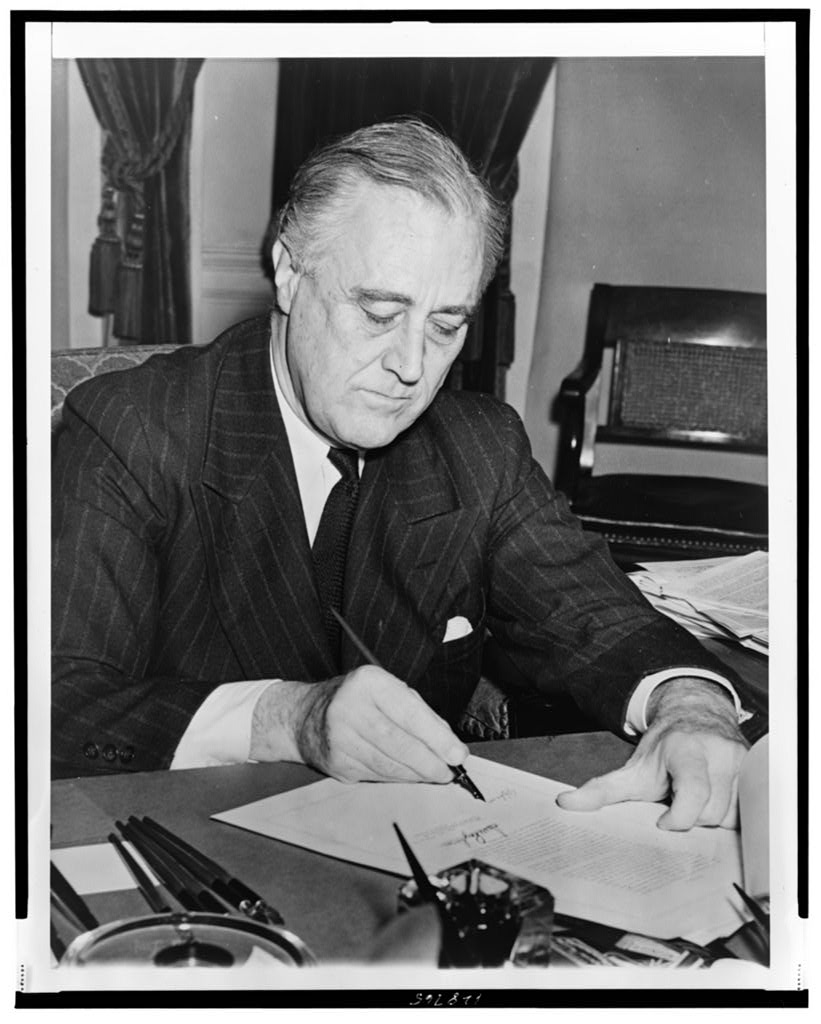
The lead image shows Roosevelt signing H.R. 1776 in 1941.[5] It fits the article because the historical argument lives in that administrative moment. The Lend-Lease Act mattered not only because it sent goods abroad, but because it rewrote the meaning of those transfers. The statute made it possible to say that supplying another country's war effort was still, in law and in political theory, part of defending the United States itself.[1][4]
Timeline anchors: the Act sat between neutrality law and undeclared mobilization
- September 1940: the United States and Britain reached the destroyers-for-bases deal, an earlier sign that Roosevelt was already pushing aid outward while avoiding formal entry into war.[1][4]
- December 17, 1940: Roosevelt used the "garden hose" analogy at a press conference, arguing that military aid to Britain should be understood as temporary practical help to a neighbor whose house was on fire.[2]
- December 29, 1940: in his fireside chat, Roosevelt called the United States the "great arsenal of democracy."[3]
- January 10, 1941: the Lend-Lease bill was dated and sent into Congress, beginning the formal legislative fight.[1]
- March 8, 1941: the Senate gave final passage to H.R. 1776.[2]
- March 11, 1941: Roosevelt signed the Act into law.[1][2]
These dates matter because they show sequence rather than myth. Lend-Lease did not appear out of nowhere after Pearl Harbor. It belonged to the long prewar corridor in which the Roosevelt administration kept moving the United States closer to material participation while stopping short of a formal declaration of war.[2][4]
First layer: the law defined outward aid as inward defense
The National Archives transcript is revealing from the first lines. The short title centers U.S. defense, and Section 3 opens with a powerful override phrase: "Notwithstanding the provisions of any other law" the President may authorize departments to procure and transfer defense articles under the Act's scheme.[1] That is not the language of a narrow exception. It is the language of a statute designed to cut through preexisting friction.
The key phrase comes a line later. Section 3 empowers the executive to procure defense articles for any government whose defense the President judges vital to the defense of the United States.[1] The sentence is elegantly circular. Foreign defense counts because it has first been folded into American defense. Britain, China, Greece, and later the Soviet Union do not enter the law as beneficiaries of pure generosity. They enter as positions in a wider American security perimeter.[1][4]
That framing solved several problems at once. It answered isolationist criticism by refusing the premise that aid abroad was necessarily a sacrifice of American interest.[2][4] It answered legal caution by insisting that the statute was not abolishing defense priorities but redefining them.[1] And it answered Roosevelt's political need to help countries already fighting Germany without openly saying that the United States had ceased to be neutral in any meaningful strategic sense.[2][3]
The same logic appears in Section 3(b), where the Act says the benefit to the United States may include payment, repayment in kind, property, or "any other direct or indirect benefit" the President deems satisfactory.[1] This is a remarkably elastic formulation. The statute does not demand a neat cash-equivalent exchange. It allows the executive to treat strategic position, survival time, production continuity, and future cooperation as benefits even if they do not look like ordinary financial return.
Second layer: the Act widened presidential discretion while keeping a noncombat fence in place
The law is expansive, but it is not sloppy. Its expansion happens through controlled discretion. The FDR Library's overview states the point plainly: opponents feared that the bill would give Roosevelt too much personal power, and in one important sense they were right.[2] Once the Act passed, the President could decide which governments qualified, what kinds of defense articles moved, and what counted as satisfactory benefit to the United States.[1][2]
That is why the statute matters as an administrative document as much as a diplomatic one. It did not merely approve a fixed transfer. It created a machine. Departments could manufacture, procure, sell, exchange, lease, lend, repair, outfit, and export under the statute's authority.[1] The policy was flexible by design because the war emergency was changing too fast for Congress to legislate each transfer one by one.
At the same time, the Act carefully preserved a fence around combat. Section 3(d) says nothing in the Act authorizes convoying by U.S. naval vessels; Section 3(e) says nothing authorizes entry of American vessels into a combat area in violation of the Neutrality Act of 1939.[1] Section 10 adds another brake, stating that nothing in the Act changes existing law on the use of U.S. land and naval forces except for the noncombat purposes listed in the statute.[1]
These clauses are historically essential. They show that Lend-Lease was built to move America closer to belligerent reality without formally crossing the line into declared war. Material, repair, information, and export could move. The statutory text was careful not to authorize combat escort or a direct rewrite of neutrality law in the most visible military sense.[1] In other words, the Act was radical in supply terms and cautious in force-authorization terms.
Third layer: Roosevelt translated the statute into household and industrial language
The public argument around Lend-Lease confirms the same structure. The FDR Library's history notes Roosevelt's December 17, 1940 "garden hose" explanation: if a neighbor's house is on fire, you lend the hose first and settle the return later.[2] The analogy mattered because it domesticated strategy. It made Britain sound less like a foreign claimant and more like a firewall for the neighborhood.
Twelve days later, Roosevelt's fireside chat widened the scale. In the official transcript, he says the United States must be the "great arsenal of democracy" and treat the emergency with the seriousness of war itself.[3] That sentence is often quoted as wartime uplift. In context it performs a harder task. It teaches the public to understand industrial production, not troop deployment, as the decisive American instrument in the crisis before formal war has begun.[3]
The Office of the Historian helps explain why this translation was necessary. Existing law allowed belligerents to buy on a "cash and carry" basis, but not to receive the kind of credit-heavy, discretionary aid Britain now needed, and many officials still worried that supplies sent abroad might simply fall into German hands.[4] Lend-Lease answered that problem by turning the question away from bookkeeping and toward strategic timing. The point was no longer whether Britain could pay now. The point was whether American defense improved if Britain stayed in the fight.[1][4]
Two readings still compete
Reading one: Lend-Lease was a backdoor abandonment of neutrality
This reading emphasizes practical reality. It points to the scale of aid, the President's discretion, and the plain fact that the United States was sustaining active belligerents long before December 1941. On this view, the noncombat disclaimers were politically useful wrappers around a policy that had already chosen sides.[1][2][4]
That reading captures something important. The statute undeniably moved the United States out of any ordinary idea of detached neutrality.
Reading two: Lend-Lease was a deliberately bounded legal bridge
This reading emphasizes the statutory architecture. It accepts that the Act shifted the country toward belligerency, but it insists that the shift was designed to remain materially aggressive and legally noncombatant at the same time.[1] The convoy ban, the combat-area language, and Section 10's preservation of existing force law all support that narrower interpretation.[1]
This second reading explains the text better. If the sole aim had been to abandon neutrality outright, those limiting clauses would have been unnecessary clutter. They are present because the administration needed a bridge: something broad enough to move arms, narrow enough to reassure Congress, and defensible as national defense rather than naked war entry.[1][2]
Why the bridge reading is stronger
The most convincing interpretation, then, is not that Lend-Lease preserved old neutrality in good faith, nor that it simply disguised war under a false label. The stronger claim is narrower. The Act constructed a legal bridge between those two positions.[1][2][4] It redefined aid as self-defense, concentrated administrative discretion in the executive, and held onto explicit noncombat limits so the United States could move far toward war without yet saying that it had entered one.
That is why H.R. 1776 still reads so sharply in 2026.[1][4] It shows how states often change course: not by announcing a total conceptual break all at once, but by rewriting what counts as defense, what counts as benefit, and which kinds of action remain outside the line for the moment. Lend-Lease did not make neutrality disappear in a day. It made neutrality administrative, conditional, and temporary. That is a different kind of historical force, and in March 1941 it was more than enough.
Sources
- U.S. National Archives, "Lend-Lease Act (1941)" - transcript and context for H.R. 1776, including the title, Section 3 powers, and the Act's noncombat limitations.
- Franklin D. Roosevelt Presidential Library & Museum, "The Lend-Lease Program, 1941-1945" - on the garden-hose analogy, congressional debate, Senate passage, and the program's later expansion.
- Franklin D. Roosevelt Presidential Library & Museum, "Fireside Chat, December 29, 1940" - official transcript of Roosevelt's "arsenal of democracy" address.
- U.S. Department of State, Office of the Historian, "Lend-Lease and Military Aid to the Allies in the Early Years of World War II" - on the legal limits of cash-and-carry, prewar resistance, and the strategic purpose of the program.
- Library of Congress Prints & Photographs Online Catalog, "(President Franklin D. Roosevelt, half-length portrait, seated at desk, looking down, signing H.R. 1776, the lend-lease bill to give aid to Great Britain, China and Greece)" - source page for the archival photograph used here.