Bessie Coleman is remembered so often as a first that the word can flatten the real shape of her achievement. Firsts are easy to file away: first African American woman to hold a pilot's license, first woman of Native American descent to do so, first person of color to receive an official FAI license.[1][2][3][4] The harder historical question is how she got there in a country whose flight schools had already closed the route in advance.
This article's argument is that Coleman's importance lies in route-building. Between 1915 and 1926, she stitched together a path the United States itself refused to provide: migration to Chicago, Black press patronage, French language study, training at Le Crotoy, then a barnstorming career used both to earn capital and to force public terms.[2][3][4][6] She mattered because she turned aviation from a closed profession into a workaround, then turned that workaround into public leverage.
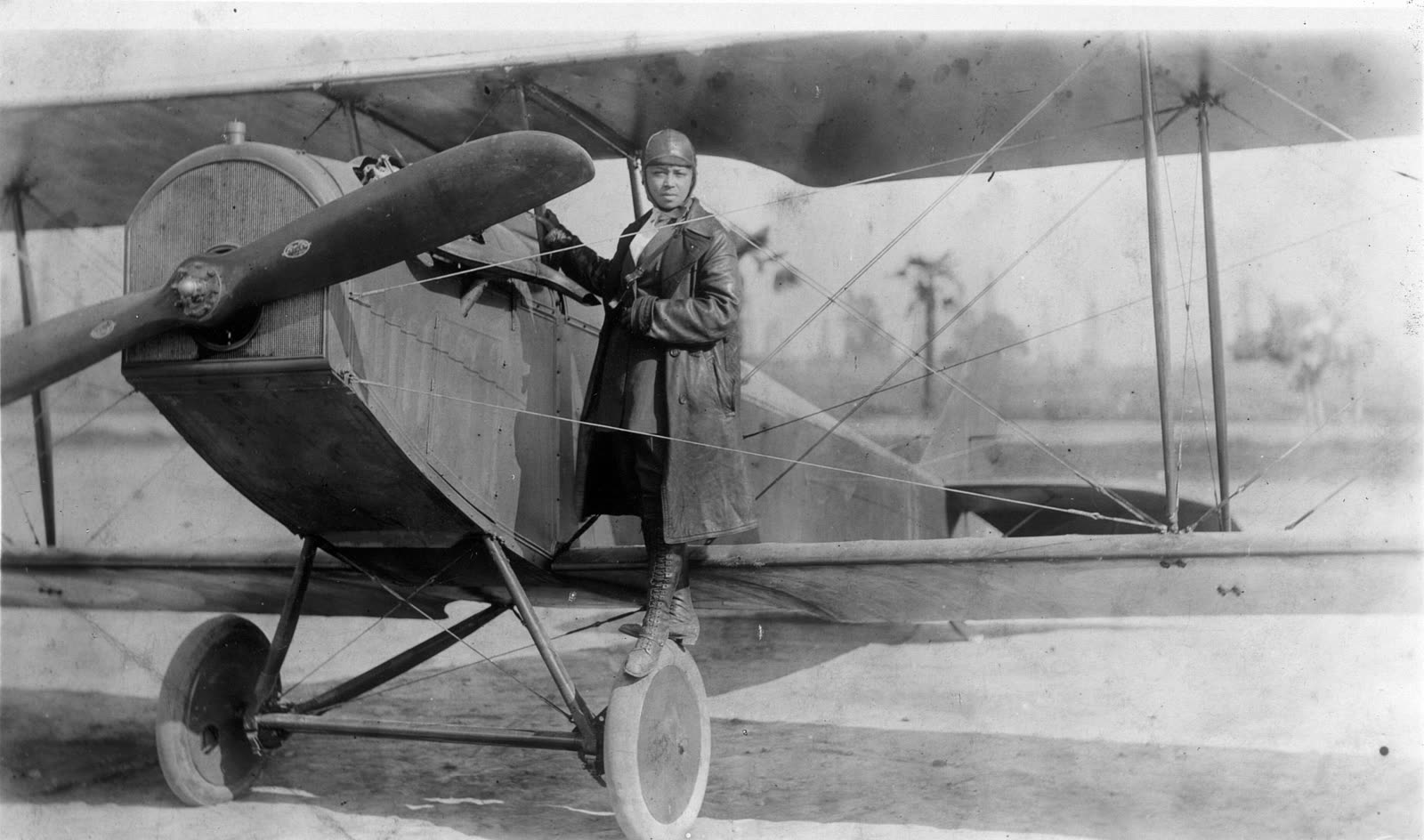
The lead image shows Coleman with her plane in 1922.[5] It fits the article because her career was practical before it was symbolic. She had to get near an aircraft, pay for instruction, survive crude machines, and keep converting visibility into the next opening. Her story works best when read that way: not as a floating legend, but as a sequence of hard logistical moves.
Timeline anchors
- 1915: Coleman moved from Texas to Chicago, joining the Great Migration and taking service work on the South Side.[3][6]
- November 9, 1920: she obtained a U.S. passport and a one-year tourist visa for France.[2]
- November 20, 1920: she sailed from New York for France to pursue flight training.[2][4]
- June 15, 1921: the Federation Aeronautique Internationale granted her pilot's license.[3][4]
- September 3, 1922: she made her first major American air-show appearance in Garden City, Long Island.[3]
- February 22, 1923: a newly purchased plane crashed in Los Angeles, seriously injuring her.[2][6]
- April 30, 1926: Coleman died in Jacksonville, Florida, while preparing for an exhibition flight.[1][3]
These dates matter because they show that her rise was neither sudden nor local. The famous license in 1921 only makes sense once it is placed between migration, fundraising, language study, and a deliberately international detour.[2][4][6]
Chicago gave Coleman a city, but not a runway
Coleman reached Chicago at 23, hoping the city would offer more than Texas sharecropping and domestic labor had done.[3] It offered wage work and a wider Black public sphere, but it did not offer equal access. PBS's reconstruction is blunt: when Coleman decided she wanted to learn to fly, every aviation school she approached refused her because she was both Black and a woman.[3] The National Women's History Museum tells the same story from the North side of the color line. Even after five years in Chicago, surviving the city's racial violence and learning a trade, she still found that race and gender narrowed the horizon of respectable ambition.[2]
That blocked horizon is the real beginning of the story. Coleman did not become historically important because she dreamed unusually hard. She became important because the available American route failed, and she had to assemble another one. Robert S. Abbott, publisher of the Chicago Defender, was crucial here.[2][3][4] He did more than encourage her. He helped name the only plausible strategy: learn French, save money, find sponsors, leave the country, and come back with a credential that American institutions would have to confront after the fact.[2][3][4]
This is the first reason Coleman deserves biography rather than slogan. The decisive move was not inside the cockpit. It was administrative and social. She made aviation thinkable by moving through barbershops, Black newspapers, consulates, steamship bookings, and language classes before she ever touched a control stick.[2][3][4][6]
France turned ambition into a license
The Women's History Museum chronology gives the sequence with unusual clarity. On November 9, 1920, Coleman secured a passport and French visa; on November 20, she sailed from New York; at Le Crotoy in the Somme she entered the Ecole d'Aviation des Freres Caudron, where the aircraft were fragile and accidents were common.[2] PBS adds that she was the only student of color in her class and that she witnessed another student die during training.[3] None of this made the route easy. It only made it open.
The date that changed the public record was June 15, 1921. FAI's own centennial note states that on that day the federation granted Coleman her pilot's license, making her the first person of color to obtain an official FAI pilot's license.[4] That matters for more than the ceremonial "first." The FAI credential was portable. It meant the training could no longer be dismissed as a private adventure or an improvised local stunt. France had given her an internationally legible document that the United States had refused to make possible.[2][4]
This is the hinge of the article. Coleman did not solve exclusion by asking the American gatekeepers again. She solved it by changing jurisdictions. That move sounds simple in retrospect, but it required cash, sponsors, literacy across institutions, and a willingness to cross an ocean for professional training in an industry that was still killing people in basic instruction.[2][3][4] Her historical intelligence lay in recognizing that if the domestic route was closed, the only serious answer was to build a transatlantic one.
Barnstorming was not a sideshow; it was her operating model
When Coleman returned to the United States, the license alone was not enough. A Black woman with a credential still needed aircraft, audiences, and money. PBS notes that her first major American show took place on September 3, 1922, in Garden City, Long Island, after which she spent the next years performing in air shows across the country.[3] The Library of Congress guide also frames the post-license period in those terms: she returned to the United States to perform at exhibitions and airshows, making the newspaper record itself part of her afterlife.[1]
It is tempting to treat barnstorming as pure spectacle, the flashy second act after the "real" achievement in France. That reading is too small. Barnstorming was Coleman's operating model. It turned an international credential into income, celebrity, and an addressable public.[1][3][6] The crowds came for loops, dives, and daring; Coleman used that attention to make a claim about who belonged in the air. She needed stunt work because the American aviation economy of the early 1920s did not contain a neutral professional lane waiting for her to enter. Public performance was the lane.
Her 1923 Los Angeles crash shows how precarious that lane remained. According to the Women's History Museum and Smithsonian reporting, Coleman had recently bought her own Curtiss JN-4 when the plane stalled and nose-dived, leaving her with a broken leg, cracked ribs, and facial cuts.[2][6] That episode matters because it reveals the material cost of the route she had built. She did not inherit stable equipment or institutional protection. She had to buy risk at retail.
Yet the crash did not break the larger project. Within the existing sources, the point that recurs is not mere toughness but continuity of aim. Coleman treated recovery as delay, not defeat.[2][6] She still intended to fly, still intended to expand what Black audiences could see, and still intended to build toward a school of her own.
Coleman used performance to set political terms
The most useful way to read her fame is as bargaining power. Smithsonian's account is direct: Coleman refused to perform unless Black attendees could enter on equal terms, and PBS likewise notes that she would not appear at venues that excluded Black people.[3][6] This is where her career stops looking like a generic "inspiration story" and becomes historically sharper. She did not simply symbolize racial advancement by being visible in the cockpit. She used the market value of her visibility to challenge the rules of the ground.
That choice matters because aviation in the early 1920s could easily have absorbed her as novelty. A daring Black woman pilot was marketable; a Black woman pilot insisting on equal entrance conditions was harder to neutralize.[3][6] Coleman understood that if her name could sell tickets, then promoters had to decide whether they wanted the attraction badly enough to bend their segregated routine. In this sense, the flying itself and the activism were not separate careers. They were the same mechanism seen from different sides.
Her long-range goal makes the point even clearer. Several of the biographical sources note her ambition to open a flying school for African Americans, especially Black women, so that others would not have to face the same blocked route she had confronted.[2][6] She was not trying to remain the heroic exception forever. She was trying to turn exception into pipeline.
Death froze the plan, but not the route she made visible
Coleman's last flight on April 30, 1926 interrupted that institutional ambition before it could solidify. The Library of Congress guide summarizes the crash in blunt terms: while testing a plane before an exhibition, it malfunctioned, flipped, and threw her to her death.[1] PBS gives the more specific mechanical account most often repeated in later summaries: at 3,500 feet, an unsecured wrench jammed the controls while mechanic William Wills flew; Coleman, unbelted as she looked over the side for a parachute jump site, was thrown from the aircraft.[3]
The aftermath shows how large her symbolic field had already become. PBS records that about 10,000 mourners filed past her coffin on Chicago's South Side and that Ida B. Wells presided over the funeral.[3] That scale matters. Coleman had not lived long enough to found the school she wanted, but she had lived long enough to become a public figure in Black civic life rather than a niche aviation curiosity.
Her legacy then traveled along the very route she had hoped to open. PBS notes that Black pilots from Chicago began annual flyovers of her grave in 1931, and later organizations such as the Bessie Coleman Aviators Club carried her name forward.[3] Smithsonian adds that the Bessie Coleman Aero Club became part of the infrastructure through which later Black aviators found training and community.[6] She did not institutionalize the school herself, but she made the idea hard to unsee.
Two readings still compete
Reading one: Coleman matters mainly as a barrier-breaking first
This reading emphasizes the obvious headline. She was first, the exclusion was brutal, and the image of a Black woman pilot in the early 1920s still carries enormous symbolic charge.[1][3][4]
Reading two: Coleman matters as a strategist who built a route around blocked institutions
This reading accepts the symbolic first, then asks how the achievement actually functioned. Chicago work, Abbott's patronage, French training, an international license, stunt-flying income, and equal-entry demands formed one continuous strategy.[2][3][4][6]
The second reading is stronger because it explains the sequence. If Coleman were important only because she was first, the story would climax with the license in 1921. Instead, the record keeps moving: back to the United States, into the exhibition circuit, through crash and recovery, toward a school and toward bargaining over segregated entrances. Her historical contribution was not a single credential. It was the route that credential made possible.
That is why the 1922 plane photograph works so well at the top of the article.[5] It restores the physical fact of the achievement. Coleman did not float above prejudice by force of legend. She found sponsors, crossed borders, mastered dangerous equipment, sold tickets, and tried to convert applause into infrastructure. The route was unfinished when she died. It still changed who could imagine entering the air after her.
Sources
- Library of Congress, "Bessie Coleman: Topics in Chronicling America" - overview of Coleman's chronology in the historic newspaper record, including her training in France, 1922 performances, and April 1926 death.
- National Women's History Museum, "Biography: Bessie Coleman" - passport and departure dates, training at Le Crotoy, FAI qualifying context, the 1923 Los Angeles crash, and her plan for a flying school.
- PBS American Experience, "Bessie Coleman" - Chicago move, Abbott's role, the June 1921 license, the September 3, 1922 Garden City show, anti-segregation stance, death in Jacksonville, and the size of the funeral response.
- Federation Aeronautique Internationale, "100 years since FAI granted Bessie Coleman's pilot licence" - June 15, 1921 license date and the international significance of the credential.
- Wikimedia Commons, "File:Bessie Coleman and her plane (1922).jpg" - source page for the archival 1922 photograph used as the article image, from the Miriam Matthews Photograph Collection at UCLA.
- Smithsonian Magazine, "For Pilot Bessie Coleman, Every 'No' Got Her Closer to 'Yes'" - Great Migration context, 1923 crash details, refusal to perform under segregated entrance rules, and later organizational legacy.
Editor’s Pick Review
This piece takes today’s merged standard/add-on editor-pick slot because it has the strongest 24-hour curation profile across evidence, narrative shape, bilingual readability, and updated image-policy compliance. The English article turns a familiar “first pilot” story into a precise route-building microhistory: migration, Black press sponsorship, French licensing, barnstorming economics, anti-segregation leverage, and the unfinished flying-school ambition all stay connected as one operating sequence. The 1922 aircraft photograph is exactly the kind of topic-grounded immersive archival visual the stricter policy rewards: it places Coleman beside the machine and avoids analytical diagramming altogether. The Chinese edition keeps the same causal spine with readable cadence, stable names and institutional terms, and enough scene texture to preserve the article’s historical pressure without drifting from the sources.