Franklin Roosevelt's December 8, 1941 address is remembered for one sentence and one date.[1] The sentence is famous enough to survive outside its historical setting. The date, December 7, became so fused with the phrase "day of infamy" that the speech can look like a single act of naming. Read closely, though, the address does more precise work. It is not only a denunciation of Japan's attack on Pearl Harbor. It is a short constitutional performance that makes war sound already present before Congress finishes its vote.[1][3][4]
That effect comes from compression. In a text of just over five hundred words, Roosevelt turns one day into a permanent civic marker, expands one harbor attack into a coordinated Pacific offensive, and asks Congress not to discover whether war should begin but to acknowledge that "a state of war has existed" since the Japanese assault.[1][2] The speech's speed is part of its design. It narrows the space between event, judgment, and legislation until delay feels almost unintelligible.
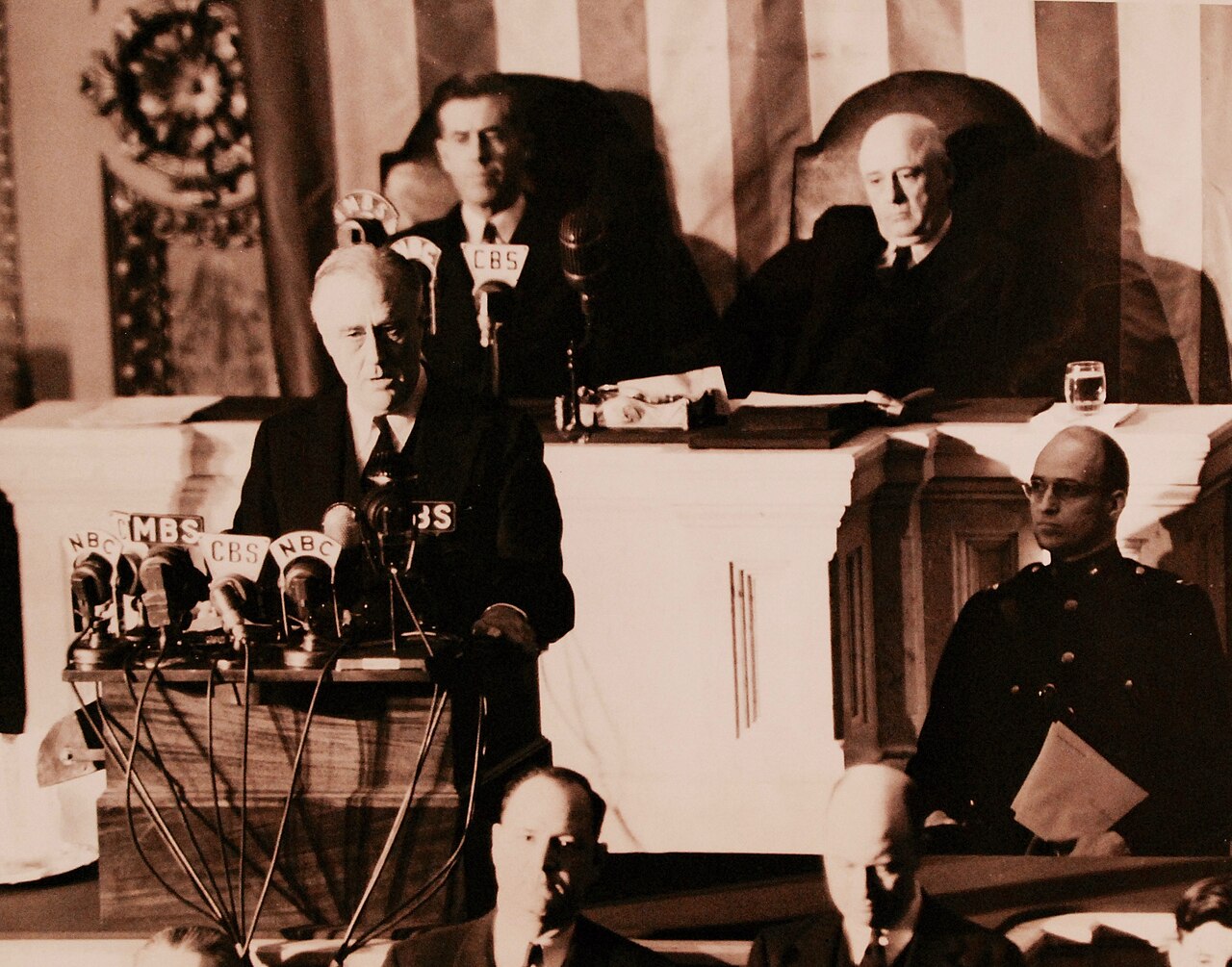
The lead image belongs with that argument.[5] It shows Roosevelt delivering the message in joint session, with Vice President Henry Wallace and Speaker Sam Rayburn behind him. The setting matters because the speech is about procedure as much as passion. Pearl Harbor had already happened. What remained on December 8 was to give the fact a public constitutional form.
Timeline anchors
- 1941-12-07: Japanese forces attacked Pearl Harbor; Roosevelt decided that evening to report to Congress and request a declaration of war the next day.[1][2]
- 1941-12-07 evening: Roosevelt dictated the first draft of the speech to Grace Tully, then revised it by hand, changing "world history" to "infamy" and updating details as news from the Pacific arrived.[2]
- 1941-12-08 12:30 p.m.: Roosevelt delivered the address to a joint session of Congress and a nationwide radio audience.[2]
- 1941-12-08: Congress approved the declaration of war against Japan; the Senate vote was 82-0, and the House vote had one dissenter, Jeannette Rankin.[3][4]
- 1941-12-11: Germany and Italy declared war on the United States, confirming that Roosevelt's December 8 message had been narrowly framed around Japan rather than the entire Axis war from the outset.[2]
Those markers matter because they show how little elapsed time the speech allows itself. The attack, the drafting, the delivery, and the declaration are forced into one sequence. Roosevelt uses that compressed tempo to make political hesitation sound out of place.
First movement: "Yesterday" turns the calendar into evidence
The speech opens with one of the most studied first sentences in American political history, but the best way to read it is grammatically rather than ceremonially. Roosevelt does not begin with theory, vengeance, or destiny. He begins with "Yesterday, December 7, 1941" and then gives the day a second life as "a date which will live in infamy."[1] The line pins the speech to a calendar fact before it enlarges the fact into moral memory.
The drafting history sharpens the point. The National Archives account of Roosevelt's revisions shows that his first phrasing was "a date which will live in world history." He replaced that with "infamy," and he also changed "simultaneously" to "suddenly."[2] Those edits matter because they move the sentence away from grandeur and toward accusation. "World history" would have named importance. "Infamy" names guilt. "Simultaneously" sounds like military description. "Suddenly" places the listener inside the experience of shock.[2]
That combination explains why the opening works so efficiently. Roosevelt does not treat December 7 as a date to be remembered later. He treats it as evidence that already carries its own verdict. The calendar itself becomes prosecutorial. Once the day is named in that way, the rest of the speech can proceed as if the central argument has already been won.[1][2]
This is one reason the address remains more forceful than a longer wartime manifesto might have been. It avoids the burden of building an elaborate case from scratch. It marks the date, assigns the act its moral character, and then moves immediately to the question of response. The opening sentence does not close debate by volume. It closes it by making the event appear self-interpreting.
Second movement: the crucial sentence makes Congress certify, not discover
The most consequential line in the address comes later and is often quoted less: Roosevelt asks Congress to declare that "since the unprovoked and dastardly attack by Japan on Sunday, December 7, a state of war has existed between the United States and the Japanese Empire."[1] The legal and rhetorical weight sits on "has existed." He does not ask Congress to initiate a condition that begins with its vote. He asks it to recognize a condition created by enemy action.
That wording narrows the room for deliberation. Congress still acts; the declaration is not a formality in a constitutional sense.[3][4] But the speech makes the action feel ratifying rather than exploratory. The attack has already crossed the threshold. Congress is being asked to put public law in line with public fact. The House Historical Office account captures the atmosphere by noting how quickly the chamber moved after the address and how unusually hushed the roll call felt, even before Jeannette Rankin cast the lone dissenting vote.[3] The Senate page is even barer and therefore revealing in its own way: the resolution passed 82-0.[4]
This is where the speech's brevity becomes political technique. Roosevelt does not invite Congress into a large argument about long-run strategy, war aims, or the risks of escalation. He presents a past-tense situation demanding present-tense recognition.[1][3][4] The address leaves very little rhetorical space for a member to say: perhaps war is not yet here. Its central claim is that war is already here, and that only the paperwork remains.
Third movement: the Pacific roll call turns Pearl Harbor into a system
Pearl Harbor is the speech's emotional center, but Roosevelt refuses to leave it as a single isolated blow. After the opening, the address quickly broadens into a list of attacks across the Pacific: Malaya, Hong Kong, Guam, the Philippine Islands, Wake Island, and Midway Island.[1] This list is not decorative. It converts one famous place into a pattern.
The drafting record shows that the list was alive to incoming reports. Roosevelt added references to Guam and the Philippines as updates reached the White House, and he added a later sentence about Hong Kong, Malaya, Wake, and Midway as the picture of the offensive widened.[2] That matters for the close reading because it shows the speech absorbing geography in real time. The address is building a map while it is being written.
The rhetorical effect is twofold. First, the roll call makes Pearl Harbor look less like a singular outrage and more like one node in a coordinated imperial operation.[1][2] Second, it does some of the explanatory work that Roosevelt's revision from "simultaneously" to "suddenly" seems, at first glance, to abandon.[2] Even after dropping the word "simultaneously" from the first sentence, the speech restores coordinated scale through accumulation. One location might suggest a raid. A chain of locations suggests a theater-wide plan.
That move is essential to the speech's authority. If the attack could be framed as a single Pacific shock, Congress might still imagine a narrow response. By the time Roosevelt has named the wider geography, narrowness is harder to maintain. The map itself has become an argument for the magnitude of the emergency.[1][2]
Fourth movement: diplomacy appears only as proof of deceit
Roosevelt also makes a sharp decision about what not to include. The National Archives essay on the speech's drafting notes that he rejected a longer State Department version by Sumner Welles that reviewed the diplomatic lead-up in more detail.[2] Instead, the final address gives only the amount of diplomacy needed to establish bad faith. While Japanese representatives were speaking to the United States in ways that seemed to hold out hope for peace, Roosevelt says, the attack was already being planned "many days or even weeks ago."[1][2]
That choice is structurally important. The speech does not invite listeners into a long documentary brief on failed negotiations. It compresses diplomacy into one conclusion: the talks now count mainly as evidence that the attack was deceitful.[1][2] Even Roosevelt's abandoned phrase "without warning," drafted and then crossed out, helps clarify the final version.[2] He did not need that extra flourish. The speech had already made surprise and deception legible through sequence, timing, and contrast.
The result is a message that sounds morally total without becoming discursive. Roosevelt does not say everything he knows. He says enough to turn negotiation itself into part of the indictment. That keeps the speech short, but it also keeps its momentum intact. Nothing is allowed to slow the march from violated peace to acknowledged war.
Why the close reading matters
The usual memory of the "Day of Infamy" speech is not wrong. Roosevelt did give the United States one of its defining wartime phrases.[1] But the phrase lasts because the address around it is more exact than memory tends to admit. It makes calendar time do moral work, geography do strategic work, and legal grammar do political work.
That is why the speech still feels immediate. It does not merely emote at Congress. It organizes perception so that Pearl Harbor appears as an event already complete in meaning. December 7 is fixed as a civic scar, the Pacific becomes a connected battlefield, diplomacy collapses into evidence of deceit, and Congress is positioned to recognize a war that the attack itself has already made real.[1][2][3][4]
The photograph of Roosevelt at the lectern preserves the public face of that transformation.[5] A man speaks into microphones in a crowded chamber. Behind the image sits a more exact historical achievement. In six minutes, the address made response look less like choice than alignment: the nation, the chambers, and the law catching up to a condition that the speech insisted already existed.
Sources
- National Archives, "'Day of Infamy' Speech: Joint Address to Congress Leading to a Declaration of War Against Japan" - transcript and archival context for Roosevelt's December 8, 1941 address.
- National Archives, "FDR's 'Day of Infamy' Speech" - drafting history, Roosevelt's revisions from "world history" to "infamy," and additions made as Pacific attack reports arrived.
- U.S. House of Representatives, History, Art & Archives, "The Declaration of War Against Japan" - House chamber context, roll-call atmosphere, and Jeannette Rankin's lone dissent.
- U.S. Senate, "Declaration of War with Japan, WWII (S.J.Res. 116)" - Senate approval record and document page for the December 8, 1941 war resolution.
- Wikimedia Commons, "FDR addressing Congress on the Declaration of War, December 8, 1941" - source record for the archival photograph used as the article image.