
The 1955 Le Mans disaster is often remembered through a grim superlative: the deadliest accident in motor-racing history.[2][3][4] That description is accurate enough to be unavoidable, but it can also hide the more useful historical question. The catastrophe was not only a car crash. It was a public-spectacle system failing in front of cameras: racing cars capable of extraordinary closing speeds, a pit straight whose layout compressed braking and passing into the same strip of road, spectators standing behind inadequate barriers, and rescue practices still adapted to an older idea of what a racing accident could be.[2][3][4]
The archival newsreel matters because it keeps those elements in the same visual field.[1] British Pathé's short report is not a technical reconstruction, and it is not comfortable viewing. It is a period news object: compressed, grave, and built for cinema audiences who were encountering the accident as current news. Its historical value lies in the way it refuses to let the disaster become an abstract motorsport lesson. The viewer sees the crowd line, the pit straight, the sudden interruption of race rhythm, the burning wreckage, and the uneasy fact that the race continued after the crash.[1][2]
Seen carefully, the film asks us to shift the unit of analysis. A driver, a car, or one steering move cannot carry the whole explanation.[2][3] The stronger reading is that Le Mans in 1955 sat at a dangerous transition point. The 24-hour race had become a showcase for postwar automotive speed and national industrial prestige, while parts of the circuit still belonged to an earlier culture of proximity: people close to the road, pits close to the racing line, and barriers that treated spectators as if they were watching from the edge of ordinary danger rather than from the edge of a high-energy debris field.[2][3][4]
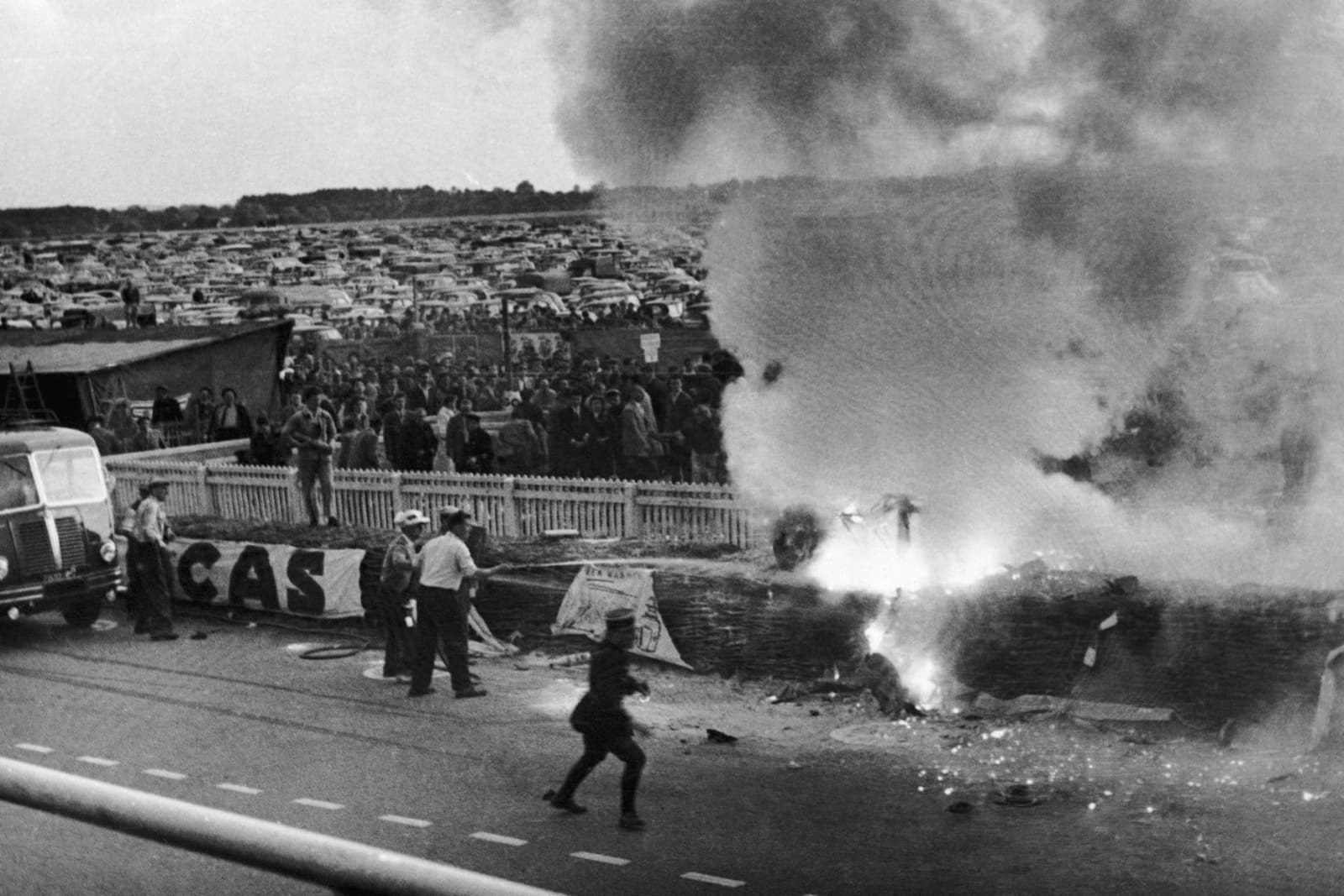
Image context: the cover uses a real 11 June 1955 Associated Press photograph by Jimmy Prickett, preserved on Wikimedia Commons.[5] It is a hard image, but not a decorative one. It shows why the article treats the event as a spatial failure: the car is airborne, the crowd boundary is close, and the disaster is already moving from racing surface into spectator space.
Historical context: Le Mans had invited faster machines than its margins could absorb
Le Mans was built around endurance rather than short-track control. By the mid-1950s, that endurance format had become a prestige arena for manufacturers. Mercedes-Benz's own public archive describes the 300 SLR as a racing sports car derived from the W 196 Formula 1 program, with the Le Mans version fitted with an air brake to increase deceleration at high speed.[3] The same Mercedes archive notes that the 300 SLR's triumphant 1955 sports-car season was overshadowed at Le Mans by the severe accident involving Pierre Levegh's car.[3] That context matters because the vehicle was not a private oddity. It belonged to a factory program whose speed and engineering sophistication were part of the event's appeal.
The Automobile Club de l'Ouest's centenary history frames the aftermath from the organizer's side. It notes that after the tragic 1955 accident, which caused numerous casualties, the organization undertook extensive work to make the circuit safer.[4] Another ACO centenary account says the race returned in 1956 after a colossal effort, following the previous year's disaster in which nearly 80 spectators were killed, and after official legal proceedings had run their course.[2] Read together, those accounts tell a restrained institutional story: Le Mans survived, but only by acknowledging that the circuit itself had to change.
That is the historical hinge. Before 1955, danger was accepted as part of racing's identity, but acceptance is not the same as design adequacy. The accident exposed a mismatch between spectacle and containment. Cars were arriving on the pit straight at racing speed. Pit entry and braking decisions were happening near the racing line. Spectators were close enough that debris could cross from competition space into public space almost instantly.[2][4][5] The disaster became historically decisive because it made an old arrangement visible as an unmanageable risk.
The casualty figures vary slightly across sources because the event was chaotic and later accounts use different counting conventions. The ACO's centenary account describes nearly 80 spectators killed, while Wikimedia's event data lists 84 deaths and 120 injured.[2][5] The exact count is less important here than the structural fact these accounts preserve: the dead and injured were not confined to drivers or mechanics. The spectator area became part of the accident.[2][5]
Video provenance
The embedded video is British Pathé's "Le Mans Disaster (1955)" newsreel as hosted on YouTube.[1] That provenance is exactly why the clip suits an archival spotlight: it is a newsreel artifact, not a modern animated reconstruction or a later documentary argument. It belongs beside the ACO and Mercedes-Benz accounts not because it settles every disputed detail, but because it preserves how the disaster first became public visual evidence.[1][2][3]
Close reading: the footage turns speed into a spatial problem
The first thing to watch is not the crash itself, but the environment around it.[1] The pit straight reads as a shared corridor: racing line, pit movement, media attention, marshals, and spectators all occupy a narrow visual arrangement. In later motorsport, these zones are aggressively separated by pit walls, run-off, catch fencing, marshal protocols, and controlled spectator placement. The 1955 footage makes the older arrangement look almost intimate. That intimacy is the problem. It lets the public feel close to the event, but it also gives flying debris too short a path to travel before it reaches people.
The clip also shows why the phrase "accident" can be too small if it means a single instantaneous cause.[1][2] A high-speed endurance race produces layered timing. One driver brakes for the pits. Another adjusts to avoid him. A faster car arrives from behind with very little space to resolve the closing speed. The image then breaks into something more violent than a racing incident because the track boundary does not absorb the energy. The event moves outward. The disaster is not only collision; it is collision plus projection into a crowd system.[1][2][5]
The burning wreckage adds a second layer of period specificity. The Mercedes 300 SLR's light-alloy body and the fire's intensity have long shaped memory of the crash, and the newsreel preserves the visual shock of flames and smoke beside a racing surface that cannot simply become a closed forensic scene.[1][3] The race continued. That fact can seem incomprehensible from a present-day safety culture, but in 1955 it sat inside a different set of assumptions about crowd order, emergency access, and the accepted cost of racing danger.[1][2] The footage is useful because it lets us see how unstable that grammar had become.
Just as important is what the newsreel does not do. It does not turn the scene into an engineering diagram. It does not isolate one driver's guilt with slow-motion certainty. It gives a compressed visual report shaped by contemporary news values: catastrophe, crowd, aftermath, authority, then continuation.[1][2] That limitation is part of its value. The film shows what a 1955 public could see before later safety analysis hardened into categories. The clip catches the moment when the catastrophe was still a shock on film rather than a settled case study.
The image source works the same way.[5] The Associated Press photograph freezes the car in the air, but the important detail is not just altitude. It is direction and boundary. The photograph shows a machine leaving the domain in which risk was supposed to remain. The crowd and barrier are not background. They are the next system the car is entering. That is why the photograph and the film belong together: one supplies the instant, the other supplies the public aftermath.[1][5]
Legacy: the disaster made safety a design question, not only a bravery question
Le Mans continued after 1955, but it could not continue as the same kind of place.[2][4] The ACO's centenary material emphasizes the work done to make the circuit safer after the tragedy, and that is the legacy that matters most for this archival spotlight.[4] Safety did not mean removing speed from the event. It meant redesigning the relationship between speed and audience, between pits and racing line, between spectacle and containment.
The disaster also widened the conversation beyond France. Mercedes-Benz's archives treat the Le Mans accident as the dark interruption in an otherwise dominant 1955 sports-car season.[3] ACO histories fold it into the race's survival story.[2][4] Those perspectives differ in tone, but they point to the same conclusion: after 1955, elite motorsport could no longer treat public proximity as a simple virtue.
That is why the footage still matters in 2026. Modern viewers do not need the clip in order to know that the disaster was terrible. They need it because it shows how danger was arranged. The historical lesson is not that racing was once reckless and now is safe in some final sense. It is sharper than that. Speed always has to be given a shape: lanes, barriers, procedures, sightlines, fire response, medical access, and spectator distance. Le Mans 1955 became catastrophic when the shape around speed failed. The newsreel preserves the moment that failure became visible enough that the sport had to redesign the edge between watching and being struck by what one came to watch.[1][2][4][5]
Sources
- British Pathé, "Le Mans Disaster (1955)," YouTube video.
- 24 Heures du Mans, "24 Hours Centenary - When the race overcame world turmoil" - ACO account of the 1956 return after the 1955 disaster and official aftermath.
- Mercedes-Benz Public Archive, "Mercedes-Benz 300 SLR (W 196 S), 1955" - technical and racing context for the 300 SLR, including its Le Mans air brake and the shadow cast by the 1955 accident.
- 24 Heures du Mans, "A century of racing: the 24 Hours of Le Mans is 100 years old!" - ACO centenary page noting that extensive circuit-safety work followed the 1955 accident.
- Wikimedia Commons, "File:1955 Le Mans disaster.jpg" - source page for the Associated Press/Jimmy Prickett archival photograph used as the cover image.