Bayard Rustin often appears in public memory as the indispensable man behind someone else's moment. He advised Martin Luther King Jr., organized the 1963 March on Washington, and then slipped back behind the curtain.[1][2] The outline is true, but it is still too small. Rustin mattered because he treated nonviolence as a form of organization. He did not approach protest as pure witness, or even as pure courage. He approached it as a structure that had to be trained, scheduled, staffed, financed, and kept legible under pressure.[1][2][4]
That is why the March on Washington is the best place to read him, even though the article is not only about that day. By August 28, 1963, Rustin had already spent years turning pacifist principle into repeatable political method: proposed marches with A. Philip Randolph in the 1940s, the 1947 Journey of Reconciliation, strategic work during the Montgomery bus boycott, and increasingly explicit arguments that the movement needed disciplined mass organization rather than moral display alone.[1][2][3] The march was where those threads were forced into one public machine.
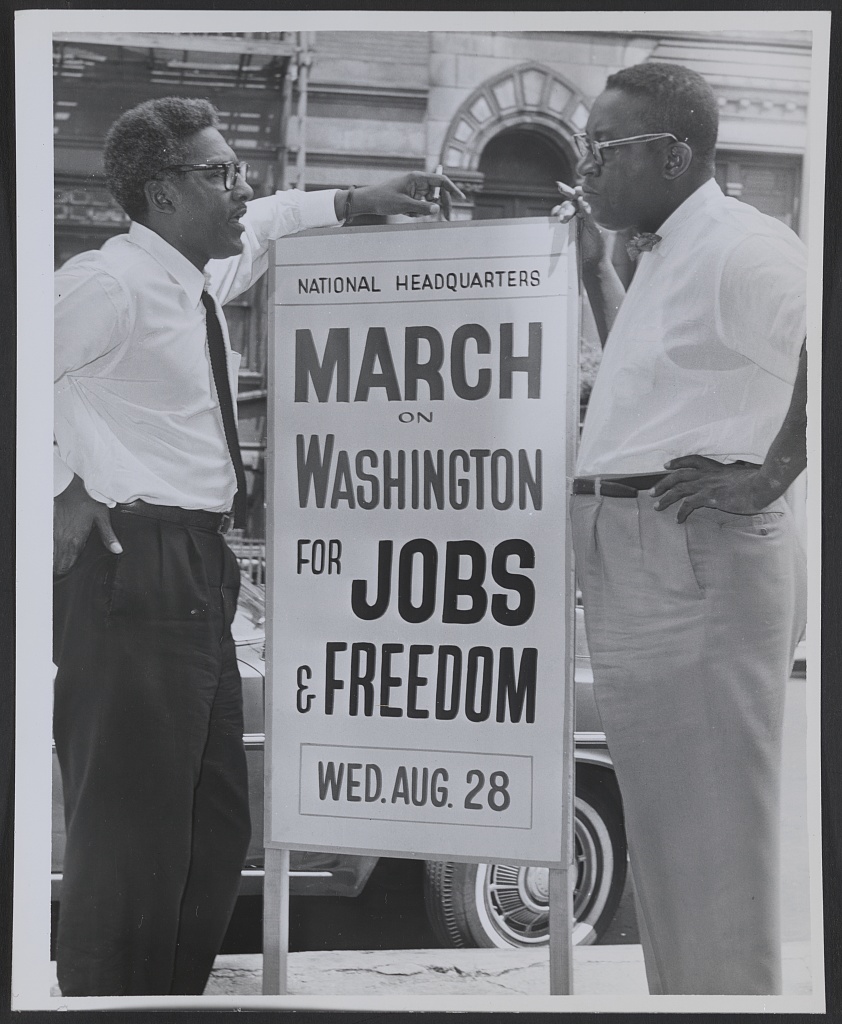
The archival photograph used here shows Rustin with Cleveland Robinson outside March headquarters in Harlem on August 7, 1963, three weeks before the demonstration.[4][7] It is the right image because it keeps his story tied to the operational center. Rustin's gift was not simply eloquence about justice. It was the ability to make thousands of moving parts arrive in Washington with a shared script and without collapse.
Time anchors
- 1912-03-17: Bayard Rustin was born in West Chester, Pennsylvania.[1][2]
- 1941-1948: Rustin worked with A. Philip Randolph on proposed Washington marches aimed at segregation in the armed forces and defense industry.[1][4]
- 1947: Rustin helped plan the Journey of Reconciliation, later remembered as a model for the Freedom Rides.[1][2]
- 1956: Rustin became a key advisor to King during the Montgomery bus boycott and deepened King's practical engagement with nonviolence.[2]
- 1957-05-10: Rustin wrote King before the Prayer Pilgrimage for Freedom, pressing him to think hard about what the movement should do next, with emphasis on nonviolence, voting rights, and organized power.[3]
- 1960: King defended Rustin's value in a letter, stressing Rustin's expertise and commitment to nonviolence despite political attacks on him.[2]
- 1963-08-28: the March on Washington for Jobs and Freedom drew roughly 250,000 people after Rustin led the day-to-day organizing effort.[4][5]
Before Washington, Rustin had already learned that principle without structure burns out
The starting point is not the Lincoln Memorial. It is Rustin's early fusion of moral conviction and organizational discipline. The National Park Service and the King Institute both place his lifelong commitment to nonviolence in the overlap between Quaker upbringing, interracial reform networks, and pacifist organizing.[1][2] That background is easy to romanticize. The useful historical point is narrower: Rustin's pacifism never stayed at the level of conscience alone. It kept moving toward method.
The 1947 Journey of Reconciliation shows that movement clearly. NPS describes Rustin as one of the planners of the trip and explicitly links it to the later Freedom Rides.[1] That matters because the journey was not just a gesture of interracial bravery on buses. It was an attempt to test a Supreme Court ruling through coordinated travel, shared discipline, and planned exposure to arrest.[1] In other words, Rustin was already working on a problem that would define the next two decades of movement politics: how to make principle survive contact with police, local law, transportation systems, and the uneven stamina of participants.
This helps explain why so many later episodes in Rustin's career look less spontaneous than the myths built around them. He had a habit of treating moral claims as operating problems. If a campaign wanted to scale, it needed trained people, agreed roles, clear public language, and a way to absorb hostility without dissolving into panic.[1][2] That is already visible in the 1940s and 1950s, long before the March on Washington turned him into what Randolph called "Mr. March-on-Washington."[2]
Rustin's advice to King was about sequence, not only righteousness
Rustin's place in the Montgomery story is often summarized as mentorship in Gandhian nonviolence. That is true, and still incomplete. The King Institute's Rustin entry notes that Rustin gave King more than abstract theory during the 1956 boycott; he brought contacts, tactical experience, and a deeper understanding of how nonviolent struggle had to be organized if it was going to endure.[2] The relationship matters historically because it linked charisma to structure.
The May 10, 1957 letter from Rustin to King sharpens the point.[3] In the editorial note on the King Institute page, Rustin is presented as telling King that the question of where the movement moved next was more important than any other question Black Americans faced.[3] Even in summary, the advice is revealing. Rustin was pushing beyond testimony and toward sequence. He wanted the movement to think in terms of next steps, constituencies, and organizational leverage, including voting rights and the role of labor.[3]
That cast of mind also clarifies why Rustin could be both central and vulnerable. The King Institute notes that his homosexuality and earlier Communist Party ties were used by opponents to attack King's relationship with him.[2] Rustin could therefore be too useful to discard and too politically exposed to place at the center of every public tableau. That tension shaped his career. It also helps explain why his work often took the form of design rather than spectacle. He built platforms that others stood on.
The March on Washington was Rustin's method made visible
The NPS history of the March on Washington is unusually good at showing what "organizing" meant in Rustin's hands.[4] Randolph delegated day-to-day planning to Rustin, and the result was not merely a speaker lineup. NPS credits him with everything from training nonviolent marshals for crowd control to handling the sound system and the setup of portable toilets.[4] It also notes that Rustin coordinated a staff of more than 200 activists and organizers who worked on publicity, fundraising, churches, buses, trains, and the other logistical details that made the march possible.[4]
That list matters because it reveals what Rustin thought a demonstration was. The march was not a crowd that happened to gather around a righteous message. It was a temporary civic system. Transportation had to converge. The crowd had to be large enough to demonstrate national force, orderly enough to deny segregationists an easy backlash narrative, and coherent enough to turn one day in Washington into pressure on Congress and the White House.[4][5][6] Rustin's contribution was to understand that moral legitimacy and logistical competence were not separate things. On a day like August 28, 1963, they were the same thing seen from two angles.
The Library of Congress blog post "Inside the March on Washington: Bayard Rustin's 'Army'" makes the same point from a different direction.[6] It recalls the long hours, student staff work, and mentorship structure around Rustin's production crew, again pushing the story away from a single speech and toward a highly compressed production effort built in about eight weeks.[6] Once that context is restored, the photograph of Rustin outside headquarters stops looking like a side note and starts looking like the center of gravity.[6][7]
The official program is evidence that Rustin was building more than a rally
The National Archives page for the Official Program for the March on Washington is useful because it keeps the event tied to its finished public form.[5] The program listed the day's events at the Lincoln Memorial, but the Archives description stresses something larger: a rare display of unity among major civil rights organizations, a march from the Washington Monument to the Memorial, a three-hour public program, and a closing White House meeting with President Kennedy.[5] Put differently, the march was built as a sequence. It moved people through space, translated coalition into order, and framed the demonstration as a national negotiation rather than a mere outburst.[5]
This is where Rustin's biography becomes more than an admiration piece. He was not historically important only because he was right about equality, or because he was personally brave, though both were true.[1][2] He was important because he understood that large democratic action requires scaffolding. Crowds need routes. Demands need form. Marshals need training. Allies need a timetable. Speakers need an order that says something about coalition legitimacy. The official program is one of the clearest surviving artifacts of that habit of mind.[5]
That same habit is already present in his 1957 advice to King and in the earlier Journey of Reconciliation.[1][3] Rustin kept asking how a moral claim could be given duration, discipline, and scale. The March on Washington did not answer every later question in the movement. It did prove that a protest of extraordinary size could be made legible, peaceful, and politically unavoidable if the planning was serious enough.[4][5][6]
Why the microhistory matters
Rustin's afterlife often slides into a familiar genre: the hidden genius rediscovered too late. There is truth in that frame, but it can flatten the record. It makes him sound like a neglected supporting actor who happened to be nearby when history arrived. The sources point to something more exact. Rustin was one of the people who changed the movement's operating grammar.[1][2][3][4]
From the 1947 Journey of Reconciliation to the 1957 letter to King and the 1963 march, Rustin kept returning to one basic insight: nonviolence works at scale only when it is organized with almost bureaucratic care.[1][3][4] The courage is real. The moral argument is real. Yet his durable contribution lies in the scaffold that let those things travel. He helped make mass democratic protest look less like eruption and more like a disciplined public instrument.
That is why the headquarters photograph belongs with this story.[7] It puts Rustin where he most often stood in history: close to the sign, close to the staff, close to the door through which ideals had to pass before they could survive a city, a timetable, and a nation watching.
Sources
- National Park Service, "Bayard Rustin" - biographical page on Rustin's pacifism, Randolph alliance, Journey of Reconciliation, and role as logistical planner of the March on Washington.
- The Martin Luther King, Jr. Research and Education Institute, "Rustin, Bayard" - encyclopedia entry on Rustin's relationship with King, his nonviolence expertise, and the politics that pushed him behind the scenes.
- The Martin Luther King, Jr. Research and Education Institute, "From Bayard Rustin" - May 10, 1957 letter note describing Rustin's advice to King on nonviolence, voting rights, and the movement's next steps.
- National Park Service, "March on Washington for Jobs and Freedom" - history of the 1963 march with details on Rustin's marshals, transport, staffing, crowd estimates, and headquarters photo context.
- National Archives, "Official Program for the March on Washington (1963)" - milestone-document page on the event's schedule, coalition character, scale, and political framing.
- Library of Congress, "Inside the March on Washington: Bayard Rustin's 'Army'" - on Rustin's production crew, staffing intensity, and the behind-the-scenes labor of making the march work.
- Library of Congress, "In front of 170 W 130 St., March on Washington..." - photograph record for the August 7, 1963 Orlando Fernandez image used as this article's cover.