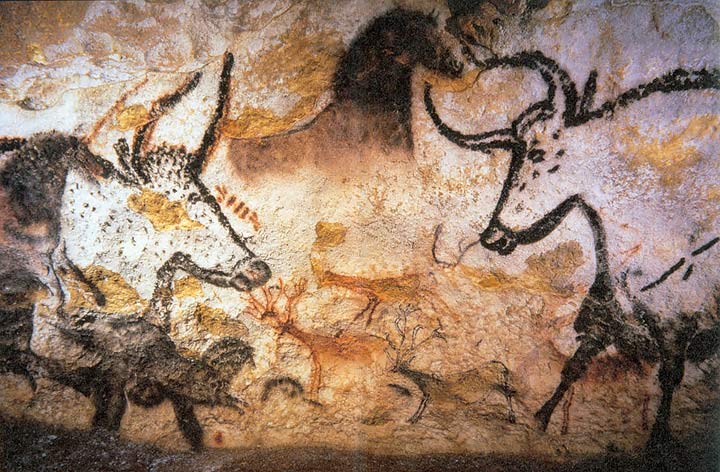
Lascaux is famous because people imagine entering it. Modern visitors picture the first flashlight beam, the sudden painted animals, the passage from ordinary ground into deep time. Yet Lascaux's public history turned on the opposite decision: almost nobody should enter the original cave at all.
That contradiction is not a footnote to the site's fame. It is the reason Lascaux has become one of the clearest modern examples of heritage by substitution. The cave was discovered in 1940, opened after the Second World War, then closed to ordinary visitors in 1963 after public access helped destabilize the fragile environment of the paintings.[1][2][5] Since then, the memory of Lascaux has been carried by replicas, facsimiles, photographs, scholarship, visitor centers, and digital models. The copy did not cheapen the original. It became the civic compromise that let the original survive.
This is a memory-and-commemoration story because Lascaux is not only an archaeological site. It is also a public ritual about restraint. The visitor is invited to care about a place they cannot quite have.
The discovery became a modern origin story
The discovery story has the shape of a legend because it begins with boys, a dog, a hole, and a hidden world. The French Ministry of Culture's Lascaux site dates the discovery to September 1940 and frames it as a turning point in knowledge of prehistoric art and human origins.[1] World History Encyclopedia gives the familiar narrative more tightly: on September 12, 1940, four boys examined the opening after a dog had fallen near the hill of Lascaux, widened the entrance, and found the painted cave.[5]
That story matters because it made Lascaux feel like a gift from accident. The paintings were not first presented to the public as the result of a planned excavation campaign. They arrived as a shock of visibility: animals on the walls where no modern person expected them. The cultural memory of Lascaux still depends on that first astonishment.
But the discovery story can mislead if it makes the cave seem newly born in 1940. Lascaux's images were already old beyond ordinary historical scale. World History Encyclopedia summarizes the paintings as Upper Paleolithic art, roughly 17,000 to 15,000 BCE, with hundreds of painted animals and many engravings.[5] The 1940 moment was not the origin of the cave's meaning. It was the origin of its modern public life.
That distinction matters. From the beginning, modern Lascaux was split between revelation and exposure. To discover the cave was to make it available to science, national heritage, tourism, schoolbooks, and reproduction. It was also to introduce the very pressures that would make ordinary access impossible.
Public access created the preservation problem
By 1948, Lascaux had been prepared for public opening.[5] That choice is understandable. A site with such paintings seemed too important to keep hidden from the public. The postwar visitor could enter a place that compressed prehistory, French patrimony, and the drama of survival underground.
The problem was that the original cave was not built to be a museum. It was a sealed environmental system before it was a public destination. Visitors brought breath, heat, humidity, dust, light, and infrastructure. World History Encyclopedia notes that the cave was closed to the public in 1963 after visitor effects, including algae growth, damaged the paintings and created ongoing conservation problems.[5] The French Ministry of Culture's preservation material describes a strong state commitment around Lascaux and places conservation at the center of the site's modern management.[2]
The closure changed the meaning of public heritage. Lascaux could no longer be commemorated through the simplest form of access: line up, enter, look, leave. The site demanded a harder bargain. If the paintings were valuable because they were real, the real thing had to become less available.
This is where Lascaux differs from many monuments. A statue can often be surrounded by barriers and still remain visible. A battlefield can be walked while interpretation signs channel the route. A manuscript can be placed behind glass. Lascaux's problem was more severe: the public body itself was part of the threat. The visitor's presence had to be redirected somewhere else.
That redirection is the core of Lascaux's commemoration. The original became a protected absence. People continued to remember it by visiting something made in its place.
The replica became an ethical instrument
The most important commemorative move was not a plaque. It was a copy.
The French Ministry of Culture's page on Lascaux II and III describes the replication program as the public way to visit Lascaux after the original cave's closure.[3] Lascaux II, opened in 1983, reproduced major parts of the cave close to the original site; Lascaux III later carried movable facsimiles beyond Montignac.[3] These were not casual theme-park gestures. They were preservation devices that turned public desire away from the vulnerable original and toward a controlled encounter.
That makes the replica ethically interesting. A bad replica pretends there is no loss. A good Lascaux replica makes the loss visible while still giving the visitor a serious experience. It says: you are not in the original cave, and that is exactly why the original can continue to exist.
Lascaux IV sharpened that arrangement. The Ministry of Culture describes the International Centre for Parietal Art, opened in December 2016, as a facility centered on a near-complete reproduction of the cave and supported by new imaging and virtual technologies for public outreach.[4] In other words, the copy became the main public architecture of Lascaux.
That is easy to mock if authenticity is understood only as physical proximity. But Lascaux asks for a better definition. Authenticity here cannot mean touching the original surface, breathing the original air, or standing in the exact original chamber. Those forms of access would damage the object that makes the experience meaningful. Authenticity has to include fidelity of interpretation, discipline of conservation, and honesty about substitution.
The replica is therefore not the opposite of preservation. It is preservation's public face.
A protected absence can still be public
Lascaux's modern memory rests on three linked sites: the original cave, the replica, and the interpretive system that explains why the first has been replaced by the second. Remove any one of the three and the public meaning weakens.
If only the original mattered, the public would be left with an inaccessible sacred object and a story of exclusion. If only the replica mattered, the cave would collapse into experience design. If only the interpretation mattered, Lascaux would become a lesson without the force of place. The power comes from the triangle. The original supplies historical gravity. The replica supplies access. Interpretation supplies the moral logic that connects the two.
This arrangement also changes the visitor's role. At many heritage sites, to visit is to claim a kind of closeness: I stood there, I saw it directly, I was in the room. At Lascaux, the more mature claim is different: I accepted distance because the thing deserved to outlast my visit. The encounter asks the public to practice conservation rather than only consume history.
That does not make the replicas neutral. Every reproduction chooses surfaces, lighting, route, scale, emphasis, and atmosphere. Lascaux II, Lascaux III, and Lascaux IV each give different public forms to the hidden original.[3][4] But those choices are now part of the site's history. Lascaux is no longer only a Paleolithic cave discovered in 1940. It is also a twentieth- and twenty-first-century institution built around the problem of how to show what must be protected from being seen too directly.
What Lascaux teaches about public memory
The lesson of Lascaux is not that copies are as good as originals. That would be too simple. The lesson is that some originals can remain public only through carefully declared copies.
That point matters far beyond one French cave. Museums, archives, archaeological sites, and fragile landscapes increasingly face the same pressure: public attention can justify preservation, but public access can also destroy what attention came to see. Lascaux offers a disciplined answer. It does not hide the original and leave the public with nothing. It creates a substitute strong enough to carry wonder while explaining why substitution is necessary.
The result is a rare kind of commemoration. Lascaux is remembered not through direct possession, but through restraint. Its modern visitor participates in a social agreement: the cave belongs to public memory, but not to unlimited public entry. The replica is the visible form of that agreement.
That is why Lascaux stayed public by becoming a copy. The cave's public life did not end in 1963. It changed medium. The original withdrew, and the facsimile took on the work of encounter. For a site whose paintings survived many thousands of years in darkness, that withdrawal may be the most historically faithful public gesture modern people could make.
Sources
- French Ministry of Culture, "Discovery" - official Lascaux page on the 1940 discovery and the site's modern archaeological significance.
- French Ministry of Culture, "A strong state commitment" - official preservation page on state responsibility and conservation management around Lascaux.
- French Ministry of Culture, "Lascaux II and III" - official page on the replica program and public access after closure of the original cave.
- French Ministry of Culture, "Lascaux IV" - official page on the International Centre for Parietal Art, opened in December 2016, and its near-complete reproduction of the cave.
- World History Encyclopedia, "Lascaux Cave" - independent overview of the cave paintings, the September 12, 1940 discovery, public opening by 1948, 1963 closure, and Lascaux II.
- Wikimedia Commons, "File:Lascaux painting.jpg" - photographic image source used for the article cover.