The Kindertransport is often remembered as a moral exception: Britain opened a door, children escaped, and parents were left behind. That memory is true as far as it goes, but it hides the mechanism. The rescue worked because it translated a desperate humanitarian claim into an administrative form the British state would tolerate in late 1938: temporary entry for unaccompanied minors, no public charge, private guarantees, group processing, and voluntary placement.
That structure saved lives. It also reveals the limits of the rescue. The same rules that made the scheme politically possible made it narrow. Children could come; parents could not. The stay was framed as temporary; the danger was not. Charities and private citizens had to absorb care, education, housing, and eventual onward-emigration costs; the state supplied permission more readily than support.[1][3]
The trigger became a processing problem
The immediate trigger was the Nazi regime's coordinated anti-Jewish violence on November 9-10, 1938. After Kristallnacht, British Jewish and Quaker representatives pressed ministers to admit children quickly. The National Archives describes the resulting scheme as one in which visa and passport restrictions were lifted, children aged 17 and younger could enter with a "white card," and guarantors or the Refugee Children's Movement carried the financial burden.[3] That detail is the hinge. A moral crisis became operational when the paperwork stopped requiring each child to pass through an ordinary immigration bottleneck.
The United States Holocaust Memorial Museum describes the British decision as permission for unaccompanied minors under 17 from Germany and German-annexed territories to enter Great Britain on temporary travel visas.[1] Jewish organizations inside the German Reich organized departures; British child welfare and refugee groups arranged reception, education, care, and eventual emigration.[1] In plain terms, the state allowed an intake lane, but voluntary agencies had to build the road to it.
The guarantee made compassion legible to the state
The second mechanism was financial containment. The Jewish Museum Berlin explains that advocates promised a guaranteed sum of GBP50 for each child, housing, and education so the children would not become a public burden.[2] The National Archives gives the same logic from the British side: most children had guarantors, the required sum was GBP50, and the Refugee Children's Movement took responsibility for "unguaranteed" children because the Home Secretary had agreed that refugee children would not become a charge on state finances.[3]
That guarantee did two things at once. It reassured officials who were anxious about unemployment, public expense, and anti-refugee politics. It also forced rescue into a casework machine. A child was not simply "admitted"; someone had to raise or pledge money, record a name, arrange travel, find a temporary bed, inspect or approve a home, and keep track of the child after arrival. The moral act depended on ledgers, lists, interviews, tickets, escorts, and follow-up.
This is why the Kindertransport was not merely a train story. It was a contract among state permission, charitable administration, and private households. The contract's central bargain was severe: Britain would accept children if others guaranteed that the children would not cost the state and if the admission did not imply a broader family refuge policy.
Group travel solved speed, not separation
Once the state accepted group processing, speed became possible. The Jewish Museum Berlin records that the first Kindertransport left German territory on December 1, 1938, and that Britain issued group visas so departures could be organized quickly.[2] USHMM notes that the first transport arrived at Harwich on December 2, 1938, carrying about 200 children; most transports left from Berlin, Vienna, Prague, and other central European cities before moving by train to Belgian and Dutch ports and then by ship to Harwich.[1]
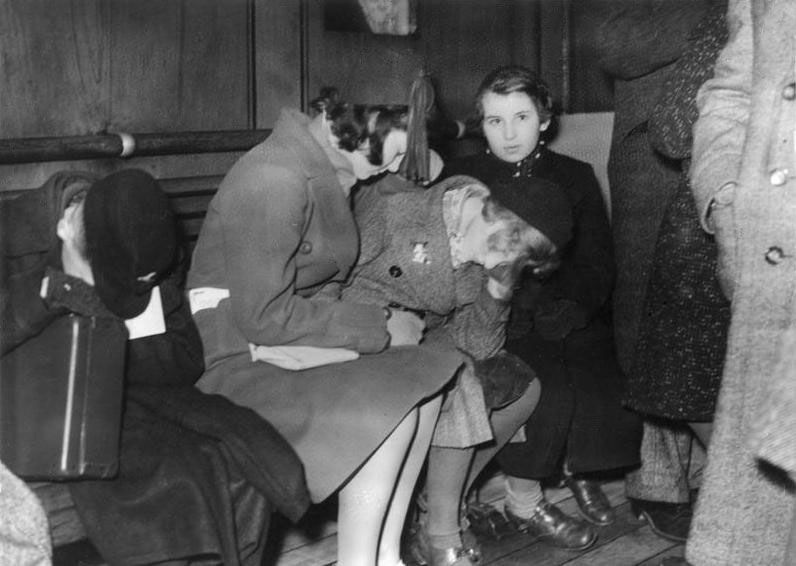
The archival photograph used for this article, preserved through the German Federal Archives and Wikimedia Commons, shows young Jewish refugees arriving at Harwich in December 1938 after traveling from the Hook of Holland.[6] It is an ordinary port scene and therefore a valuable one: tired children, coats, bags, labels, and reception logistics. The image refuses to let rescue become abstract. Every saved child had to move through borders, docks, lists, and strangers.
The same system expanded after March 1939, when Germany occupied the Czech lands and transports from Prague were hastily organized.[1][2] But the mechanics did not erase the emotional cost. The Jewish Museum Berlin notes that children could take only limited belongings out of Nazi territory, and after emigration many could stay in contact with parents only through letters; after deportations began in 1941, contact often ended altogether.[2] The mechanism saved children by separating them from the adults most responsible for their lives.
Voluntary networks turned permission into capacity
Permission alone would have failed without a reception network. Quakers in Britain describe how the Germany Emergency Committee, led in this work by figures including Bertha Bracey, collaborated with Jewish and other refugee organizations, lobbied the government, sent notices to cities from Stuttgart to Prague, helped issue travel papers, chaperoned journeys, and arranged food and accommodation at Liverpool Street and elsewhere.[4]
World Jewish Relief, then rooted in the Central British Fund tradition, frames the same rescue as a fundraising and support system: almost 10,000 Jewish children were rescued, while the organization and allied networks raised money for travel and later support.[5] That is the capacity story. A policy exception had to become foster homes, hostels, schools, camps, committees, volunteers, and archives.
The first reception sites mattered because the transports did not arrive as settled lives. Dovercourt near Harwich, Liverpool Street station, Quaker schools, local hostels, relatives' homes, and foster placements were all parts of the same chain.[1][4] The chain was uneven, and some children experienced loneliness, exploitation, cultural dislocation, or the shock of being treated as temporary guests rather than future citizens. Still, the operational achievement was real: thousands of children moved from escalating Nazi persecution into a country that had not planned to receive them at scale.
The stop condition exposes the boundary
The Kindertransport's end shows how fragile the mechanism was. The National Archives states that children arrived from December 1938 to September 1939 and that, with the outbreak of war, borders closed and transports ceased.[3] USHMM gives the longer edge case: the last transport from the Netherlands left for Britain on May 14, 1940, the day the Dutch army surrendered, and the whole effort brought about 10,000 children to safety by May 1940.[1]
The stop condition matters because it was not the end of need. It was the end of a workable route. War closed borders, invalidated travel documents, cut cooperation, and made the train-ferry chain impossible. The mechanism had depended on a strange prewar interval in which Nazi authorities still allowed some Jewish emigration, British authorities allowed a constrained exception, charities could coordinate across borders, and shipping routes remained open.
That interval was brief. It also explains why the Kindertransport should be understood neither as national absolution nor as a simple failure. It was a rescue of children inside a policy architecture that refused a larger adult refuge. It saved nearly 10,000 lives while leaving most families exposed. Its moral force comes from that tension: practical rescue was possible, but only after being narrowed into a form the receiving state could accept.
The historical lesson is therefore mechanical as much as sentimental. The Kindertransport worked because advocates did not stop at asking for mercy. They built a process: group lists instead of individual visa queues, guarantees instead of public expenditure, escorts instead of uncoordinated flight, reception camps and homes instead of arrival without care. The process was imperfect and painfully bounded. But in the dangerous months between Kristallnacht and war, it turned permission into movement, and movement into survival.
Sources
- United States Holocaust Memorial Museum, "Kindertransport, 1938-1940" - overview of British temporary admission, organizing agencies, routes, dates, and total children rescued.
- Jewish Museum Berlin, "Kindertransporte (Children's Transports) 1938/39" - explanation of the GBP50 guarantee, group visas, belongings restrictions, transit, and family contact.
- The National Archives, "Kindertransport" - education resource on visa and passport restrictions, white cards, guarantors, the Refugee Children's Movement, arrival dates, and wartime cessation.
- Quakers in Britain, "Quakers and the Kindertransport" - role of the Germany Emergency Committee, Bertha Bracey, lobbying, notices, travel papers, chaperoning, and local reception work.
- World Jewish Relief, "The Kindertransport rescue" - Central British Fund/World Jewish Relief timeline and fundraising/support role in the rescue of almost 10,000 children.
- Wikimedia Commons, "Bundesarchiv Bild 183-1987-0928-501, England, Judische Fluchtlingskinder.jpg" - source page for the archival photograph of the first refugee children arriving at Harwich in December 1938.