The phrase "Seward's Folly" makes the Alaska Purchase sound like a national punchline that later happened to become a bargain. That memory is useful only up to a point. There was real mockery in 1867, especially from political opponents who saw ice, distance, Reconstruction politics, and President Andrew Johnson's damaged administration as reasons to distrust the deal.[3][4] But the joke has become too powerful. It makes a complicated transfer look like one man's eccentric mistake instead of a diplomatic bargain with many moving parts.
The evidence points to a sharper story. Alaska was not bought because William H. Seward alone saw treasure where everyone else saw snow. Russia wanted out of a vulnerable North American colony. American expansionists wanted Pacific reach. Charles Sumner helped turn skepticism in the Senate into ratification. Commercial interests already knew the North Pacific was not empty. And the treaty itself carried a moral problem that later bargain stories often soften: Alaska Native people were treated as subjects to be governed, not as sovereign parties to the transfer.[1][2][3][4][5]
Myth: America simply laughed at a frozen mistake
The ridicule was real. The Senate Historical Office records the familiar hostile names: Seward's Folly, Seward's Icebox, and a polar-bear version aimed at Johnson.[4] The Library of Congress also notes that critics attacked the secrecy of the deal after Seward agreed on March 30, 1867 to purchase Alaska from Russia for $7.2 million.[5] That is the part of the story that survives because it is vivid. A large, distant territory enters the United States while the country is still reeling from Civil War, Reconstruction conflict, and Johnson's political collapse. A joke travels faster than a resource report.
But the vote itself does not fit a simple national-laughter story. The Senate approved ratification on April 9, 1867, by 37 to 2, after Sumner, initially cautious, used his Foreign Relations Committee position to investigate the territory and then argued for the treaty.[2][4] The Senate account frames the deal as "Sumner's Project" as much as Seward's, because treaty power required more than secret diplomacy.[4] A purchase that could survive that vote was controversial, but it was not politically friendless.
The Alaska Historical Society's myth-debunking essay pushes the correction further, drawing on Richard E. Welch's study of 48 major news outlets in 1867-1868 to argue that press opinion was more favorable than the later folklore allows.[6] That source is intentionally polemical, so the safer conclusion is not "everyone loved the purchase." The safer conclusion is that the ridicule was selective, memorable, and politically useful, while support was broad enough to move the treaty and payment through a divided government.
Evidence: Russia was retreating from a colony it could not defend
The purchase also looks different when it begins in St. Petersburg rather than Washington. The State Department's history places the sale after Russia's weakening interest in North America: the Russian state lacked the resources to sustain major Pacific settlements, permanent Russian settlers in Alaska never exceeded a few hundred, and the Crimean War made the colony look harder to defend against Great Britain.[2] The Library of Congress gives the Russian side more detail: sea-otter commerce had declined, Russian attention had shifted toward the Amur and Maritime regions after treaties with China in 1858 and 1860, and British pressure in the North Pacific remained a strategic concern.[3]
That context matters because it makes the sale less like a clearance-rack bargain and more like imperial triage. Russia was not selling nothing. It was selling a place that might become valuable to a rival and costly to hold. The Library of Congress describes Grand Duke Konstantin as an early advocate for selling and identifies a ministerial decision in December 1866 to proceed, with Russian negotiators seeking a price and ultimately reaching Seward's $7.2 million figure.[3]
The myth turns Alaska into inert scenery. The evidence turns it into a strategic liability for Russia and a Pacific opportunity for the United States. Those are not the same story.
Myth: Seward alone made the deal happen
Seward mattered. He negotiated with Russian minister Edouard de Stoeckl and had long favored expansion toward the Pacific.[2][3] But the lone-visionary version hides the institutional work that made the agreement durable.
Sumner is the clearest missing actor. The Senate Historical Office says he began with skepticism, moved the treaty into committee, studied maps, journals, scientific material, newspapers, manuscripts, and books, and then spoke for three hours in support of ratification on April 8, 1867.[4] That performance did not merely decorate Seward's diplomacy. It converted an obscure northern territory into a legible Senate question: population, climate, resources, fisheries, commercial reach, and national strategy.
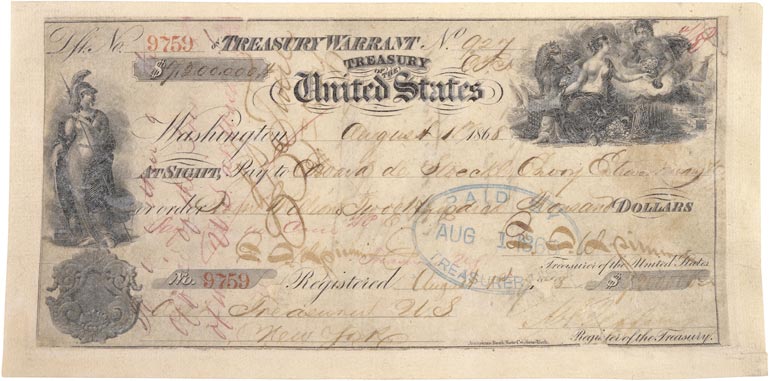
The House mattered too, because Russia still had to be paid. The Library of Congress notes that the appropriation process in 1868 was made bumpy by Johnson's impeachment politics, with Congressman Nathaniel Banks helping guide the payment bill.[3] The National Archives' cancelled Treasury warrant, issued August 1, 1868, is the paper proof that acquisition required more than a dramatic treaty signing.[1] First came negotiation, then ratification, then transfer, then money.
Evidence: commerce was already part of the argument
The phrase "icebox" works by making Alaska look economically blank. Yet several sources point to known commercial stakes before the Klondike gold rush made the later bargain obvious. JSTOR Daily, summarizing Howard Kushner's work on American commerce in Russian America, emphasizes that some western commercial interests were already eager for acquisition; ice, fishing, whaling, sealing, fur, and North Pacific trade all gave the territory a practical economic meaning before 1896.[7]
This does not mean everyone correctly priced Alaska's future oil, minerals, military geography, or statehood. It means the purchase did not depend solely on magical foresight. The Library of Congress frames Seward and other expansionists as seeing Alaska inside a larger Manifest Destiny and Pacific-commerce project.[3] The State Department later reads the purchase as an important step in the rise of U.S. power in the Asia-Pacific region.[2] Those interpretations can sound grand in hindsight, but they rest on a real nineteenth-century logic: ports, fisheries, whaling routes, Asian markets, British Canada, and the removal of a European power from North America.
The best evidence against the frozen-waste myth is not that Alaska eventually became valuable. It is that some contemporaries already argued from commerce, naval position, and resources, not merely from fantasy.
The harder evidence: the treaty excluded Native sovereignty
The bargain story has another blind spot. The United States and Russia negotiated over land where Alaska Native peoples already lived. The National Archives transcript of the treaty is blunt. Article III allowed some inhabitants to remain and eventually enjoy rights, but excluded what it called "uncivilized native tribes," placing them under future U.S. laws and regulations for Indigenous peoples.[1]
That clause should change how the purchase is remembered. It was not only a transaction between two states; it was a transfer of imperial claims over people who did not sign the agreement. The myth of Seward's Folly asks whether Americans overpaid. The stronger historical question asks who was allowed to define ownership, value, and consent in the first place.
This does not erase the diplomatic story. It completes it. Russia's strategic retreat, Seward's expansionism, Sumner's Senate work, commercial optimism, newspaper debate, and the Treasury warrant all belong in the record. So does the fact that the treaty converted Native homelands into a problem of U.S. administration without Native treaty consent.
What the myth gets wrong
The Alaska Purchase was mocked, but mockery was not the whole political climate. Seward was central, but he was not alone. Alaska looked remote, but not economically meaningless. Russia sold because holding the colony had become strategically awkward, not because the land had no value. And the United States did not simply buy empty northern space; it bought an imperial claim and then governed through it.
That is why the cancelled check is a better image than the punchline. It shows the purchase as an administrative fact: $7.2 million, a named payee, a Treasury warrant, and the slow machinery of state. The joke survives because it is compact. The evidence is better because it is crowded. It holds the laughter, the vote, the commerce, the Russian retreat, the payment delay, and the people left outside the bargain in the same frame.
Sources
- National Archives, "Check for the Purchase of Alaska (1868)" - source page for the cancelled Treasury warrant image and treaty transcript, including payment terms and Article III.
- U.S. Department of State Office of the Historian, "Purchase of Alaska, 1867" - diplomatic overview of Russian motives, treaty dates, transfer, later governance, and strategic aftermath.
- Library of Congress, "The Alaska Purchase" - Meeting of Frontiers essay on Russian strategy, Seward, Stoeckl, Sumner, Banks, price negotiation, and congressional payment politics.
- U.S. Senate Historical Office, "Charles Sumner and the Purchase of Alaska" - Senate account of criticism, Sumner's investigation, April 8 speech, and the 37-to-2 ratification vote.
- Library of Congress, "Alaska Purchase Treaty: Primary Documents in American History" - research guide to the treaty, related congressional debates, newspapers, and primary materials.
- Alaska Historical Society, J. Pennelope Goforth, "Debunking a Myth: Enough, Already!" - historiographical polemic summarizing Welch, Kushner, and Stahr on the later distortion of the Seward's Folly story.
- Matthew Wills, "Buying Alaska," JSTOR Daily, 2017, updated 2024 - short synthesis of scholarship on American commercial interest, Russian motives, and the purchase's later statehood context.