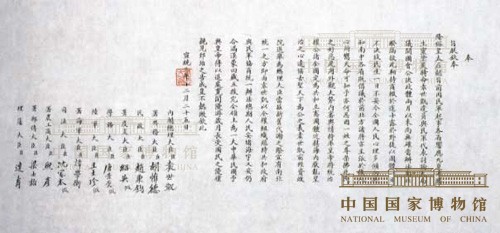
The Qing abdication edict of February 12, 1912 looks, at first, like a ceremonial ending: a short imperial document announcing that the last emperor would leave the throne. Read closely, it is much stranger. It did not simply say that a dynasty had lost. It tried to turn loss into continuity. The edict translated revolution, military pressure, elite bargaining, and dynastic self-preservation into a legal formula that could say the empire had become a republic without admitting that the state had shattered.[1][2][5]
That is why the document deserves to be read as a primary source rather than as a footnote to the 1911 Revolution. The National Museum of China places the object in the chain after the Wuchang Uprising, Yuan Shikai's pressure on the court, the revolutionaries' willingness to hand him the presidency, and the Articles of Favourable Treatment for the abdicated emperor.[1] The Office of the Historian gives the wider sequence: revolt in October 1911, a provisional republic declared on January 1, 1912, Sun Yat-sen's promise to resign if Yuan could secure abdication, and the final exit of the Qing throne in February.[4]
The edict's close-reading problem is therefore not "why did the Qing fall?" It is "how did a defeated court write its fall so that the new regime could inherit the country?"
The Edict Speaks In The Old Voice To Authorize The New
Qing imperial decrees normally carried a deep ritual grammar. The National Palace Museum explains that such decrees announced major state events, were drafted through high administrative channels, and traditionally spoke in the emperor's voice to make an event known under heaven.[3] The abdication edict used that inherited form for an anti-imperial result. It made the monarchy's own documentary machinery certify the end of monarchy.
That contradiction is the document's first source of power. If the revolutionaries alone proclaimed the republic, the result could look like secession or conquest. If the court alone clung to imperial continuity, the country might face civil war. The edict stood between those possibilities. It used imperial authority to authorize a post-imperial order.
The English translation preserved in a 1912 Tianjin postcard puts the pivot in plain terms: the whole country was tending toward republican government, and the emperor would "hand over the sovereignty to the people."[2] The line matters because it does more than concede defeat. It names sovereignty as transferable. The emperor does not merely abandon a palace or resign a job. The old source of political authority is being rerouted from dynasty to people, while the old dynastic voice performs the transfer.
There is a careful fiction here. Sovereignty had already been contested by provincial declarations, revolutionary armies, negotiations, and Beiyang military pressure. The edict did not create that pressure; it domesticated it. It gave the revolution a document that could be cited as succession rather than rupture.
The Republic Arrives As A Bargain, Not A Clean Break
The edict's second key move is its treatment of Yuan Shikai. By early 1912, Yuan was the indispensable broker. The National Museum of China summarizes the bargain bluntly: Yuan declared support for the republic, the revolutionaries accepted his route to the provisional presidency, and both sides agreed on favorable treatment for the Qing emperor after abdication.[1] A documentary collection of the Articles of Favorable Treatment describes the settlement as the republican side of the same compromise: the emperor's abdication came in the edict, while the republic's assurances came in a separate formal document.[5]
That document-pair changes the way the edict reads. It is not a spontaneous act of enlightened renunciation. It is the last written stage of a negotiation in which every side needed something. The revolutionaries needed a national handoff that might avoid a northern war. Yuan needed the republic to pass through his hands so that his presidency would look necessary rather than opportunistic. The Qing court needed safety, stipend, ritual status, and a way to preserve the imperial household from immediate destruction.[1][5]
That is why the edict's language of unity is so loaded. It speaks of a republic that will join the peoples of the former empire into one state.[2] The phrasing is doing political work. It tries to make the new Republic of China not merely the victor over the Qing but the successor to Qing territorial claims. In that sense, the abdication edict was not only an ending document. It was also an inheritance document.
This point is easy to miss if the fall of monarchy is imagined as a clean ideological conversion. The edict was written in a world where the Qing court still had symbolic authority, Yuan had military leverage, Sun Yat-sen's provisional government had revolutionary legitimacy, and the borderlands of the old empire posed unresolved questions. The document's job was to compress those conflicts into one sentence-like act: empire becomes republic, but the state remains whole.
Favorable Treatment Made Abdication Administratively Possible
The Articles of Favourable Treatment were not a sentimental afterthought. They were part of the mechanism that made abdication acceptable to the imperial household. The document provided that the abdicated emperor would retain his title, receive an annual subsidy, remain temporarily in the Forbidden City before moving to the Summer Palace, keep a bodyguard, and receive protection for imperial temples, mausoleums, and private property.[5] The National Museum of China similarly places the articles immediately before the edict's issuance.[1]
This matters because the edict did not end monarchy by erasing the emperor. It ended monarchy by relocating him. The child emperor Puyi ceased to be sovereign, but the republican settlement allowed an imperial remnant to remain inside the Forbidden City. That compromise looks paradoxical, but it explains why the document could work. The court could accept abdication because the dynasty was not asked to disappear socially and ritually in the same instant that it disappeared politically.
The bargain also exposed the limits of the new republic. A government confident in total revolutionary authority would not need to pay and house the old ruler. A government trying to prevent fragmentation might. The edict, read beside the favorable treatment articles, shows a republic born from negotiation with what it replaced.
That negotiated birth helps explain why later memory of 1912 can feel both decisive and unfinished. The dynasty ended. Imperial sovereignty was renounced. Sun stepped aside. Yuan was elected provisional president on February 15, according to the National Museum of China.[1] Yet the constitutional and military foundations of the republic remained unstable. The edict solved the throne problem faster than it solved the state problem.
The Document Turns Defeat Into Continuity
The most important feature of the abdication edict is its refusal to narrate collapse as collapse. The Qing had been unable to suppress the revolution, unable to rely on provincial obedience, and unable to control Yuan without depending on him. Yet the edict does not read like a battlefield surrender. It reads like a managed transfer for the sake of unity.
The formal quality is the point. The old order ended through a document that still sounded like state order. Instead of the republic having to prove itself only through arms, it received a textual bridge from the dynasty it had displaced. The edict and the favorable treatment articles worked as paired documents: one transferred sovereignty away from the throne, while the other made the old court's survival administratively tolerable.[1][5]
That bridge carried costs. By allowing Yuan to stand at the center of the handoff, the settlement gave enormous authority to the military politician whose later ambitions would wound the republic. By preserving territorial continuity in imperial-to-republican language, it also left unresolved the political consent of many peoples and regions named inside the inherited state. The edict's elegance was not the same as democratic settlement.
Still, the document did something historically consequential. It made the end of more than two centuries of Qing rule, and more than two millennia of imperial monarchy, administratively legible.[1][4] It converted a revolutionary fact into a state document. It gave the republic a founding claim that did not depend only on overthrow: the emperor himself, speaking through the last usable form of imperial authority, had transferred sovereignty away from the throne.
The abdication edict is therefore not merely the last page of imperial China. It is a hinge document. One side faces the old world of decrees, regency, dynastic title, and court ritual. The other faces the new world of provisional presidencies, republican legitimacy, military brokerage, and contested national inheritance. Its power lies in making those worlds touch on paper.
Sources
- National Museum of China, "Imperial Edict of the Abdication of the Qing Emperor," object page with date, dimensions, negotiation context, and February 1912 sequence.
- Chinese History for Teachers, "Source 8 Abdication Edict Feb 12th 1912 (Tianjin Postcard)," Omeka item with a contemporary postcard translation of the edict.
- National Palace Museum, "Treasures from the National Palace Museum's Collection of Qing Dynasty Historical Documents: Imperial Decrees," exhibition page explaining Qing decree form and administrative process.
- U.S. Department of State, Office of the Historian, "The Chinese Revolution of 1911," Milestones page on the 1911 revolt, the Republic of China, Sun Yat-sen, Yuan Shikai, and abdication.
- Ibiblio Chinese History, "Government Documents: The Articles of Favorable Treatment," text of the agreement setting terms for the Qing emperor and imperial household after abdication.