The Kinder Scout mass trespass is easy to tell as a clean liberation story: on 24 April 1932, working-class walkers climbed a forbidden moor, faced gamekeepers, went to prison, and opened the English countryside. The appeal of that version is obvious. It gives the right to roam a dramatic origin scene, with bodies on a hillside instead of committees in meeting rooms.
The evidence points to a better story. Kinder did not single-handedly win public access to open country. It did not immediately create national parks, it did not make Kinder freely walkable the next morning, and it did not replace decades of quieter campaigning by rambling clubs, open-space societies, planners, and postwar reformers. But it also was not a harmless footnote. The trespass mattered because it turned a diffuse access grievance into a public drama: a route from Bowden Bridge, a clash at William Clough, jail terms at Derby Assizes, and a memory that later campaigners could use.[1][2][4]
That is the myth-vs-evidence balance. Kinder was not the whole cause. It was the spark that made a longer cause harder to ignore.
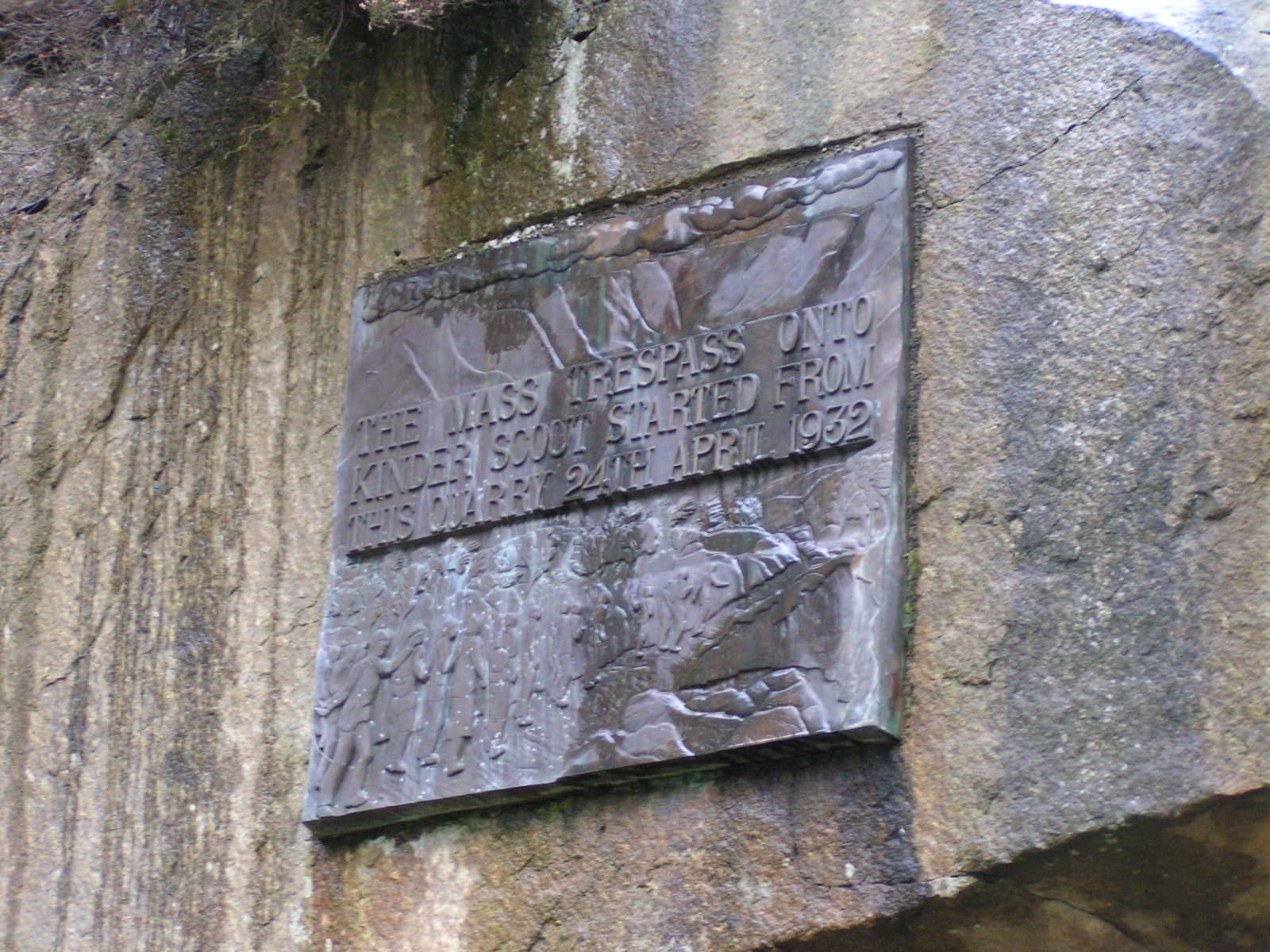
Image context: the cover photograph shows the commemorative plaque at Bowden Bridge Quarry, the gathering point associated with the 1932 trespass. It is a real photographed memorial, not a diagram or generated image. That suits the argument because Kinder's power lies partly in how a contested episode became a durable public memory site.[6]
Myth: the trespass immediately opened the moors
The walk itself was brief, tense, and carefully staged. Peak District National Park's account places hundreds of men and women on the route from Bowden Bridge toward the Kinder plateau. Benny Rothman, then a young Lancashire secretary of the British Workers' Sports Federation, addressed the crowd before the walkers moved out. The plan drew police attention toward Hayfield while the trespassers gathered at the quarry and headed for William Clough.[1]
The contemporary press record confirms the scale and heat of the day. The Manchester Guardian report, republished by The Guardian, put the crowd at "four or five hundred" and described a confrontation with keepers before the walkers continued toward Ashop Head and returned to Hayfield, where police detained men from the group.[2] The Peak District account gives the later legal sequence: six young men were arrested, five were found guilty, and prison sentences ran from two to six months.[1]
That did not amount to immediate access. Sheffield City Council's archive guide gives the wider access context more starkly: before 1949, only about 1% of Peak District moorland was publicly accessible, with only 12 legal paths, while grouse-shooting estates used gamekeepers to keep walkers out year-round.[3] The point is not that the 1932 action failed. The point is that it changed visibility before it changed law.
If the test is "Could ordinary walkers freely roam Kinder after 24 April 1932?" the answer is no. If the test is "Did the episode make exclusion look politically uglier, classed, and punishable in a way that could travel through newspapers and memory?" the answer is yes.[1][2][3]
Myth: Kinder came from nowhere
The legend also compresses the prehistory. The 1932 trespass was dramatic because it took direct action, but the access movement was already old. The Peak District's open-access timeline points back to nineteenth-century open-space organizing, the formation of outdoor clubs, failed access bills in 1884, 1908, and 1926, the Hayfield and Kinder Scout Ancient Footpaths Association in 1876, and a wider boom in working-class outdoor recreation after the First World War.[5]
That earlier history matters because it stops Kinder from becoming a lone miracle. The trespassers acted inside a landscape already full of argument: industrial workers seeking cheap recreation, landowners preserving moorland for shooting, older ramblers pursuing legal and parliamentary routes, and public-health ideas that treated fresh air as more than private leisure.[3][5]
The immediate politics were also sharper than a general love of walking. The British Workers' Sports Federation was Communist-influenced, and many participants came from Manchester and surrounding industrial districts.[1][3] That made the protest easy for opponents to dismiss as disorder. It also helped explain why the punishments generated sympathy: the state looked harsh when young workers asking for open moorland were treated as rioters.
So the evidence does not support a story in which respectable conservation slowly woke up because one day of trespass revealed a hidden truth. It supports a story in which long access claims, class conflict, youth politics, and a punitive trial suddenly converged in a form the public could remember.
Myth: historians must choose between triumph and debunking
The strongest challenge to the popular version comes from historian David Hey, whose 2011 essay argues that the Kinder story became too simple. Hey stresses the work of earlier and longer-established rambling organizations, notes that some mainstream ramblers opposed the trespass at the time, and warns against treating a single afternoon as the direct explanation for the whole right-to-roam settlement.[4]
That correction is necessary. The access chain after Kinder was long. The Standing Committee on National Parks formed in 1936. Wartime and postwar planning reports kept the national-park idea alive. The National Parks and Access to the Countryside Act passed in 1949. The Peak District became Britain's first national park on 17 April 1951. The first local access agreements for private moorland around the Peak followed in the early 1950s, while the Pennine Way opened in 1965. The Countryside and Rights of Way Act did not arrive until 2000.[1][5]
Those dates are fatal to the simplest slogan. A campaign that takes from 1932 to 2000 cannot honestly be described as one walk followed by one victory.
But debunking has its own risk. If the legend exaggerates Kinder, the reaction can make the trespass sound merely theatrical. That also misses the mechanism. Direct action sometimes works not by drafting the law but by changing what later law has to answer. The jail terms made the access cause legible as injustice. The route gave the movement a geography. Rothman and the other defendants gave it names. The anniversary culture gave it repeatable memory. Those are not substitutes for legislation, but they are political resources.[1][4][5]
What Kinder actually did
Kinder's real effect was to create an access story with three unusual strengths.
First, it joined class and landscape. The Sheffield archive guide makes the social setting plain: the 1920s and 1930s produced more working-class ramblers from Sheffield, Manchester, and other industrial centers, while nearby moorland remained tightly controlled for grouse shooting.[3] That meant access was not only about scenery. It was about who could use health, leisure, and space after a week of industrial work.
Second, it made exclusion physical. A parliamentary bill can fail quietly. A path dispute can stay local. A scuffle with gamekeepers at William Clough, followed by arrests and prison sentences, becomes harder to sanitize.[1][2] The episode put the contradiction in public view: land used for a few days of sport by one class could be closed all year to another.
Third, it survived as a usable memory. The 1982 fiftieth anniversary, later campaign groups, and the Bowden Bridge plaque all turned the trespass into a place-based ritual of remembrance.[5][6] That matters because access politics needs more than policy detail. It needs a way to explain why a footpath, moor, or map boundary is a democratic question rather than a hobby dispute.
The better causal chain therefore runs like this: older organizations and failed bills created the access problem's political vocabulary; interwar working-class walking gave it numbers and urgency; Kinder gave it drama and sympathy; postwar planning converted access into national-park administration; local agreements opened specific moors; later legislation widened the legal right.[1][3][4][5]
No single link is the whole chain.
Evidence: the law arrived slowly and partially
The slow timetable also explains why Kinder remains useful in present memory. The 1949 act did not create a universal right to roam. It provided the institutional basis for national parks and access machinery.[5] The 1951 Peak District designation did not make every acre open at once; it started negotiations and agreements.[5] The 2000 Countryside and Rights of Way Act introduced access rights to particular categories of land, including mountains, moors, heaths, and downs, but even that was a mapped and bounded legal settlement, not the abolition of landownership.[5]
This gradualism should change how the episode is taught. Kinder is strongest when it is presented neither as fairy-tale victory nor as overpraised myth. It is a case study in how social movements turn pressure into institutions. The trespassers could not legislate from a hillside. What they could do was make the hillside a public argument.
That is why the plaque at Bowden Bridge is the right image. It does not show open moorland as if access simply arrived. It shows a memorial fixed into stone at the starting point of a dispute. The inscription, the quarry, the route, and the repeated anniversaries all say the same thing: the right to walk was made politically durable because people kept returning to a contested place and telling a contested story.[5][6]
The best historical judgment is therefore exacting but generous. Kinder Scout did not win the right to roam in one day. It helped make one-day certainty impossible for the people who wanted the old exclusions to remain invisible.
Sources
- Peak District National Park, "The Mass Trespass" - official account of the 1932 Kinder Scout trespass, William Clough confrontation, arrests, prison sentences, Benny Rothman background, and later access campaign timeline.
- The Guardian, "Mass trespass on Kinder Scout" (original report from April 25, 1932) - contemporary newspaper account of the crowd size, confrontation with keepers, route toward Ashop Head, and police detentions.
- Sheffield City Council Archives and Local Studies, Sources for the Study of the Kinder Trespass, 1932 - archive guide with access context, pre-1949 moorland access figures, and working-class rambling background.
- David Hey, "Kinder Scout and the legend of the Mass Trespass," Agricultural History Review 59:2 (2011) - historiographical challenge to the simplified right-to-roam legend and assessment of longer-running access organizations.
- Peak District National Park, "A history of open access land" - campaign and legislation timeline from early access groups through the 1932 trespass, 1949 Act, Peak District designation, access agreements, and the 2000 Countryside and Rights of Way Act.
- Wikimedia Commons, "File:Mass Trespass Plaque, Bowden Quarry - geograph.org.uk - 50842.jpg" - source page for the photographed plaque used as this article's image.