On May 10, 1933, a fire in Berlin's Opernplatz made censorship look like participation. The Nazi state had already begun forcing German public life into line after Adolf Hitler became chancellor on January 30, 1933. The April boycott of Jewish-owned businesses, the pressure on universities, and the accelerating removal of political opponents all mattered before a single book went into the flames. But the book burning did something more theatrical. It converted an administrative campaign against writers, teachers, publishers, and libraries into a night scene that crowds could witness and newsreel cameras could reuse.[2][5]
The burnings were not a spontaneous mob act. The United States Holocaust Memorial Museum describes them as student-led events supported by the Nazi regime, organized through the German Student Association and framed as a "Campaign against the Un-German Spirit." The campaign was announced in early April 1933, with the May 10 ceremonies as its climax. Students were instructed to cleanse private and public collections, blacklists circulated, and ritual slogans called "fire oaths" told participants which authors and ideas were being symbolically destroyed.[2] That structure is the historical center of the event. The fire was not only destruction. It was a lesson in obedience.
The numbers also show why Berlin should not swallow the whole story. USHMM describes book burnings in more than twenty university towns and cities, while PBS's American Experience account frames the May 10 campaign across thirty-four university towns and more than 25,000 books.[2][5] The variation is not a fatal contradiction; it reflects the fact that some burnings occurred on May 10, some were postponed by rain, and other Nazi groups held additional burnings across the year. The point is that the Opernplatz footage records the most famous scene in a wider national performance.[2][4]
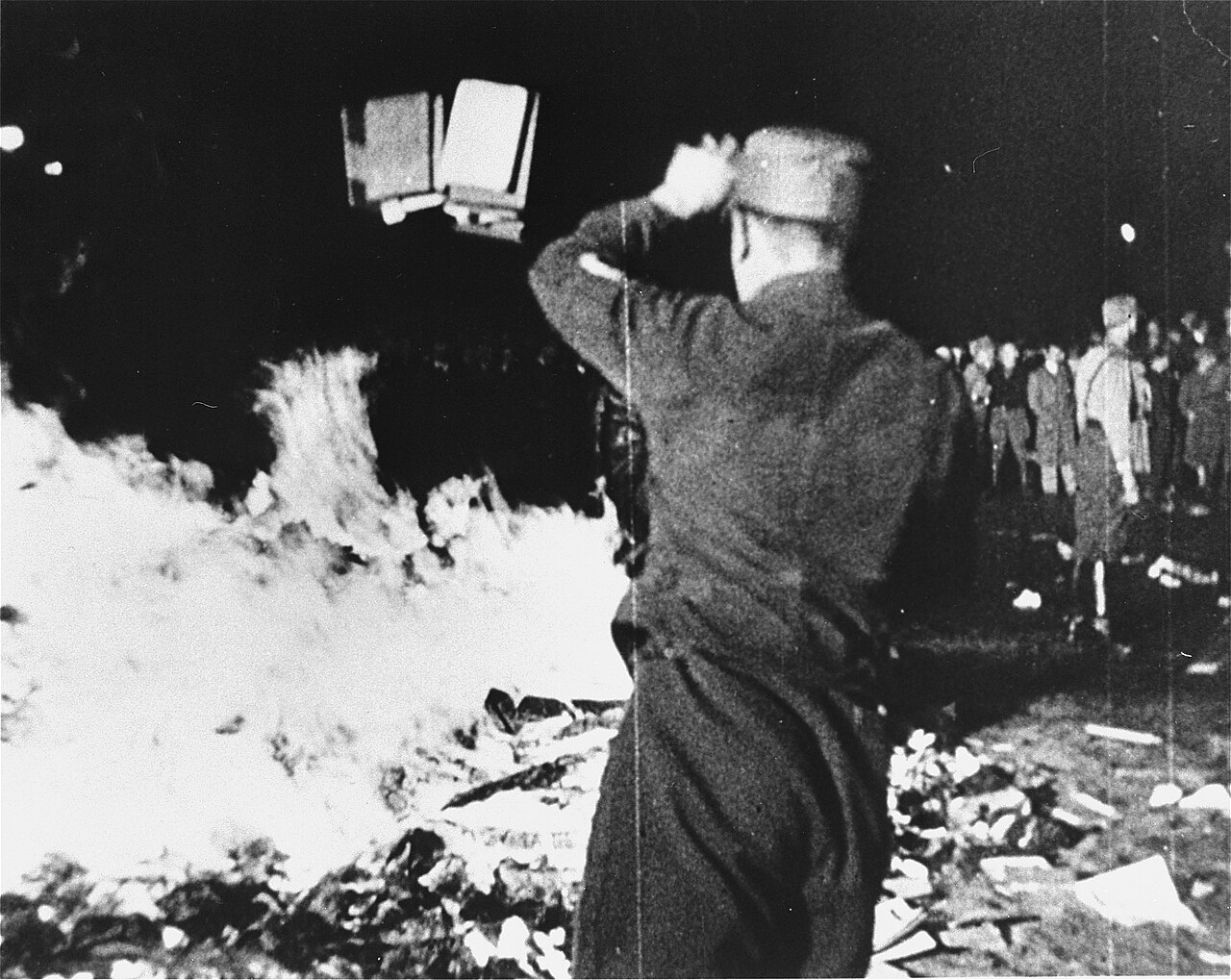
Image context: the cover is a real archival photograph of the Berlin book burning, preserved through Wikimedia Commons from a National Archives source. It is used here because the gesture in the frame matters historically. The image shows censorship as bodily action: a person lifting books, a crowd watching, and a bonfire turning policy into spectacle.[6]
The Archival Film
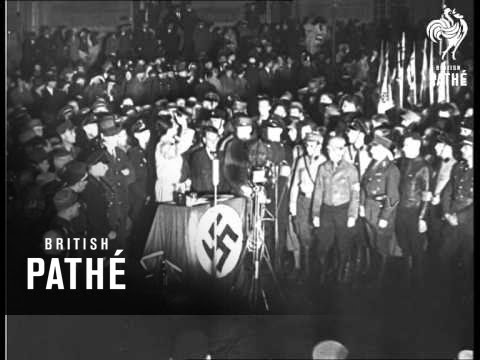
The embedded video is British Pathe's YouTube upload "Burning The Books - Germany 1933 (1933)." The upload identifies the material as unused or unissued, with uncertain paperwork, and the footage itself carries the subject title "The Burning of the Books, 10 May."[1] That imperfect provenance is useful rather than disqualifying. Archival film often arrives with gaps: title cards, catalog notes, newsreel conventions, later digitization, and missing production paperwork. Here the uncertainty sharpens the viewing question. We are not watching a clean documentary explanation. We are watching a fragment of a propaganda-era public ritual, preserved through an archive whose very metadata reminds us to separate what the camera shows from what later historians can verify.
What The Camera Makes Visible
The first thing to notice is the event's orderliness.[1] The fire does not appear as private vandalism. The scene is arranged around a public square, a crowd, uniformed participants, speakers, and a ceremonial treatment of the books as named enemies. That matters because censorship often feels invisible after the fact: a missing volume, a banned author, a closed institute, a silenced press. The archival footage lets the viewer see the opposite form of censorship, the kind meant to be watched. The destruction was designed to show that certain writers and intellectual traditions no longer belonged inside the national community being imagined by the Nazi movement.
The second thing to notice is the relation between youth and authority. USHMM is careful about agency: the May 1933 book burnings were organized by pro-Nazi university students, not directly by the central Nazi government, but local and national Nazi officials participated and their presence gave the events legitimacy.[2] That distinction is important. The regime did not need to perform every act itself when institutions, student groups, party organizations, professors, and spectators could help enact the new boundaries. The ceremony taught that cultural policing could be distributed.
The "fire oaths" reveal how scripted the performance was. USHMM explains that a May 9 bulletin sent to student groups supplied slogans to be read while particular works were tossed into the flames. Authors such as Erich Maria Remarque, Sigmund Freud, Kurt Tucholsky, and Carl von Ossietzky were named in this ritual language.[2] This makes the word "burning" too simple. The event paired physical destruction with spoken classification. Before a book became ash, it had to be named as alien, pacifist, Jewish, Marxist, liberal, democratic, or otherwise incompatible with the regime's racial and nationalist idea of culture.
That pairing is why the footage should not be read as anti-intellectualism in a loose sense. It was more precise and more dangerous. Nazi students and officials did not reject all books. They rejected certain authors, disciplines, politics, and identities while claiming to purify German culture. The NS Documentation Center in Munich describes the book burnings from March to October 1933 as public attacks on writings proscribed as "un-German," including a Munich burning at Konigsplatz.[4] The local repetition matters. This was not only Berlin's spectacle. It was a portable ritual that could be staged wherever institutions were ready to declare loyalty.
What The Film Cannot Show
The camera captures flames and crowds, but it cannot show the paperwork that made the ritual possible. The blacklists mattered before the square did. USHMM traces many of the lists to librarian Wolfgang Hermann and shows how the categories of burned books ranged across communism, socialism, pacifism, Weimar republicanism, criticism of the Nazis, Jewish authorship, sexuality, and other targets.[2] PBS names some of the internationally recognizable authors caught in the sweep, including Einstein, Freud, Hemingway, Helen Keller, and Remarque.[5] The spectacle depended on prior sorting.
Nor can the footage fully show what happened to Magnus Hirschfeld's Institute for Sexual Science. USHMM notes that material confiscated from the institute was among the works burned in Berlin.[2] That detail matters because the book burning was not only a symbolic attack on abstract "ideas." It targeted archives, research, patient records, sexual science, queer life, Jewish scholarship, and reform networks. When a library or institute is looted, the loss is not only the object in the fire. It is the destruction of a knowledge system and of the people who depended on it.
The film also cannot show reception abroad except indirectly. USHMM records international outrage, including in the United States.[2] That reaction became part of the event's afterlife because the footage traveled. USHMM's separate film page for "The Nazi Plan": Book Burning notes that footage titled "The Burning of the Books, 10 May 1933" was later compiled from German source material and shown as evidence at the International Military Tribunal in Nuremberg on December 11, 1945.[3] The same visual grammar that once served Nazi display could later serve prosecution and historical memory.
Why The Fire Still Matters
The Berlin book burning is often remembered through a moral shorthand: first they burned books, later they burned people. That warning has force, but it can flatten the historical sequence if it makes May 1933 sound like a prophecy rather than an action. The sharper lesson is operational. The book burnings showed how a regime could use students, universities, lists, slogans, public squares, radio, newsreels, and spectators to make exclusion feel like renewal.[2][4]
The footage matters because it preserves that operation at the level of behavior. A reader can learn from a source page that tens of thousands of books were burned. The video shows how burning became a civic pose: hands raised, bodies gathered, objects passed forward, fire treated as purification, camera positioned to make the scene reproducible.[1] It is not the complete history. It is the performative surface of a larger campaign. But that surface is evidence, because authoritarian culture often advances by making people rehearse its categories in public.
Seen this way, the book burning was not only an attack on shelves. It was an attack on the social habits that make shelves meaningful: disagreement, borrowing, reading across difference, academic autonomy, satire, pacifist critique, sexual research, Jewish intellectual life, and the ordinary assumption that a library can contain conflicting worlds. The fire oath tried to replace that plural space with a single national script. The archival film still matters because it lets us see censorship becoming ceremony before ceremony hardened into law, exile, imprisonment, and murder.
Sources
- British Pathe, "Burning The Books - Germany 1933 (1933)," YouTube video.
- United States Holocaust Memorial Museum, "Nazi Book Burnings" - article on the student-led campaign, fire oaths, authors targeted, Berlin ceremony, and wider national context.
- United States Holocaust Memorial Museum, ""The Nazi Plan": Book Burning" - film page on German newsreel footage later compiled for the Nuremberg trial record.
- NS Documentation Center Munich, "The Book Burnings in Germany and in Munich" - local and national context for 1933 book burnings, including the Munich Konigsplatz event.
- PBS American Experience, "Book Burnings in Germany, 1933" - overview of the May 10 campaign, targeted authors, and Berlin crowd scale.
- Wikimedia Commons, "File:1933-may-10-berlin-book-burning.JPG" - source page for the archival photograph used as this article's image.