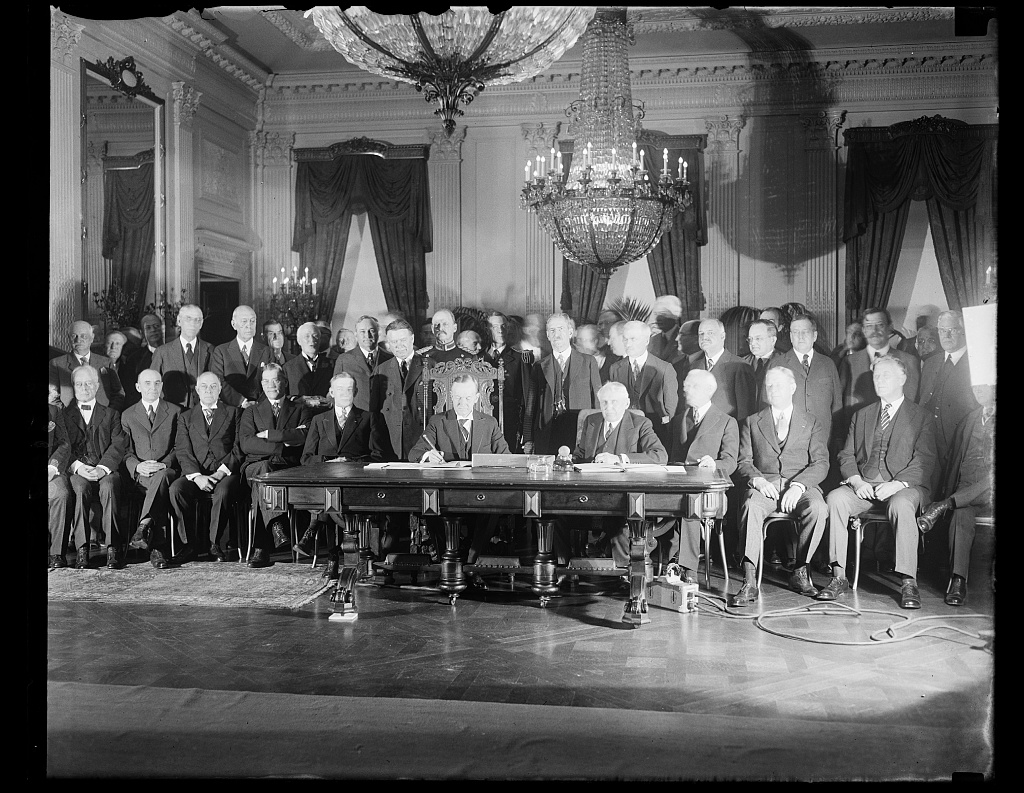
Most dismissals of the Kellogg-Briand Pact are half-right. The agreement did not stop the 1931 Japanese invasion of Manchuria, the remilitarization crises of the 1930s, or the Second World War.[2] But calling it only a naive peace wish misses what the text actually tried to do. On August 27, 1928, fifteen powers signed a very short treaty in Paris that moved war from the normal toolkit of statecraft into a category that states had publicly renounced.[1][2]
That distinction matters. The pact did not create a world police force. It did not define every border case. It did not make self-defense disappear. Its importance sits in a more fragile place: it made governments say that war was no longer an ordinary instrument of national policy, then left future crises to test whether reputation, public opinion, diplomacy, and later institutions could make that promise bite.
Image context: the cover uses Harris & Ewing's January 17, 1929 photograph of President Calvin Coolidge formally signing the U.S. ratification document in the White House. The scene is useful because it shows the pact's legal route: a Paris signature became Senate advice and consent, presidential ratification, deposited instruments, and finally a public treaty obligation.[1][5]
Article I Turns War Into A Confession
Article I is the treaty's center of gravity. The parties say, in the names of their peoples, that they condemn recourse to war for resolving international controversies and renounce it as an instrument of national policy in relations with one another.[1] The key word is not peace. It is instrument.
Before 1928, a government could still present war as a grave but legitimate tool: a way to collect claims, adjust boundaries, punish affronts, protect interests, or force a settlement. Article I tries to change that public grammar. It does not merely ask states to prefer peace. It asks them to stop treating war itself as a usable policy instrument among signatories.
The phrasing is narrower than a modern reader might want. It speaks of relations "with one another," so it is primarily a treaty among parties, not a full charter for every possible use of force. It does not separately name colonial violence, civil war, blockade, covert action, or proxy pressure. It also does not supply a court that can determine, in real time, whether a government is disguising aggression as necessity. Those omissions are not footnotes. They are the treaty's weak joints.
Still, Article I changes the burden of language. Once a state has renounced war as policy, it has to explain why a later military act is not exactly what it promised to abandon. The pact's force begins there: not as a tank-stopping device, but as a rule that makes aggression harder to describe honestly.
Article II Moves Conflict Into Process
Article II follows with a procedural promise. Disputes or conflicts, "of whatever nature or of whatever origin," are to be settled only by peaceful means.[1] That clause does two things at once. It widens the category of problems covered by the agreement, and it avoids specifying the machinery that should handle them.
The breadth is ambitious. The pact does not limit itself to one class of disputes, such as reparations, frontiers, treaty interpretation, or commercial injury. It says the origin does not matter. A conflict can arise from security fear, debt, territory, prestige, or domestic pressure; the formal route should still be peaceful.
The machinery, however, remains thin. Article II does not name a required court, arbitration panel, conciliation commission, timetable, fact-finding procedure, sanction, or emergency meeting format.[1] Article III focuses instead on ratification, accession, deposit of instruments at Washington, certified copies, and telegraphic notice.[1] In administrative terms, the pact is much stronger at spreading the promise than at adjudicating a breach.
That helps explain why the document was so easy to join and so hard to enforce. The Office of the Historian notes that after the initial fifteen signatories, forty-seven more nations followed, making the pact nearly universal among established states.[2] Broad adherence was part of the design. A treaty against war needed scale to matter. But scale came partly because the obligation did not force states into an automatic enforcement system.
Self-Defense Was The Safety Valve
The pact's popular appeal depended on a crucial assurance: it was aimed at aggressive war, not military self-defense.[2] That assurance solved a political problem and created a historical one.
In the United States, Senate ratification came only after concern that participation should not limit self-defense or require U.S. action against violators.[2] The Senate Foreign Relations hearings show how central that boundary was. Secretary of State Frank B. Kellogg defended the treaty while preserving national judgment over defense; the hearing record repeatedly circles the question of who decides when danger is real and what measures are allowed.[3]
This was not a small loophole. It was the price of entry. A treaty that abolished every unilateral claim of self-defense would never have attracted the same range of governments. France wanted security against Germany. The United States wanted to avoid a bilateral alliance with France and keep freedom of action. Britain, Japan, Italy, Germany, and the dominions all had their own strategic anxieties.[2][3] The language had to be strong enough to outlaw war as policy and flexible enough that states would not feel trapped in an emergency.
The result is the pact's central tension. Self-defense made the treaty signable, but it also gave future violators a vocabulary. A state could still claim that its attack was preventive, protective, local, defensive, restorative, or forced by disorder. The pact did not make those claims true. It did, however, leave too much of the first judgment to the state making the claim.
The Enforcement Gap Was Visible Immediately
The enforcement problem was not discovered only after disaster. It was visible almost at once. On October 10, 1929, less than three months after the treaty was proclaimed in force on July 24, 1929, Secretary of State Henry L. Stimson recorded the difficulty bluntly: the pact had no investigative machinery, and unlike the League of Nations it had no sanction except world public opinion.[1][4]
That memorandum is valuable because it prevents a lazy hindsight reading. Officials did not need 1945 to know the pact lacked teeth. They knew in 1929 that a norm without machinery would struggle when facts were contested or when a great power calculated that condemnation was tolerable. Stimson's worry was not only punishment after the fact. It was the absence of a usable process for investigating disputes and informing the world before a crisis hardened.[4]
The 1931 Manchurian crisis then exposed the gap. Japan was a signatory. The pact said war should not be used to solve international controversies. Yet the combination of depression, strategic caution, weak collective appetite, and limited willingness to fight over China left the United States and the League without an effective enforcement response.[2] The treaty could name the problem, but it could not compel a remedy.
This is why the pact should be read neither as a triumph nor as a joke. Its failure was operational. It changed the declared norm faster than it changed the institutions needed to defend that norm.
What The Text Actually Left Behind
The most durable reading of Kellogg-Briand is therefore modest but serious. It did not end war. It did not prevent authoritarian revisionism. It did not solve the ambiguity of self-defense. It did not equip international law with a standing enforcement arm. But it made one public claim unusually hard to walk back: aggressive war was no longer a respectable policy instrument among civilized states.[1][2]
That claim had consequences even when states violated it. The violator now had to disguise aggression, deny the category, invoke defense, fabricate incidents, appeal to emergency, or claim that the conflict was not really war. Those evasions are not proof of success by themselves. They are proof that the legal vocabulary had shifted.
The close-reading lesson is that the treaty's greatest strength and greatest weakness were the same. It turned peace into a public legal promise broad enough for many states to sign. Yet it left enforcement to opinion, diplomacy, and later institutional improvisation. The pact did not fail because words never matter. It failed because words mattered enough to create a new standard, but not enough to police the first governments that decided to violate it.
Read this way, Kellogg-Briand is less a monument to interwar innocence than a hinge document. It shows the moment when major powers tried to outlaw war before they had built a reliable system for identifying aggression, judging excuses, and imposing costs. The pact's tragedy is not that it asked for too much. It is that it stated a necessary rule before the world had agreed how to enforce it.
Sources
- The Avalon Project, "Kellogg-Briand Pact 1928" - treaty text, ratification sequence, proclamation date, articles, and adhering countries.
- Office of the Historian, "The Kellogg-Briand Pact, 1928" - diplomatic background, signatories, self-defense boundary, Senate vote, Manchuria test, and enforcement limits.
- The Avalon Project, "The Kellogg-Briand Pact - Hearings Before the Committee on Foreign Relations United States Senate" - December 1928 hearing record on the treaty, self-defense, and U.S. ratification concerns.
- The Avalon Project, "The Kellogg-Briand Pact - Memorandum by the Secretary of State" - October 10, 1929 Stimson memorandum on missing machinery and the pact's reliance on public opinion.
- Library of Congress image service, "President Coolidge signs Kellogg Treaty" - direct JPEG of the Harris & Ewing glass-negative photograph used as the article image.