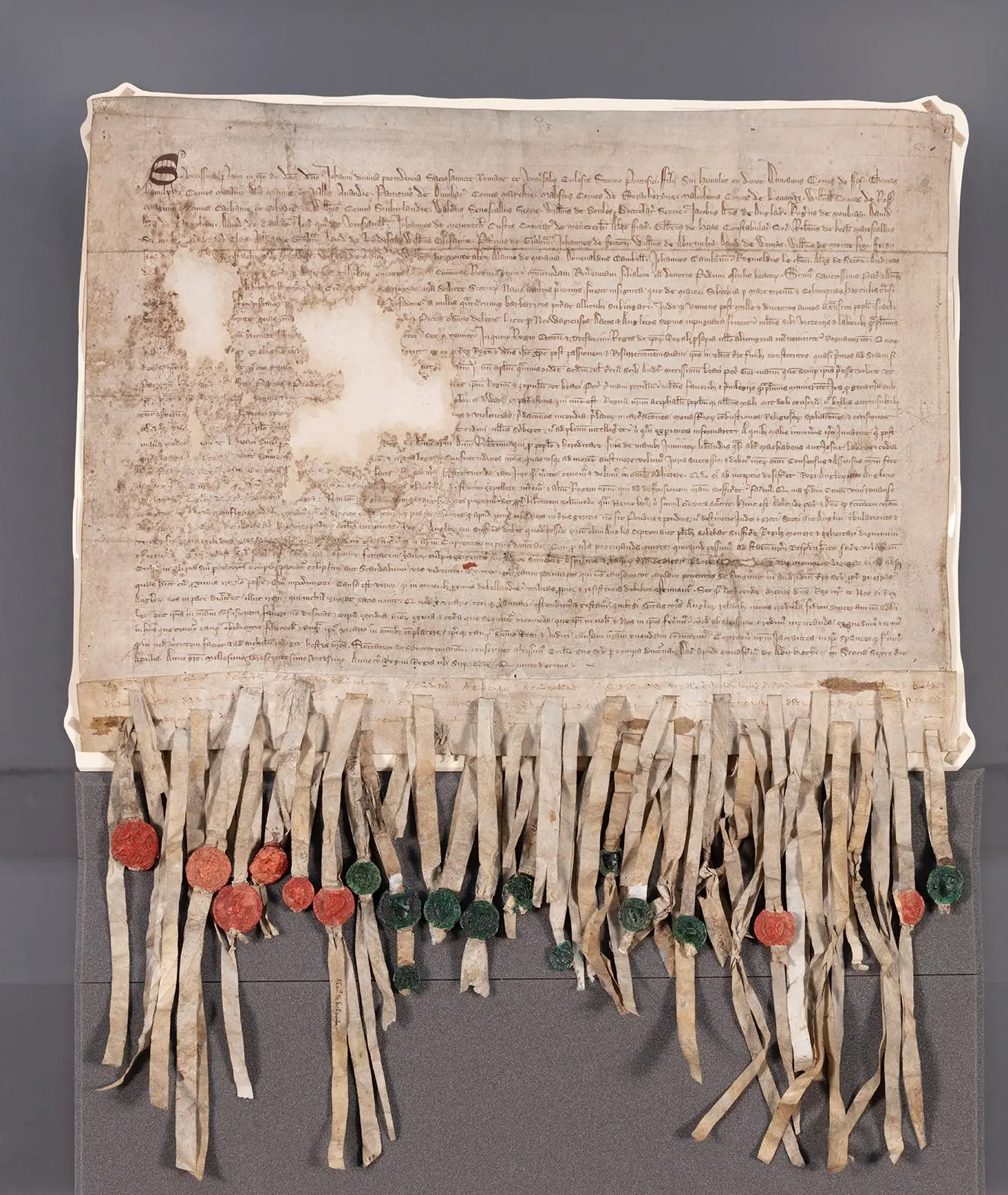
The Declaration of Arbroath is easy to remember as a ringing national manifesto. That memory is not wrong, but it can make the document sound as if it were written for posterity. It was not. The Declaration was a diplomatic letter, in Latin, dated 6 April 1320, sent in the name of Scottish nobles, freeholders, and the "whole community" of the kingdom to Pope John XXII at Avignon.[1][2] Its first audience was not a modern public. Its immediate purpose was to pressure the pope to recognize Scotland's independence and Robert Bruce's kingship during a war that legal victory had not yet settled.[1]
That makes the text sharper, not smaller. Read closely, the Declaration is not just a patriotic paragraph about "freedom alone." It is a carefully arranged argument about political legitimacy. It tells the pope that Scotland is an ancient kingdom, that English overlordship is an invasion rather than a right, that Robert Bruce is lawful king by providence, succession, and consent, and that even Bruce's authority depends on defending the kingdom's liberty.[2][4] Its most radical move is not simply that Scotland should be free. It is that kingship itself becomes conditional on preserving that freedom.
The historical clock matters. Edward I had pressed English overlordship claims after the Scottish succession crisis and invaded in 1296.[1] Robert Bruce seized the throne in 1306, then fought through internal and external opposition. Bannockburn in 1314 gave Bruce a military triumph, but England did not immediately recognize Scottish independence or his title.[1] By 1320, relations with the papacy were strained, and the Scots needed a diplomatic counter-argument as much as a battlefield memory.[1][4] Formal recognition of independence would not arrive until 1328.[1]
The Letter Begins By Accepting The Pope's Court
The Declaration opens upward. Its addressee is the pope, and its senders present themselves as Christian petitioners rather than as a people beyond judgment.[2] That posture is not ornamental. It shows the document working inside the medieval international order. The Scots do not tell John XXII that papal authority is irrelevant. They tell him that he has been misled about the political reality of Scotland and that continued war will carry moral responsibility.
This matters because the Declaration's independence claim is not a modern claim of popular sovereignty against all outside authority. The text accepts one hierarchy in order to contest another. Papal standing is acknowledged; English lordship is rejected. The letter's argument is that Scotland can be obedient to Rome without being subject to England.
The sender line is also doing work. The letter speaks for named nobles and for the wider political community of the realm.[2][4] That does not mean every inhabitant of Scotland had a democratic voice in the modern sense. The Scottish History Society learning resource stresses that the letter was probably a government-led effort, with nobles being urged or required to provide seals, rather than a spontaneous declaration drafted by a mass assembly.[4] But the formula still matters. The document's authority is not presented as Robert Bruce's solitary voice. It is the kingdom speaking around and through its leading political actors.
Origin Story Turns Independence Into Continuity
After the formal opening, the Declaration reaches backward. It offers a legendary account of the Scots' ancient movement, settlement, kings, and Christian identity.[2][4] This is not the part modern readers usually quote, but it is essential to the argument. The letter needs Scotland to be more than a province in rebellion. It needs Scotland to be a kingdom whose freedom predates the English claim.
The point is not antiquarian trivia. Origin stories did legal and diplomatic work. If Scotland had possessed its own line of kings, its own Christian standing, and its own political continuity, then Edward I's intervention after the succession crisis could be framed as aggression under cover of friendship, not as lawful overlordship.[1][2] The ancient past becomes evidence for present status.
There is a historian's caution here. The Declaration's origin narrative is not a neutral chronicle. It is a pleading document. It selects and organizes the past to persuade the pope. But that does not make it empty propaganda. Medieval political writing often argued from lineage, memory, divine favor, and jurisdiction. The Declaration's history section tells us less about early Scottish ethnogenesis than about what claims a kingdom in crisis thought would be legible at Avignon.
Bruce Is Necessary, But Not Unconditional
The central turn comes when the letter moves from Scotland's antiquity to Robert Bruce. The text presents Bruce as the figure through whom the kingdom has been delivered from danger. It gives him three overlapping foundations: divine providence, legal succession according to Scottish custom, and the consent or assent of the political community.[2][4]
That stack is important. Bruce's kingship is not defended only as hereditary title, and not only as military success. It is made plausible by combining God, law, custom, and collective acceptance. The argument had to be layered because Bruce's path to the throne had been contested. He had seized the crown in 1306 after a violent struggle with rival claims, and the Balliol alternative had not simply disappeared from political imagination.[4]
Then the Declaration introduces its most bracing constitutional logic. If Bruce were to give up the cause and make the kingdom subject to England, the senders say they would treat him as an enemy and choose another man capable of defending them.[2][4] The king is praised, but he is not made identical with the kingdom. His legitimacy is tied to a job: defending the realm's freedom.
That clause is often overshadowed by the famous freedom sentence that follows it. It should not be. The conditional-kingship clause is what turns the freedom language from slogan into political architecture. The community does not merely love independence; it reserves judgment over the king who fails it.
"Freedom" Means The Kingdom, Not A Modern Rights Catalogue
The Declaration's best-known line says the Scots fight not for riches or honors, but for freedom.[1][2][3] The phrase is powerful because it is compact, but modern readers can make it too broad. In the letter, "freedom" is first the freedom of the kingdom from English lordship. It is about jurisdiction, recognition, and the right to have a king who is not made subordinate to the English crown.
That does not reduce the line to mere dynastic messaging. The text's freedom is political and collective. It is not a catalogue of individual civil liberties, yet it is also not simply the private interest of Robert Bruce. The Declaration makes the kingdom's liberty something that stands above the king. The crown is legitimate because it serves that liberty; if it betrays that purpose, another defender may be chosen.[2][4]
This is the document's durable tension. It is not democratic in the way later constitutional culture would define democracy. It speaks in the voice of nobles, freeholders, and political community, not universal suffrage. But it also refuses to let kingship swallow the realm. The king matters because he protects a corporate freedom that the community claims as its own.
The Seals Make The Argument Physical
The manuscript reinforces the point. National Records of Scotland describes the surviving document as the original file copy, damaged by damp during its later custody but still the only version to survive in original form.[1] It was authenticated by seals, not signatures, and only 19 seals remain from what may once have been about 50.[1] UNESCO in the UK lists the Declaration as a manuscript in the Memory of the World national register, inscribed in 2016.[3]
Those material facts are not decorative. The pendant seals show the text's claim to collective authority. The stained parchment shows how much of medieval statecraft depended on fragile objects: a letter drafted for a papal court, kept among national records, damaged, reconstructed through later copies and engravings, and eventually turned into an icon.[1][2][3]
The text is famous because later readers found in it a language of national freedom. The document itself is more specific and more interesting. It is a wartime legal-diplomatic brief that uses history, theology, noble assent, and physical authentication to argue that Scotland is a kingdom, not an English possession.
The Declaration of Arbroath therefore should not be flattened into either proto-democracy or royal propaganda. Its force lies between those labels. It makes Robert Bruce necessary, but not absolute. It honors the pope's court while rejecting English lordship. It turns an embattled kingdom's freedom into the test of legitimate rule. Before it became a monument of national memory, it was a hard-working letter with a clear demand: recognize the kingdom, and understand that even its king is bound to defend it.
Sources
- National Records of Scotland, "The Declaration of Arbroath" - archival context, manuscript image, war-of-independence background, custody history, and seal information.
- National Records of Scotland, "Transcription of the Declaration of Arbroath" - Latin transcription and English translation, with notes on the reconstructed text tradition.
- UNESCO in the UK, "The Declaration of Arbroath" - Memory of the World national-register entry with inscription year, type of heritage, and summary significance.
- Scottish History Society, The Declaration of Arbroath learning resource - outline, context, dynastic crisis, sealing process, and interpretation of the deposition and freedom clauses.