
The 1964 New York World's Fair opened with the confidence of a billboard and the instability of a news day. On April 22, 1964, President Lyndon B. Johnson came to Flushing Meadows to dedicate a fair built around the slogan "Peace Through Understanding."[4] The site offered a giant steel earth, corporate pavilions, fountains, monorails, consumer demonstrations, international displays, and a future tense so polished that it almost hid the politics around it. Almost.
That is why the Universal Newsreel footage embedded below is more interesting than a nostalgia reel.[1] It preserves the fair at the moment of official self-presentation, but the frame keeps leaking context. The National Archives' account of the same newsreel notes the rain, the fair's lack of sanction from the Bureau of International Expositions, the projected 70 million visitors, and the final attendance shortfall: about 51 million people came over the two-season run.[2] The Associated Press archive adds what the celebratory camera could not fully absorb: opening-day civil-rights demonstrations, arrests, and James Farmer of CORE being carried from a protest site.[3] The fair was not simply a playground of tomorrow. It was a contested public stage.
The history matters because world's fairs are arguments disguised as attractions. The 1964 fair asked visitors to believe that technology, corporate ingenuity, national leadership, and global display could be made to converge around a peaceful future. Yet it opened in the same year as the Civil Rights Act, in a city with unresolved school and housing conflicts, during Cold War anxiety, and only months after John F. Kennedy's assassination. Johnson's speech tried to turn the fair's theme into a moral forecast, warning that scientific achievement could lead either toward abundance or devastation unless people learned to govern conflict.[4] The footage records that optimism. The opening day records the friction around it.
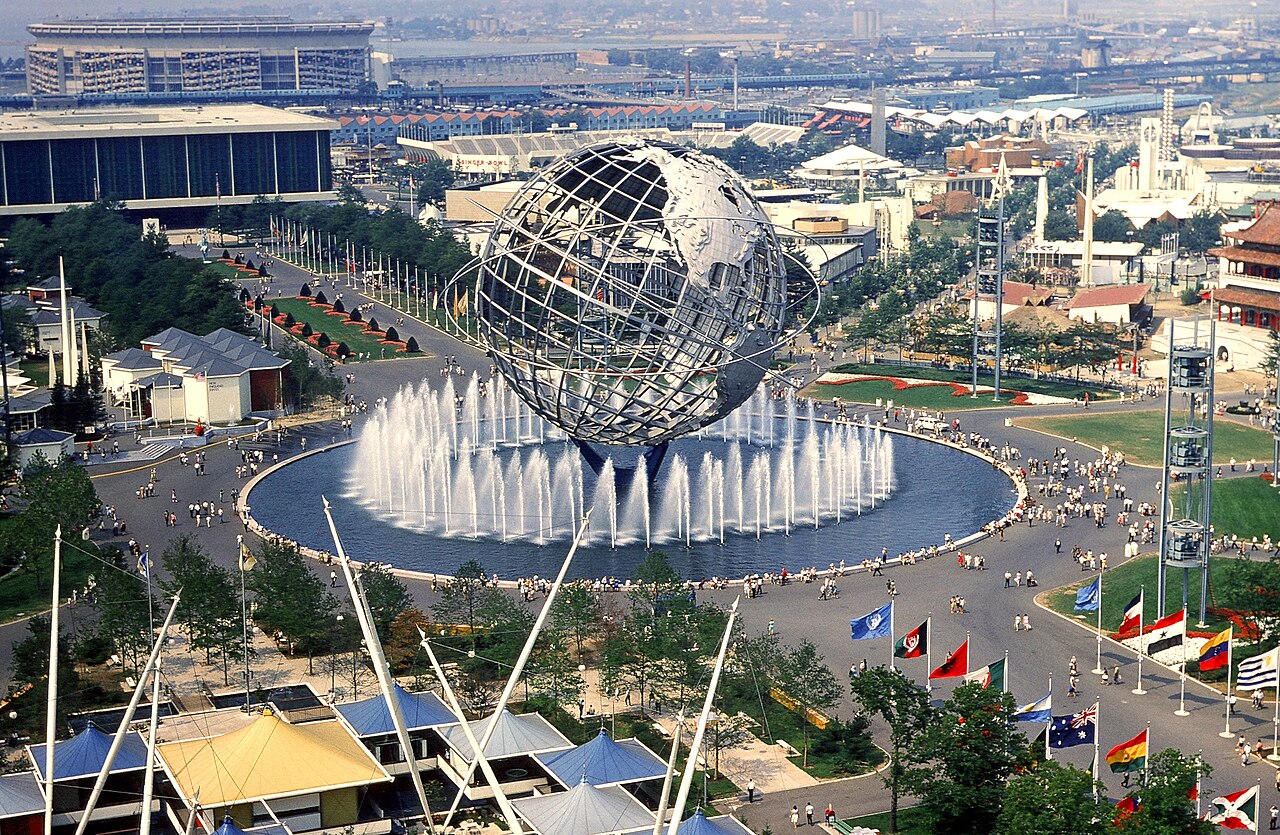
Image context: the lead image is a real color photograph from August 1964, taken from an original Kodachrome slide and showing the Unisphere and surrounding fairgrounds.[6] It is used here as documentary atmosphere rather than proof of opening-day weather. The image captures what the fair wanted visitors to carry away: the globe as center, the pavilions as orbiting promises, and the grounds as a temporary city of managed futurism.
Historical Context: A Fair Built For Consensus In A Year Without It
The 1964-65 fair stood on inherited ground. Flushing Meadows had already hosted the 1939-40 New York World's Fair, and that earlier fair had promised a "World of Tomorrow." The second fair returned to the same Queens site with a more corporate and Cold War inflection. The New York City Landmarks Preservation Commission's Unisphere report describes the steel globe as the logo of the fair and the center of its visual program.[5] The object mattered because it made the fair's argument instantly legible: the world could be represented, encircled by satellite rings, and surrounded by fountains.
That image of unity was also a management strategy. The National Archives blog notes that the fair covered 646 acres, offered 139 pavilions, and promised visitors miles of walkways, immense fountains, and enough communications infrastructure to resemble a small city.[2] Those numbers are not decorative. They explain why the fair needed newsreel compression. No viewer could grasp the whole site at once, so the camera had to turn scale into sequence: aerial views, the Unisphere, crowds, presidential ceremony, pavilions, spectacle.
But the fair's institutional status was already awkward. Because it was not sanctioned by the Bureau of International Expositions, and because it sat between Seattle's Century 21 Exposition and Montreal's Expo 67, it was easier to market locally than to legitimize internationally.[2] That did not make it minor. IBM's corporate history notes that the fair had more than 140 pavilions, 110 restaurants, roughly 45 corporate exhibits, and more than 51 million visitors.[7] It made the fair something slightly different from a classic international exposition: a massive American corporate-public theater of the future.
Opening day exposed the gap between the theater and the city around it. AP's archive shows the fair's first day as more than a ribbon-cutting. Johnson cut a ribbon and spoke the language of peace, while civil-rights protesters challenged New York's racial inequalities and tried to disrupt access to the fairgrounds.[3] AP photographs identify police tangling with demonstrators at a subway station, CORE figures arriving at the fair, pickets moving before the Unisphere, and Farmer being carried from a sit-in near the New York City pavilion.[3] The point is not that protest overwhelmed the fair. It did not. The point is that the fair's future had to open inside a present that refused to stay outside the gates.
The Archival Footage
The embedded video is Universal Newsreel Volume 37, Issue 33, April 23, 1964, uploaded to YouTube as a preserved Universal Newsreel item.[1] The National Archives explains the provenance of this collection: Universal Newsreels ran in theaters from 1929 to 1967, and Universal deeded its edited newsreel and outtake collection to the United States through NARA in 1974.[2] That provenance matters because this is not a later documentary using the fair as retro design. It is a newsreel trying to make opening day legible for a mass audience almost immediately after the event.
Close Reading: What The Newsreel Lets Us See
The first thing to notice is how hard the newsreel works to make scale feel friendly.[1] A site of hundreds of acres could easily become administrative abstraction. The film solves that by returning to visible anchors: globe, fountains, pavilions, aerial geometry, crowds, and the president. That is a classic newsreel move, but it also reveals how the fair wanted to be understood. Modernity had to look navigable. If the future seemed too large, the Unisphere gave it a center.
The second thing to notice is weather. The National Archives post calls the opening day dreary and reads the rain as emblematic of the event's later trouble.[2] That may sound like retrospective irony, but the image matters. Fairs depend on voluntary wonder. Rain thins crowds, flattens ceremony, and makes grand designs look temporary. The fair's publicity promised a controlled environment of fountains, lighting, pavilions, and movement; opening day reminded everyone that the most basic public condition, being outside in weather, could still interrupt the script.
The third thing to notice is what the footage cannot comfortably hold. The newsreel presents the official opening as a civic spectacle.[1] AP's opening-day photographs show the counter-scene: protesters at transit points and fair entrances, arrests, placards, and civil-rights organizers using the fair's visibility against itself.[3] Read together, these sources give the day its historical depth. The fair's slogan asked for peace through understanding, but activists were insisting that understanding without justice was too thin a promise.
Johnson's speech sharpens that contradiction. He did not merely bless the fair as entertainment. In the published remarks, he tied its theme to a choice between development and destruction, between scientific achievement and global ruin.[4] That language belongs to the Cold War, but it also belongs to 1964 domestic politics. A fair could show abundance; a president could prophesy peace; a corporation could display a computer or a future car. None of that settled who had equal access to schools, neighborhoods, jobs, transportation, or political power.
The fourth thing to notice is the corporate texture. The fair's future was not only national and international. It was branded. IBM's retrospective description emphasizes the concentration of corporate exhibits and consumer technologies.[7] That helps explain the footage's visual rhythm: pavilions are not passive buildings, but propositions. They tell visitors that tomorrow will arrive through systems, appliances, communication, transport, and managed experience. This was a future you queued for and moved through as a consumer-citizen.
That is why the Unisphere is such an effective symbol and such an ambiguous one. The landmarks report identifies it as a 350-ton, 120-foot-diameter stainless-steel globe whose three orbital rings referred to early satellites.[5] Its scale made global unity photogenic. Yet a globe in a fountain can suggest consensus more easily than it can produce it. In the newsreel, the Unisphere organizes the scene; in the historical record, it stands amid disputes over legitimacy, finance, race, attendance, and the limits of corporate optimism.[2][3][5]
Legacy: The Future Became A Ruin And A Memory
The fair's afterlife makes the opening footage more valuable, not less. Many pavilions vanished after the gates closed. Some structures remained as park landmarks, museums, or half-preserved objects. The Unisphere endured because it was both sculpture and logo, a form strong enough to outlast the temporary city around it.[5] The New York State Pavilion survived in a more wounded way, which is part of the fair's lesson: mid-century futurism aged unevenly.
The opening newsreel therefore catches a brief moment before decay, debt, nostalgia, and preservation politics rearranged the fair's meaning.[1][2] It shows the fair as it wanted to be seen: coherent, immense, peace-minded, technological, and public. The written record lets us add what the footage smooths over: non-sanctioned status, attendance pressure, rain, civil-rights protest, and the gap between Johnson's high rhetoric and the unresolved present outside the ceremonial frame.[2][3][4]
That combination is why the 1964 World's Fair still deserves archival attention. It was neither a simple failure nor a simple wonderland. It was a temporary city where the American future was performed before it was agreed upon. The Universal Newsreel gives us the performance. The surrounding sources remind us that the audience was never as unified as the globe at the center made it look.
Sources
- Universal Newsreels, "Universal Newsreel Volume 37, Issue 33, April 23, 1964" - YouTube upload containing the New York World's Fair opening-day newsreel segment.
- U.S. National Archives, The Unwritten Record, "This Week in Universal News: The New York World's Fair Opens, 1964" - provenance and release-sheet context for the Universal Newsreel segment.
- Associated Press Images Blog, "1964 World's Fair: 'Peace Through Understanding'" - archival AP photographs and opening-day context, including Johnson's ceremony and civil-rights protests.
- The American Presidency Project, "Remarks at the Opening of the New York World's Fair" - Lyndon B. Johnson's April 22, 1964 speech.
- New York City Landmarks Preservation Commission, "The Unisphere with its surrounding pool and fountains" - designation report on the fair centerpiece, dimensions, symbolism, and preservation context.
- Wikimedia Commons, "File:New York World's Fair August 1964.jpeg" - source page for the archival color photograph used as the article image.
- IBM, "The 1964-65 New York World's Fair" - corporate history context on pavilions, restaurants, corporate exhibits, attendance, and technology display.