The public-memory version of Katherine Johnson is neat and cinematic. When electronic computers were preparing John Glenn's Friendship 7 mission for orbital flight on February 20, 1962, Glenn wanted Katherine Johnson to run the numbers by hand before he trusted the machine. NASA repeats that story for good reason.[2][4] It captures something real. Yet if the anecdote is told by itself, Johnson begins to look like a human backup device wheeled in at the last minute when electronics made people nervous. That is smaller than the record.
The more useful historical reading is institutional. Johnson mattered because she stood at the seam between two computing orders. Hired in 1953 into Langley's segregated West Area Computing Section, she learned the discipline of human calculation inside late NACA and then carried that discipline into early NASA precisely when orbital flight, reentry, and mission planning were becoming machine-assisted problems.[1][2] The Glenn anecdote matters, but it matters as evidence of trust: astronauts and engineers were willing to let early electronic computation govern flight only because mathematicians like Johnson could interrogate, reproduce, and defend the logic underneath it.[2][4]
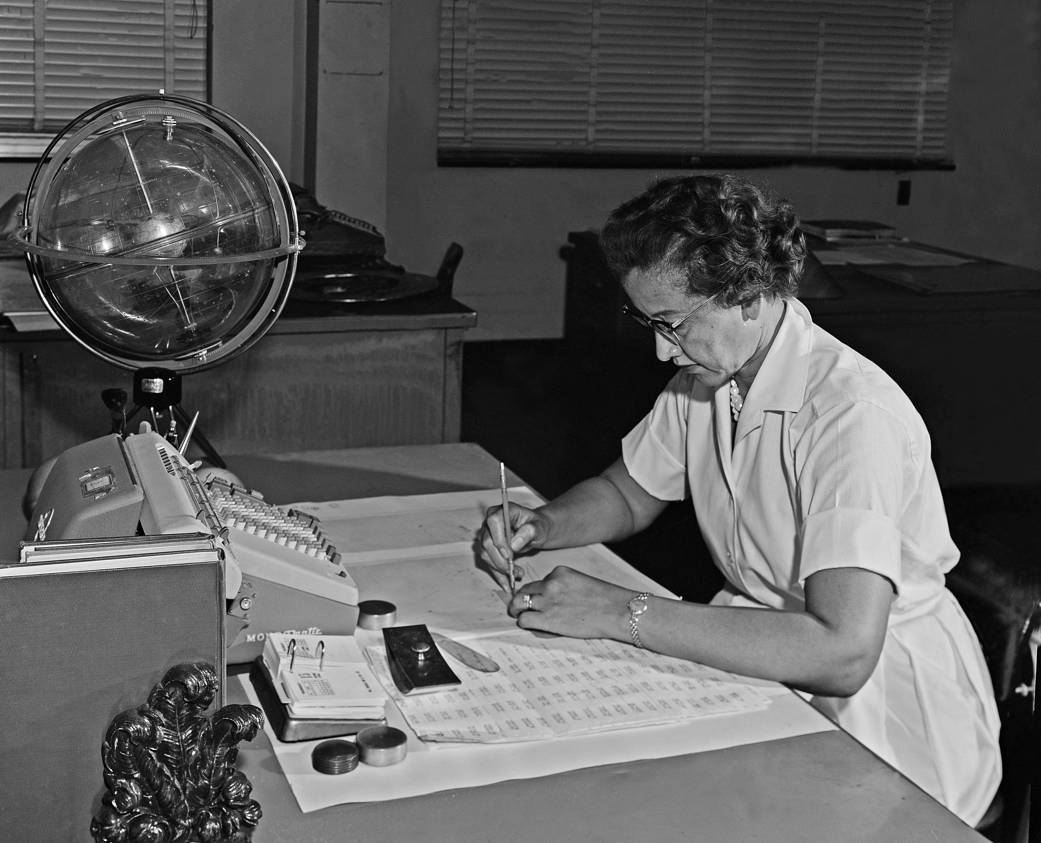
Image context: NASA's 1962 photograph of Katherine Johnson at her Langley desk is the right image for this article because it places her inside the year of Friendship 7 rather than in retrospective legend. The desk, papers, and celestial training device make the history look like what it was: not abstract inspiration, but sustained technical labor performed while human and machine calculation were being forced into one dependable system.[3]
Time anchors that make the story legible
- 1953: Johnson joined Langley's all-Black West Area Computing Section after NACA hired her as a research mathematician.[1][2]
- 1958: NACA became NASA, and Johnson's work moved further into the orbital and trajectory problems of crewed spaceflight.[1][2]
- May 5, 1961: Johnson calculated trajectory work for Alan Shepard's Freedom 7 mission, the first American human spaceflight.[3][4]
- February 20, 1962: Glenn flew Friendship 7, and Johnson verified the orbital equations that the mission depended on.[2][4]
- September 1962: NASA issued a technical note coauthored by Johnson on the first 500 days of the Echo I satellite and its rocket casing in orbit.[5]
- July 1964: NASA issued another technical note coauthored by Johnson on approximating flight-path angle during upper-atmosphere reentry.[6]
Before Friendship 7, Johnson had already moved inside the flight problem
One reason the Glenn anecdote can mislead is that it makes Johnson sound external to the main technical work, as though she only entered the story when the agency needed reassurance. NASA's own educational biography points the other way. Johnson began in the Guidance and Control environment where women computers worked problems assigned by engineers, but she stood out by asking questions that pushed her closer to the engineering briefings themselves.[1] That detail matters because it shows how she crossed a boundary common in mid-century technical institutions: the boundary between doing calculations and being allowed to know exactly what the calculations were for.
That boundary was racial as well as professional. The West Area section existed inside the segregated labor order of Langley, and Johnson entered it under Dorothy Vaughan's leadership.[2] The usual flattened retelling makes the setting look like a simple prelude to eventual recognition. The microhistory is harder than that. Johnson's later authority depended on technical excellence, but it also depended on moving through an institution that separated Black women into a computing pool while simultaneously relying on the accuracy of their work. Her career makes most sense when those two facts stay together.
By the time NASA entered the Mercury era, Johnson was already inside the new mission rather than outside it. NASA's image and news features credit her with trajectory work for Alan Shepard's Freedom 7 flight in 1961 and with orbital verification for Glenn's 1962 mission.[3][4] That sequence is important. It means Friendship 7 was not the first time she was trusted with crewed-flight math. The mission became famous because it condensed a larger transition already underway: human spaceflight had become computationally dense, electronic systems were becoming central, and the institution still needed a mathematician whose hand-derived reasoning everyone believed.
The Glenn story matters because it was about trust, not nostalgia
The popular version of the Friendship 7 episode sometimes sounds like a sentimental triumph of human intuition over cold machinery. The NASA record suggests something subtler. In one retelling, Johnson "verified the orbital equations" for Glenn's flight from blastoff to splashdown.[2] In another, Glenn wanted her to check the computer's numbers before launch.[4] Those accounts differ in emphasis, but they agree on the point that matters historically: early electronic computation had not yet become self-legitimating. Machine output still needed to pass through a human standard of intelligibility and credibility.
That does not mean Johnson represented an older world resisting technological change. The opposite is closer to the truth. She was part of the process by which technological change became governable. Engineers did not need someone to reject the machine; they needed someone who could translate machine output back into mathematical confidence. Johnson's importance lies there. She made it easier for an institution in transition to trust its own new tools.
This is also why the exact wording of the famous Glenn anecdote matters less than the structure behind it. The story survives because it captures a mixed computational regime. Friendship 7 did not emerge from pure hand calculation, and it did not emerge from unquestioned machine authority. It emerged from a layered system in which human computers, engineers, early electronics, mission planners, and astronauts all had to reach the same answer with enough confidence to let a person ride the result into orbit.[2][4]
The technical notes show Johnson was not only checking other people's math
If Johnson's legacy rested only on astronauts remembering that they trusted her, the historical record would remain anecdotal. It does not. In 1962, NASA published The Orbital Behavior of the Echo I Satellite and Its Rocket Casing During the First 500 Days, coauthored by Gertrude C. Westrick and Katherine G. Johnson.[5] The paper is technical and dry in the most useful way. It tracks the orbit of Echo I, compares the sphere and its rocket casing, measures perturbation, and analyzes how solar radiation pressure altered long-term behavior.[5] That kind of work is a reminder that Johnson's role was not merely ceremonial verification attached to famous astronauts. She was participating in the broader mathematical labor of making orbital behavior predictable over time.
The same point becomes sharper in 1964, when NASA published Approximate Solutions for Flight-Path Angle of a Reentry Vehicle in the Upper Atmosphere, coauthored by Jack A. White and Katherine G. Johnson.[6] Here the problem is no longer a one-off mission check but a guidance problem under computational constraint. The report argues that closed-form approximations were attractive partly because more elaborate guidance systems required more computer storage and component complexity than one might want.[6] That detail matters historically. It shows Johnson working not at the edge of computation but at its practical center, where mathematics, hardware limits, and flight safety met.
Taken together, the two technical notes change the scale of the story. They show a mathematician who moved from segregated computing pools into authorship on orbital-behavior and reentry-analysis problems at precisely the moment NASA was teaching itself how to think about sustained space operations.[5][6] The archive does not support the idea that Johnson was just a brilliant checker standing outside the main flow of aerospace history. It supports a harder conclusion: she helped make that history calculable.
What the biography/microhistory changes
Biography can easily become hero worship, and Johnson's public afterlife often pushes in that direction. One familiar version turns her into a lone genius; another turns her into an inspirational symbol recovered from institutional neglect. Both versions contain part of the truth, but neither is enough for history.
The microhistory of 1953 to 1964 gives a more exact account. Johnson entered NACA through a segregated labor system.[1][2] She pressed beyond the narrow expectations attached to that system by insisting on understanding the engineering problems behind the assigned math.[1] She became central to Mercury-era trajectory work, including the computational trust problem condensed in Friendship 7.[2][4] And the printed NASA record shows her moving from mission-critical verification into published orbital and reentry analysis.[5][6]
That sequence is the real achievement. Johnson was not the opposite of computing modernity. She was one of the people who made modern computing dependable enough for flight. When Glenn asked for a hand check, he was not reaching backward into a vanished era. He was relying on the mathematician who embodied the bridge between old and new methods. That is why the story lasts. It is not only about an individual triumph. It is about the moment when human judgment, institutional trust, and machine calculation had to be made to hold together before the capsule left Earth.[2][4]
Sources
- NASA, "Katherine Johnson: A Lifetime of STEM" — biographical overview of her 1953 hiring, question-asking inside Langley, and later flight-math work.
- NASA, "A Human Computer Hidden No More" — on West Area Computing, the Space Task Group, Friendship 7 verification, and Johnson's 26 research reports.
- NASA, "Katherine Johnson at Work, 1962" — image source page for the Langley desk photograph and summary of her Freedom 7, Friendship 7, and Apollo work.
- NASA, "NASA Dedicates Facility to Mathematician, Presidential Medal Winner" — on Johnson's Shepard trajectory work and the Glenn hand-check story.
- Gertrude C. Westrick and Katherine G. Johnson, The Orbital Behavior of the Echo I Satellite and Its Rocket Casing During the First 500 Days (NASA Technical Note D-1366, 1962).
- Jack A. White and Katherine G. Johnson, Approximate Solutions for Flight-Path Angle of a Reentry Vehicle in the Upper Atmosphere (NASA Technical Note D-2379, 1964).