Popular memory usually reduces Dwight Eisenhower’s January 17, 1961 farewell address to one phrase: the warning about the military-industrial complex. That line deserves its fame, but it can also flatten the speech that carries it. Read in full, the address is not a free-floating denunciation of militarism, and it is not an elderly general suddenly discovering the dangers of national security at the very end of his presidency. It is a tightly organized argument about proportion. Eisenhower accepts the permanence of Cold War danger, accepts the need for strength, and then asks how a republic can keep that strength from overrunning the constitutional life it is meant to defend.[1][2]
That makes the speech more interesting than the slogan version. Its center of gravity is balance: balance among national programs, balance between readiness and solvency, balance between expert systems and public control, and, finally, balance between security and liberty.[1] The famous sentence about unwarranted influence lands inside that wider architecture, not above it.
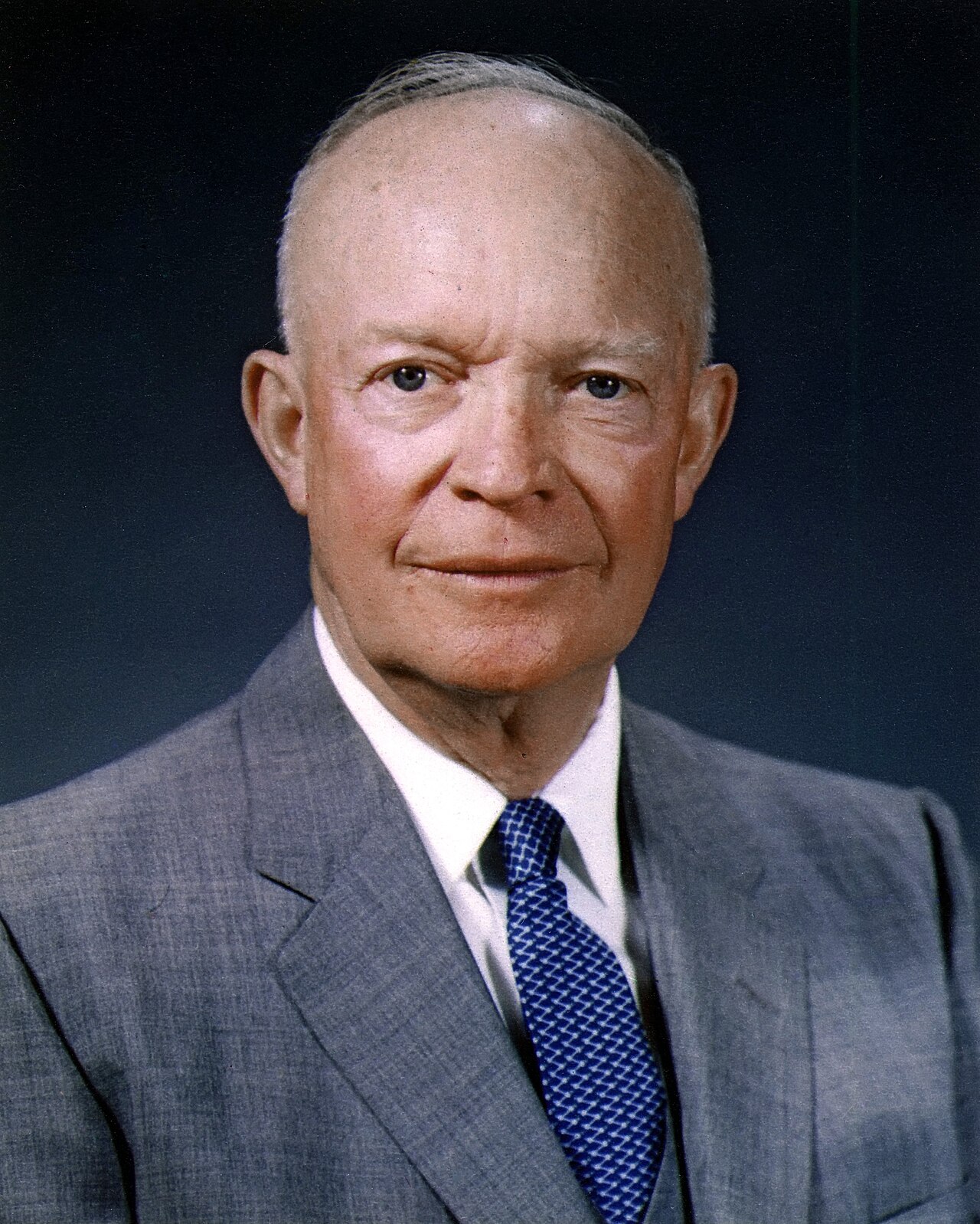
Image context: the hero image is Eisenhower’s official May 29, 1959 portrait. It works here because the speech’s authority came from a president who had spent eight years managing Cold War mobilization from the center of government rather than criticizing it from the outside.[6]
Time anchors that shape the speech
- January 1957: Eisenhower announces the Eisenhower Doctrine, widening the conditions under which the United States might use force in the Middle East.[5]
- October 4, 1957: the Soviet Union launches Sputnik-1, intensifying American fears of technological and missile inferiority.[4]
- July 1958: U.S. troops enter Lebanon in the first real test of the Eisenhower Doctrine’s logic.[5]
- January 17, 1961: Eisenhower delivers the farewell address after years of governing inside a permanent-security environment.[1][2]
The speech’s first move: strength is necessary, but it must stay in proportion
The first thing to notice is what Eisenhower does not do. He does not frame the Cold War as a misunderstanding that can be wished away, and he does not ask his successor to dismantle the defense state. On the contrary, the speech openly states that the United States has been compelled to create a permanent armaments industry of unprecedented scale and to maintain a large military establishment in peacetime.[1] That is the factual premise of the whole address.
This matters because the warning only makes sense after that concession. Eisenhower is not talking as a pacifist outsider. He is talking as the president who lived through Korea’s aftermath, authorized the Eisenhower Doctrine, responded to Lebanon in 1958, and governed through the technological panic sharpened by Sputnik.[4][5] In other words, the speech is strongest when read as the self-correction of a statesman who knows the machinery from within.
His key concern is therefore not military power in the abstract. It is imbalance. The Miller Center transcript preserves the structure clearly: after acknowledging danger, he urges the nation to maintain “balance in and among national programs.”[1] That phrase is easy to skip because the more dramatic noun phrase comes later. Yet it is the speech’s operating instruction. Defense must exist, but it cannot consume the civic and fiscal order around it.
That is also why the address carries a repeated undertone of restraint. Eisenhower worries about the burden of armament on resources, about short-term emergency habits hardening into normal practice, and about a public culture that might surrender judgment to institutional momentum.[1] The speech does not imagine safety through innocence. It asks for a disciplined democratic supervision of power already deemed necessary.
Why the famous phrase distorts the speech when lifted out of sequence
The address is often remembered as if Eisenhower built toward one theatrical revelation. The archival trail suggests something more deliberate and more sustained. The Eisenhower Presidential Library’s online document set shows that the farewell address was not improvised in the final week alone; the project stretches backward through memoranda, outlines, and draft material reaching into May 1959.[2] The Presidential Library’s subject guide adds further weight: the surviving files include background suggestions from 1959-1960, a large cluster of drafts, and multiple annotated versions from January 1961.[3]
That draft history changes the tone of the warning. The phrase was not a stray flourish that happened to survive editing. It emerged within a planned farewell framework that had been under consideration for a long time.[2][3] Eisenhower was shaping his closing argument about what a national-security republic had become.
Inside the speech itself, the “military-industrial complex” line appears after a sober description of a structural novelty: before the twentieth century, the United States had not maintained a permanent armaments industry on this scale in peacetime, but Cold War conditions had fused that industry with a standing military establishment.[1] The danger, then, is not merely that factories exist or that officers exist. The danger is that a durable web of institutions, contracts, and habits may acquire decision-making weight beyond democratic control.
That institutional reading is more precise than the popular afterlife of the phrase. Eisenhower is warning about how government can be bent by the regularized partnership of military need, industrial supply, and political routine.[1][7] The target is not one villain. It is a system of incentives that becomes normal precisely because it is continuous.
The “scientific-technological elite” matters just as much
A second distortion enters when readers stop at the better-known phrase and leave the next movement of the speech unread. Eisenhower’s warning does not end with the military and industry. He turns immediately to research, federal funding, universities, and the possibility that public policy itself may become captive to a “scientific-technological elite.”[1]
That line makes much more sense when placed in the late 1950s. The State Department’s historical summary of Sputnik shows how the Soviet launch on October 4, 1957 intensified American fear that technological capability had become inseparable from military survival.[4] Missiles, satellites, laboratories, and defense planning increasingly belonged to one strategic environment. At the same time, the Eisenhower Doctrine and its 1958 Lebanon test case reflected an executive branch willing to think globally and act quickly in the name of containment.[5] Put those pressures together and the speech’s scope becomes clearer: Eisenhower is tracing not one danger but a whole ecology of permanent mobilization.
This is why the address is not anti-science. Eisenhower does not sneer at research, and he does not imagine a modern state without technical expertise.[1] His warning is constitutional rather than anti-intellectual. When government depends heavily on specialized knowledge and long procurement chains, ordinary citizens can begin to feel that policy belongs elsewhere, in closed systems of experts, contractors, and planners. The speech asks how democracy can survive that feeling.
His answer is strikingly political. He does not end with a bureaucratic fix. He ends with the demand for an “alert and knowledgeable citizenry.”[1] In context, that line is not ceremonial uplift. It is the only counterweight he trusts. If permanent-security institutions are here to stay, then public vigilance must be permanent too.
Two strong ways to read the address
Interpretation A: an antiwar prophecy
This reading emphasizes the speech’s language of unwarranted influence and misplaced power. It sees the address as a conservative president’s late recognition that the United States had built machinery capable of distorting democracy long after the emergency that justified it.[1][7]
That interpretation catches something real. Eisenhower clearly fears the political consequences of permanence. He thinks structures created for defense can outgrow their proper place and begin shaping the republic in their own image.[1]
Interpretation B: a stewardship speech from inside the Cold War state
This reading gives priority to the speech’s acceptance of deterrence, its respect for defense requirements, and its repeated emphasis on balance rather than rollback.[1][5] On this account, Eisenhower is drawing guardrails for a system he still thinks the nation needs.
That interpretation also captures something central. The speech does not urge withdrawal from global responsibility. It urges proportion, accountability, and civic supervision.
Working assessment
The strongest reading is sequential. Eisenhower’s farewell address is a warning because it is first a stewardship speech. Its authority comes from the fact that the speaker had helped normalize permanent mobilization and then concluded that democratic life required a permanent discipline over that normalization.[1][2][3] Once the speech is compressed into one phrase alone, its hardest achievement disappears: it tried to imagine how a republic could remain armed, technologically advanced, globally engaged, and still recognizably self-governing.
Why the speech still reads sharply
Many historical documents survive because they supply a reusable slogan. Eisenhower’s farewell address survives more deeply than that. It captures a recurring problem of modern states: institutions built for emergency become durable, respectable, and technically complex, while the public capacities needed to supervise them weaken by comparison.[1][4][5]
That is why the speech still matters as a primary source. It shows a president at the end of power trying to set a boundary he knew could not be kept by presidents alone. The final lesson is less romantic than the speech’s afterlife sometimes suggests. Security has to be organized. Expertise has to be funded. Force has to be available. Yet none of those facts relieves a democracy of the work of keeping means and ends in proportion. That was Eisenhower’s final argument on January 17, 1961.[1][2]
Sources
- Miller Center, "January 17, 1961: Farewell Address" — transcript and summary of the speech.
- Dwight D. Eisenhower Presidential Library, "Farewell Address" — online documents, audio, reading copy, drafts, and post-speech correspondence.
- Dwight D. Eisenhower Presidential Library, Farewell Address (including the use of the phrase "military-industrial complex") — subject guide listing the relevant draft files and archival boxes from 1959-1961.
- Office of the Historian, U.S. Department of State, "Sputnik, 1957" — Cold War technology shock and intensified missile-space competition.
- Office of the Historian, U.S. Department of State, "The Eisenhower Doctrine, 1957" — the administration's willingness to use U.S. force in Middle Eastern crises and the 1958 Lebanon test case.
- Wikimedia Commons, "File:Dwight D. Eisenhower, official photo portrait, May 29, 1959.jpg" — image source page for the article photograph.
- James Ledbetter, Unwarranted Influence: Dwight D. Eisenhower and the Military-Industrial Complex — Yale University Press book page.