The Antarctic Treaty is often remembered through its cleanest slogan: a continent reserved for peace and science. That is true, but it is not enough to explain why the bargain worked. In 1959, Antarctica was not politically empty. Seven countries had territorial claims, some of them overlapping; the United States and the Soviet Union preserved bases for future claims without recognizing anyone else's; and the Cold War had already taught governments to treat remote scientific stations as strategic infrastructure.[1]
The treaty's durable mechanism was narrower and more practical than a dream of global harmony. It took a continent where sovereignty could have been performed through bases, maps, flags, military logistics, and symbolic occupation, then changed the reward system. Scientific work would count as the legitimate form of presence. Military activity would be barred except where equipment or personnel supported peaceful research. New or enlarged territorial claims would not accumulate legal weight while the treaty remained in force. Stations, equipment, ships, aircraft, and scientific results would become visible to other parties.[1][2]
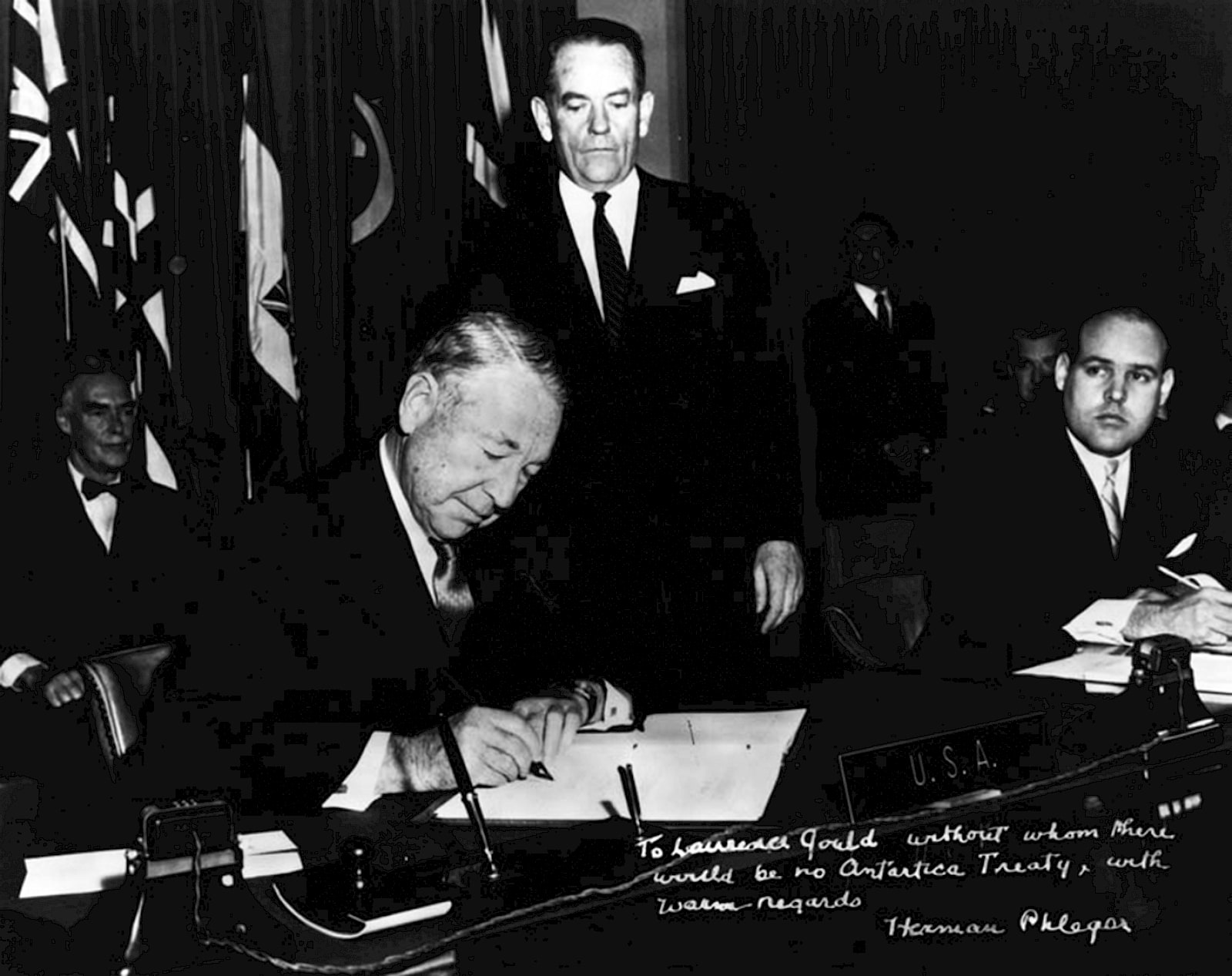
The key timeline is compact. During the International Geophysical Year of 1957-58, twelve nations operated Antarctic programs and built a habit of cooperation under extreme logistics.[3][4] On December 1, 1959, those twelve governments signed the Antarctic Treaty in Washington. On June 23, 1961, it entered into force after the original ratifications were completed. In July 1961, the first consultative meeting in Canberra began turning the treaty text into operating practice.[5][7]
Image context: the signing photograph belongs here because the Antarctic Treaty was a paperwork solution to a physical problem. A room in Washington had to govern ice shelves, bases, aircraft, radios, nuclear anxieties, and overlapping sovereignty claims without pretending those claims had disappeared.[8]
The IGY made presence legitimate and risky
The International Geophysical Year did the diplomatic work before the diplomats finished the treaty. It made Antarctic science visible as a shared enterprise. The U.S. National Science Foundation summarizes the operating scale: during the 1957-58 program, twelve nations established about fifty Antarctic research stations, and the later U.S. Antarctic Program grew out of that moment.[3] The Australian Antarctic Program frames the same period as a proof of concept: the IGY demonstrated that multiple nations could cooperate in Antarctic research and helped create the conditions for the 1959 treaty.[4]
That cooperation had a double edge. Science created trust, but it also created facts on the ground. A station is not only a place to collect data. It is a runway, radio room, fuel cache, weather post, flagpole, and wintering claim of competence. In a region where sovereignty was disputed and where permanent civilian populations did not exist, scientific occupation could easily become territorial theater.
The treaty's first move was therefore to keep the useful part of the IGY while limiting its claim-making power. Article II preserved freedom of scientific investigation and cooperation. Article III required scientific observations and results to be exchanged and made freely available. The same treaty also prohibited military measures, nuclear explosions, and radioactive waste disposal in the treaty area.[1][2]
That combination matters. Science was not treated as decoration added to a peace treaty. Science became the acceptable way for states to be present in Antarctica. A government could continue sending people, ships, aircraft, and equipment, but the public justification had to run through research, logistics for research, and exchange with other parties. The treaty converted presence from a sovereignty signal into an activity that other governments could inspect, join, and evaluate.[1]
Article IV froze claims without solving them
The most important political trick was Article IV. The treaty did not ask claimants to renounce their claims. It did not ask non-claimants to recognize them. It did not ask the United States or Soviet Union to give up their reserved positions. Instead, it protected all those positions at once and declared that acts carried out while the treaty was in force would not become a basis for asserting, supporting, or denying sovereignty. It also blocked new claims and enlargement of existing claims.[1]
This was not a settlement. It was a pause button with legal teeth. The claimant states could sign because their older positions were not erased. The non-claimants could sign because they were not forced to concede those claims. Washington and Moscow could sign because neither had to surrender future options. The price was that everyone had to accept a rule against turning ongoing Antarctic activity into fresh sovereignty leverage.[1][5]
That is why the treaty should be read less as a border agreement than as an anti-escalation mechanism. It separated use from title. A station could produce weather data, geophysical measurements, and logistical reach. It could not, by itself, make a stronger claim. A traverse could cross disputed territory. It could not, by itself, redraw the map. The mechanism worked by preventing ordinary operations from becoming evidence in a legal land rush.
The move was especially useful because the alternative was not a clean global administration. Attempts to settle ownership outright would have forced every dormant disagreement into the open. Article IV kept the disagreement visible but non-productive. It made the unresolved status of Antarctica governable.
Science became the voting credential
The treaty also tied political voice to research activity. The Antarctic Treaty Secretariat notes that participation in decision-making beyond the original signatories depends on demonstrating interest in Antarctica by conducting substantial scientific research there.[2] That rule is easy to miss because it sounds procedural. It is actually one of the treaty's strongest incentives.
In most territorial systems, political authority follows sovereignty. In the Antarctic Treaty System, consultative standing follows scientific contribution. A state that wants full participation has to show up with research, logistics, and long-term institutional capacity. That does not remove national interest, but it channels ambition through a publicly legible form of work.
The result was a governance bargain with a built-in filter. Science did not make states selfless. It made their claims to influence auditable. Research stations, published observations, field programs, and cooperation with other national programs became the currency of standing. The article's quiet mechanism is that legitimacy moved away from drawing a line on a map and toward maintaining a program other parties could see.
This also explains why the treaty could grow. NSF says that fifty-eight nations have pledged to uphold the treaty today.[3] The number matters less than the path by which participation became meaningful. The treaty did not need every party to own ice. It needed parties to accept the rule that Antarctic presence would be judged by peaceful use, science, information exchange, and inspections.[1][2]
Inspection made trust routine rather than sentimental
The inspection provisions are the treaty's hard edge. The Antarctic Treaty Secretariat summarizes Article VII as opening all areas of Antarctica, including stations, installations, and equipment, to inspection at all times.[1] President John F. Kennedy emphasized the same point when the treaty entered into force on June 23, 1961: observers could be sent anywhere in Antarctica, and overflight rights covered all areas.[7]
The point was not that inspectors would constantly police every hut and airstrip. Antarctica made that impossible. Distance, weather, aircraft range, icebreakers, and seasonal logistics all limited what any party could do. A State Department memorandum from October 1961 shows officials thinking through exactly that problem: inspection rights were valuable, but an inspection trip could divert scarce ships or aircraft from scientific programs.[6]
That memo is revealing because it treats inspection as a diplomatic habit, not only a crisis tool. U.S. officials argued that inspections could be normal activity under the treaty and might reduce suspicion precisely because they were routine. They also worried that exercising inspection rights without evidence of wrongdoing could make cooperation look colder than it was.[6]
The tension is the mechanism. Inspection had to be real enough to deter hidden militarization, but ordinary enough not to become an accusation every time it happened. The treaty's genius was to make access reciprocal. A station was still national, but not sealed. Aircraft and ships still belonged to governments, but their Antarctic use could be reported and observed. In a Cold War arms-control context, that was unusually concrete.
The first meeting turned text into administration
Entry into force did not finish the system. It started the administrative phase. A State Department memorandum from July 28, 1961 records that the treaty entered into force on June 23 after ratifications by Argentina, Australia, and Chile were deposited, and that the first consultative meeting met in Canberra from July 10 to 24. The same memo says the meeting approved recommendations related mainly to scientific and logistical cooperation, conservation of living resources, preservation of historic sites, and exchange of information about nuclear equipment and techniques in Antarctica.[5]
Those topics show how quickly the treaty moved from grand principle to operational housekeeping. Antarctic governance had to manage radio systems, supply lines, historic huts, scientific plans, conservation problems, and information notices. The treaty did not need to answer every future question in 1959. It needed a meeting system that could turn new problems into recommendations before they became territorial tests.
That is the final causal link. The treaty lasted because it was not only a ban. It was a machine for recurring coordination. Article IV froze claims. Articles II and III made science the common language. Article VII made verification possible. The consultative meetings gave the parties a place to update practice without reopening the sovereignty settlement every year.[1][2][5]
The limits remained real. The system did not abolish national competition, resource temptation, environmental risk, or unequal capacity. It did not make Antarctica a world park in 1959. Later agreements, especially environmental rules, had to do additional work. But the original treaty made that later work possible by keeping the central sovereignty problem from swallowing every discussion.
The Antarctic Treaty therefore belongs in the history of institutions that succeeded by refusing to solve the impossible question directly. It did not decide who owned Antarctica. It made ownership less useful as a daily operating principle. In its place, it rewarded science, required visibility, normalized inspection, and made new sovereignty gains legally inert. That is why a Cold War treaty signed over a continent of ice became more than a pause in rivalry. It became a way to make rivalry behave.
Sources
- Secretariat of the Antarctic Treaty, "The Antarctic Treaty" - official overview of signature, entry into force, current parties, Articles I-IV, and Article VII inspection language.
- Secretariat of the Antarctic Treaty, "Science and Operations" - science as the treaty system's main activity, Articles II and III, and consultative participation through substantial scientific research.
- U.S. National Science Foundation, "U.S. Antarctic Program" - history of USAP, the 1957-58 IGY station-building context, original treaty nations, and current treaty participation.
- Australian Antarctic Program, "International Geophysical Year (IGY) and International Polar Year (IPY)" - IGY cooperation, Antarctic science context, and the transition toward the 1959 treaty.
- U.S. Department of State, Office of the Historian, FRUS 1961-1963, Volume XXV, Document 455 - July 1961 memorandum on entry into force, the first Canberra consultative meeting, and early recommendations.
- U.S. Department of State, Office of the Historian, FRUS 1961-1963, Volume XXV, Document 456 - October 1961 memorandum on Article VII inspection rights, logistics, and early treaty practice.
- The American Presidency Project, "Statement by the President Upon the Entry Into Force of the Antarctic Treaty" - John F. Kennedy's June 23, 1961 statement on peaceful use, inspection, science, nuclear restrictions, and territorial claims.
- Australian Antarctic Program, "60th anniversary of the Antarctic Treaty" - archival signing photograph of Herman Phleger and summary of Australia's role as an original signatory.