The bill came to $11,680, before interest and deductions. Jourdon Anderson counted thirty-two years of his own work and twenty years of his wife Mandy's. Then he gave his former enslaver an address in Dayton, Ohio, where the money could be sent. A request to return to a Tennessee plantation had become a demand to settle its accounts.[1]
Anderson's reply, dated 7 August 1865, is famous for its dry courtesy. The man addressed as Colonel P. H. Anderson had apparently promised to do better for him than anyone else could. Jourdon answered by asking what that promise meant in wages, whether his daughters would be safe, and whether his children could attend school. Read in that sequence, the letter asks a precise question: what evidence should a family require before trusting someone who once owned them?[1]
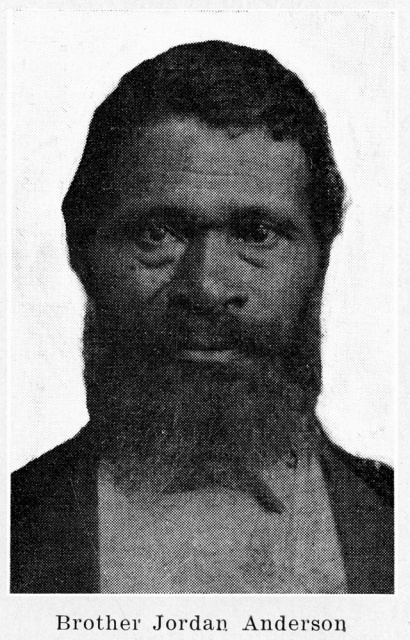
A voice that reached print
The version examined here occupies pages 265–267 of Lydia Maria Child's The Freedmen's Book, published in Boston in 1865. Its introductory note says, “Written just as he dictated it.” That is the edition's claim about its transmission; readers encounter a printed transcription, with the mediation that implies.[1]
An Associated Press investigation published in July 2012 connected the letter to Anderson's documented life and identified Dayton banker and abolitionist Valentine Winters as his reported collaborator. It also traced publication to the Cincinnati Commercial in August 1865. Those findings support reading the letter as Anderson's account, while leaving room for uncertainty about an intermediary's contribution to its final wording.[2]
That distinction matters because admiration has sometimes turned into disbelief. When the letter circulated widely online early in 2012, researchers checked census and newspaper records against its names and circumstances. Pew Research Center documented both the doubts and the corroborating discoveries. Biographical matches strengthen attribution; they cannot independently authenticate every phrase. The reading that follows therefore concerns the argument preserved in the published text.[3]
Freedom was already in hand
Before considering payment, Anderson removes one supposed benefit from the proposed bargain. He says he obtained his free papers in 1864 from the military authority at Nashville. His former enslaver's offer of freedom consequently provides “nothing to be gained on that score.” The invitation assumes a power to grant what Anderson already possesses.[1]
His account of Ohio supplies the standard against which any offer must be judged. He receives twenty-five dollars a month, together with food and clothing. His children attend school. Mandy is called “Mrs. Anderson.” That small parenthesis belongs beside the wage figure: recognition of his wife's standing helps describe what the household has gained.[1]
The passage also preserves discomfort. Other people's references to the children's former enslavement hurt them. Ohio is not presented as a place where prejudice has vanished. Yet Anderson can compare circumstances and ask whether a move would serve his family's interests. The letter exercises that freedom of judgment before its recipient has answered a single question.[1]
Making a promise pay its debts
Mandy's fear introduces the central demand. She wants proof that the colonel will treat them justly. The letter then shifts into the plural: “we have concluded to test your sincerity.” The household has discussed the offer and set its own condition.[1]
The arithmetic makes the condition unusually concrete. At the rates Anderson proposes, his thirty-two years at twenty-five dollars a month produce $9,600. Mandy's twenty years at two dollars a week produce $2,080, using fifty-two weeks a year. Together they yield the stated $11,680. These are retrospective valuations of labor performed under slavery, rather than a record of wages previously agreed and left unpaid.[1]
Anderson asks for interest on the withheld earnings. He also allows deductions for clothing, three visits from a doctor to him, and a tooth pulled for Mandy. The specificity is devastating. Expenses an enslaver might invoke as evidence of care become small entries against decades of uncompensated work. Accepting them into the calculation exposes how little they answer the larger claim.[1]
The proposed delivery through Adams's Express, care of Winters in Dayton, gives the demand the ordinary form of a transaction. There is an amount, an adjustment, a carrier and a destination. The colonel has been offered a way to demonstrate the generosity he advertises.[1]
Anderson then states the connection between past and future directly: “If you fail to pay us for faithful labors in the past, we can have little faith in your promises in the future.” The sentence makes the old account relevant to the new offer. A history of taking labor without payment is evidence about the reliability of another promise.[1]
The bill can also be read as a condition intended to make return impossible. Its force survives either reading. Whether Anderson expected payment or expected refusal, he made his former enslaver's conduct the test. The surviving text establishes that demand; it does not establish a willingness to return if the money arrived.[1]
What money could not settle
The questions that follow keep the bill from becoming a complete price for the family's return. Anderson asks about the safety of Milly and Jane and invokes what happened to Matilda and Catherine. He does not supply their full stories. His warning about the young masters' violence nevertheless makes the danger to his daughters explicit, and he says he would accept starvation before exposing them to it.[1]
Schooling comes next. Anderson asks whether schools for Black children have opened in the neighbourhood, then names his children's education as the great desire of his life. A better wage could not by itself satisfy these conditions. The proposed destination would have to offer safety and a future for the children as well.[1]
The closing request to thank George Carter for taking away the colonel's pistol returns the reader to an earlier allegation: Anderson says his former enslaver shot at him. The courtesy carries an accusation through to the signature. Any promise of kind treatment must be read against that remembered act.[1]
Child's introductory address to The Freedmen's Book hoped that readers would read aloud to others. In that setting, Anderson's reply could travel beyond its named recipient as an example of a freed family's judgment.[1] Its lasting force lies in the work its questions perform. The colonel must name the wage, account for the past and answer for the children's safety. The family in Dayton gets to decide whether the answers are enough.
Sources
- Jourdon Anderson, “Letter from a Freedman to His Old Master,” dated 7 August 1865, in Lydia Maria Child, The Freedmen's Book (Boston: Ticknor and Fields, 1865), pp. 265–267; also Child's introductory address—primary text, reproduced by Project Gutenberg.
- Allen G. Breed and Hillel Italie, Associated Press, “How did ex-slave's letter to master come to be?” The Salt Lake Tribune, 14 July 2012—documentary research, reported dictation and publication history, and the undated portrait.
- Sovini Tan, “Social Media Share a History Lesson,” Pew Research Center, 9 February 2012—online circulation, authenticity questions and research in census and newspaper records.
- Wikimedia Commons, “Jordan Anderson Image.jpg”—archival photograph, photographer unknown; file record credits Dayton History Books and records digitization in February 2012.