At 6:52 p.m. on 19 January 1917, an explosion at Brunner Mond's TNT works tore through Silvertown, beside London's docks. The local fire station was destroyed along with the homes of firemen. Seventy-three people died; hundreds were injured. A district that needed rescuing had lost part of the machinery intended to rescue it.[1]
The response spread outward into hospitals, churches, docks and government offices. Within months, another question had emerged: when public money restored a damaged house, how much of its old inadequacy should return with it? Following the recovery from the first hospital arrivals to the parliamentary exchanges that summer shows how quickly emergency decisions acquired lasting consequences.[6]
Beds before buildings
The danger had arrived before the fire. Britain's shell shortage in 1915 encouraged the hurried conversion of existing industrial premises to explosives production. Brunner Mond's management reluctantly accepted the work. Its Silvertown factory stood only about 200 yards from workers' cottages, near wharves holding other combustible materials. The factory and the neighbourhood shared the consequences of that wartime choice.[1]
At the London Hospital, a police request brought doctors and dressers together within minutes. Transport was harder: staff searched for taxis and a passing car owner volunteered. House governor E. W. Morris described the response in The Hospital on 27 January.[2]
Poplar Hospital, already full, sent patients onward. Engineers and orderlies assembled spare bedsteads; nurses prepared wards and corridors. Casualties arrived chiefly on motor-lorries in bitter cold; coffee circulated among their helpers. Morris recorded sixty treated and thirty-five admitted—figures for his hospital, not the disaster.[2]
When arrivals slowed, returning doctors reported that fire and wreckage prevented access to victims. Quiet did not mean rescue was complete. Whitechapel Infirmary offered lodging for people needing warmth rather than medical treatment. Finding somewhere for uninjured survivors to spend the night was already part of the response.[2]
Schools and churches became temporary accommodation. At the Barking Road Wesleyan Methodist church, photographs preserved by Newham's archives show food being distributed and an improvised surgery in the vestry. Rooms built for other purposes became places of care.[1]
The fire outlasted the explosion
An Explosion Emergency Committee was established the following day. Alongside relief for residents came the need to keep goods moving: grain traffic was redirected through other docks. The damaged district belonged to a port supplying a country at war, so recovery involved both households and cargoes.[3]
Tugboats also carried injured people to hospital. The waterfront's transport could assist the rescue even while its storage buildings burned. Equipment already at work in the docks became part of the neighbourhood's emergency provision.[3]
The Port of London Authority's Dock and Warehouse Committee took stock on 23 January. Its record, quoted in London Museum's catalogue of the resulting photograph album, distinguished blast damage from fires spread by hot metal and burning debris. Numerous sheds had been destroyed; granaries and transit silos were damaged. Six PLA employees had been killed or subsequently died of injuries, and forty-four were injured.[4]
The record separately counted four other people killed inside the dock area and fifteen injured. Its categories distinguished employees from others caught within the same damaged premises. Neither group represented the whole neighbourhood.[4]
That boundary matters when reading a disaster through an institution's archive. The PLA's chief engineer was instructed to obtain photographs for a board meeting on 22 March. The camera would make damage inspectable by people who had not stood among it. The album's administrative purpose helps explain why particular buildings and views survive in such detail.[4]
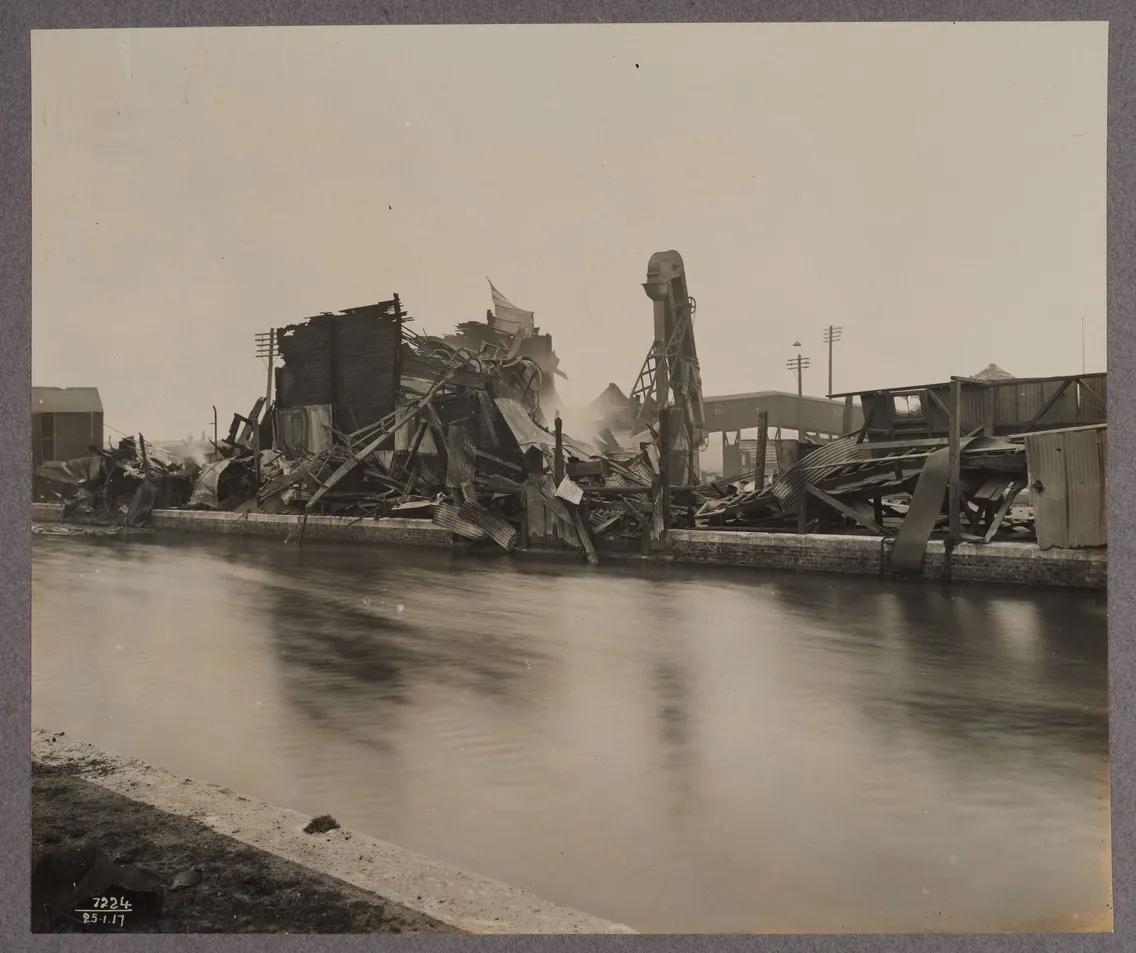
John H. Avery & Co.'s photograph of 25 January belongs to that extended aftermath. D Silo had been destroyed by fire, but destruction had not ended the burning. The museum's object record cites a report by the PLA's chief police officer on 8 February: the silo and Vernon's Mills were still alight, despite the attendance of more than a hundred firefighters.[5]
The dated photograph therefore resists the apparent finality of a view of ruins. It records a place still undergoing the disaster. A shattered building could remain dangerous long after the blast had passed, while officials elsewhere were already organising its replacement. The sequence was overlapping: firefighting, recording losses and restoring use proceeded on different schedules.
What counted as a repaired home?
By mid-February, more than 1,700 men were working on house repairs. London Museum's account places the completion of most of this work by August, while repairs at Royal Victoria Dock continued into the 1920s. Even the physical recovery had more than one endpoint.[3]
In Parliament on 6 July 1917, First Commissioner of Works Sir Alfred Mond gave the estimated expenditure on Silvertown reconstruction as £130,000. Lord Henry Cavendish-Bentinck challenged the purpose of that spending: was the government perpetuating housing conditions damaging to public health?[6]
Mond answered with the immediate predicament of residents who had nowhere else to go. He acknowledged that rebuilding elsewhere as a garden city would be more desirable, but said wartime conditions made it impossible. The exchange exposes two different tests of success. One asked whether people could return indoors promptly. The other asked whether the restored neighbourhood would be fit to live in for years afterward. A programme could meet the first test while leaving the second unresolved.[6]
The argument became more concrete on 30 July. Mond described his department's task as making houses "winter and waterproof" and said work had begun within three days of the explosion. Government had instructed it to restore private property, rather than redesign it at public expense. He rejected accusations of indifference and maintained that conditions had improved.[7]
Cavendish-Bentinck pressed complaints about damp and defective housing. Local MP Will Thorne added a revealing qualification: he reported assurances from borough officials that the repairs were an improvement, yet argued that the wider district needed comprehensive rebuilding. Improvement and inadequacy could coexist. These parliamentary statements establish the dispute; they cannot substitute for inspections of every repaired house. Assessing the competing claims would require those inspections and residents' accounts, alongside the official defence.[7]
Silvertown's recovery began with finding vehicles, assembling beds and opening rooms to strangers. It reached a harder boundary when restoring shelter meant deciding what standard of home survivors could expect. The emergency made speed indispensable. It also gave the familiar shape of the old neighbourhood a powerful advantage over plans for something better.
Sources
- Historic England, "The Silvertown Tragedy: Explosion on the Home Front," 19 January 2017 — factory setting, destruction and archival photographs of emergency relief.
- E. W. Morris, "The Explosion on January 19," The Hospital, 27 January 1917, pp. 343–344.
- London Museum, "Silvertown 1917: London's largest explosion" — emergency committee, redirected grain traffic and the different timetables of housing and dock repairs.
- London Museum, Silvertown explosion photograph album, PLA/PLA/ENG/3/3/4 — committee records and the photographic commission.
- London Museum, D Silo photograph, 25 January 1917, PLA/PLA/ENG/3/3/4/3 — image provenance and continuing fires.
- House of Commons, "Silvertown Explosion (Reconstruction)," Hansard, 6 July 1917 — estimate and rehousing debate.
- House of Commons, "Consolidated Fund (No. 4) Bill," Hansard, 30 July 1917 — Silvertown exchanges between Cavendish-Bentinck, Mond and Thorne near the end of the debate.