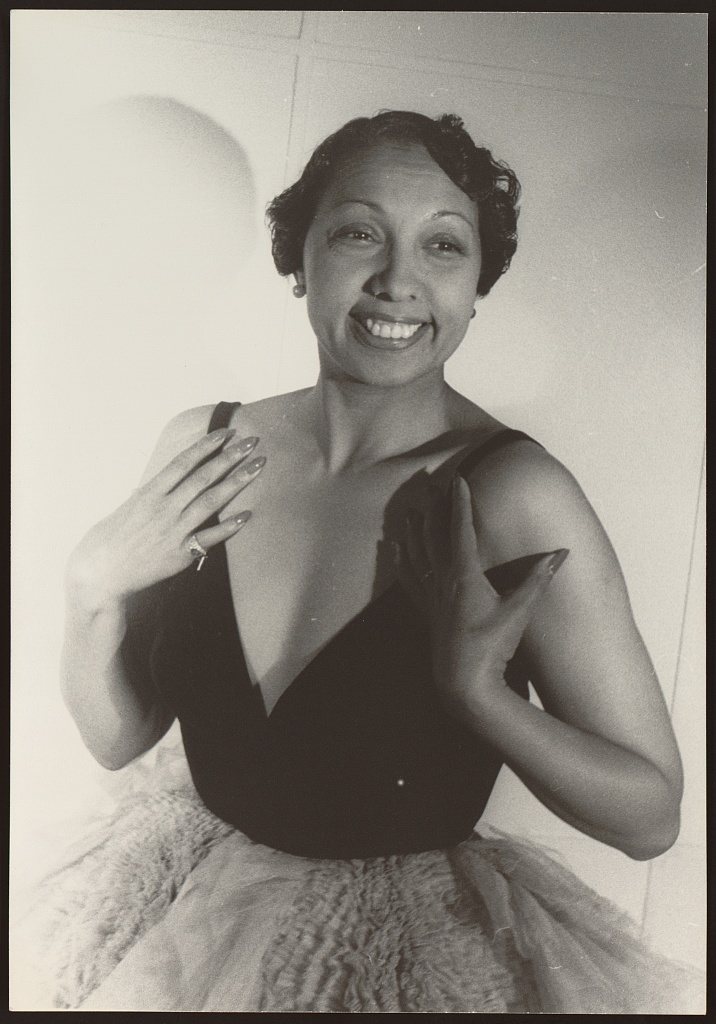
The National Park Service page on Josephine Baker opens with a Library of Congress portrait that captures the quality most likely to mislead a reader.[1] Baker looks light, poised, and socially effortless. That surface is real. It is also incomplete. If we remember her only as the Jazz Age performer in Paris, we miss the harder historical point. Baker mattered because she learned how to make fame itself portable. She turned celebrity into a form of movement that could cross jurisdictions: out of the segregated United States, into French stardom, through wartime intelligence circuits, and back onto the stage of American civil-rights politics.[1][2]
That is the sharp question this microhistory tries to answer. Why did Baker's life carry such unusual political weight across such different settings? Plenty of artists became famous. Plenty of wartime helpers took risks. Plenty of civil-rights supporters lent their names to a cause. Baker's historical force came from joining those worlds into one operating route. Paris gave her a scale that St. Louis and New York had refused.[1][2] The French Resistance then used that scale as cover.[2] When she later returned to American public life, she did not arrive as a local petitioner. She arrived as a Black international celebrity and decorated war figure whose life abroad had already exposed the smallness of segregation at home.[1][3][4]
Seen that way, Baker's biography works best through mobility rather than glamour. The key historical thread is not simply performance, espionage, or activism taken one at a time. It is the way she converted movement between stages, countries, and publics into leverage that other activists and officials could not easily replicate.[1][2][3]
Image context: the cover uses the archival portrait featured by the National Park Service.[1] It fits this essay because the argument begins with appearance and then moves behind it. Baker's smile mattered historically because it traveled with her into rooms where politics usually hid behind etiquette.
Timeline anchors
- June 3, 1906: Freda Josephine McDonald is born in St. Louis, Missouri.[1][2]
- 1923: she reaches New York and works as a chorus dancer before looking abroad for larger opportunities.[1]
- 1925: Baker moves to Paris, where she becomes a major star in a social world less formally segregated than the United States.[1][2]
- 1936: she becomes a French citizen, further shifting the legal and political terrain in which she moves.[1]
- 1940-1941: after the German advance, Baker leaves Paris, aids refugees in the south of France, and begins intelligence work linked to Jacques Abtey and the French Resistance.[2]
- 1944-1945: her wartime courier work through places such as Lisbon and London culminates in postwar decorations from Charles de Gaulle.[2]
- July 2, 1952: Baker headlines a benefit concert for the National Council of Negro Women in Washington, D.C.[1]
- August 28, 1963: the Library of Congress records Baker at the podium during the March on Washington for Jobs and Freedom.[4]
- November 30, 2021: France symbolically places Baker in the Panthéon, explicitly binding her memory to the Resistance, U.S. civil rights, and women's emancipation.[3]
Paris did more than make her famous
Baker's early life matters because it explains why mobility became the central instrument of her later politics. The National Park Service summary traces the familiar baseline: low-income childhood, early work, street performance, then chorus roles in New York before the move to Paris in 1925.[1] On one level, that is a standard ascent story. On another, it is a jurisdiction story. In the United States, Baker's talent was filtered through a racially segregated entertainment economy that still expected Black performers to occupy narrow and often humiliating slots.[1] Paris did not erase exoticism or exploitation, but it changed the scale of what her public presence could do.
That shift is why her French success should not be read as decorative prelude. In Paris, Baker stopped being a replaceable chorus figure and became an international name.[1][2] The move gave her money, recognition, and social reach. It also gave her comparative evidence. She had lived inside an American order that treated Black brilliance as background labor, then entered a European capital willing to make her hyper-visible, profitable, and symbolically modern.[1][2] That contrast did not produce a simple fairy tale of liberation. It produced a working political intelligence. Baker learned that racial hierarchy was not a natural limit; it was a regime that looked provincial the moment one crossed into another public.
By 1936, French citizenship hardened that transformation.[1] She was no longer only an American visitor succeeding abroad. She had become a person whose legal and social identity now ran through France as well. That mattered once Europe entered crisis. Baker's later wartime usefulness did not emerge out of nowhere. It rested on the celebrity, respectability, and access she had accumulated in the interwar years.[2]
War turned stage access into courier infrastructure
The National WWII Museum's account is strongest where it refuses to separate Baker's artistry from her espionage.[2] When the Germans advanced on Paris in 1940, Baker fled south like millions of others. At her chateau she sheltered refugees and then came into contact with Jacques Abtey, who recognized what many historical retellings flatten: Baker's celebrity was operationally valuable.[2] She could travel. She could enter diplomatic functions. She could listen without immediately triggering suspicion. Her career had built exactly the sort of social permeability an intelligence service wanted.
This is where the article's main claim sharpens. Baker did not contribute to the Resistance by stepping outside her public persona. She contributed by using it as cover.[2] According to the museum account, she attended parties and embassy functions, gathered information on troop movements and active ports or airfields, hid notes on her body, and later carried intelligence in invisible ink on sheet music while moving through neutral routes such as Lisbon on the way toward London.[2] The mechanism here matters more than the romance. Baker's fame reduced the likelihood of invasive scrutiny. A celebrity entertainer moving with music and luggage looked ordinary enough to pass. Inside that ordinary surface sat intelligence work.
The postwar decorations confirm that this was not legend layered onto a glamorous life after the fact. Baker received the Croix de Guerre, the Rosette de la Résistance, and recognition in the Légion d'honneur orbit under de Gaulle's France.[2] The French memory page published for her Panthéon entry later folded the same wartime service into a wider national story of liberty and emancipation.[3] In other words, the Republic eventually remembered her not as a mascot who happened to be brave, but as someone who had made her public stature useful in war.
That distinction is historically important. Many biographies describe Baker as a performer who also helped the Resistance. The stronger reading runs in the opposite direction. Her performing career built a transnational logistics surface: invitations, trains, parties, passports, music folders, and expectations of deference. War revealed what that surface could do when placed under political pressure.[2]
The return to the United States changed the meaning of her fame again
After the war, Baker did not retire into safe legend. The National Park Service page follows her back into American public life through anti-segregation work, benefit appearances, and civil-rights advocacy.[1] The detail that matters most is not simply that she supported the movement. It is that she returned with a different kind of authority than the United States had granted her in the 1920s. By the early 1950s, Baker was not a young dancer pleading for recognition from white gatekeepers. She was a global star, a French citizen, and a war figure whose career had already exposed how cramped American racial arrangements looked from abroad.[1][2]
The Washington thread makes this visible. On July 2, 1952, she headlined a benefit for the National Council of Negro Women in the capital.[1] The same NPS page notes that the NAACP honored her with a day in her name and that she repeatedly used public appearances to challenge segregation in clubs and other spaces.[1] This activism did not borrow moral weight from a later legend. It drew directly on the transatlantic career she had already built. Baker could shame American racism from an angle that domestic officials found difficult to dismiss, because she was carrying both celebrity and Allied-era legitimacy.
The August 28, 1963 podium image at the Library of Congress captures the endpoint of that route.[4] Baker is no longer merely an expatriate success story. She is physically present on the steps of the Lincoln Memorial during the March on Washington. The official program preserved by the National Archives shows how formally the event was organized and how tightly its public speaking lineup centered major male movement and religious leaders, while women were largely compressed into a short tribute segment.[5] Against that structure, Baker's presence registers with extra force. She appears as a woman whose public authority had been built elsewhere and then carried back into one of the central civic theaters of the movement.[4][5]
This does not make Baker the core organizer of the March. The point is narrower and more useful. She changed the symbolic temperature of the stage. A Black woman whom the United States had once constrained to subordinate entertainment roles now stood at the capital's great democratic backdrop with a career that already linked antifascism abroad and desegregation at home.[1][2][4][5]
The Panthéon afterlife clarifies the whole arc
The 2021 Panthéon ceremony matters because official memory often exposes what a life came to mean after the noise of its own moment has settled. The French Ministry of Culture described Baker as committed to the fights for liberty and emancipation, explicitly naming the Resistance during the Second World War, civil rights in the United States, and women's rights.[3] That is a broad triad, but it is also accurate to the logic of her biography. Baker's life cannot be contained within a single national story because her influence depended on crossing national containers.
Her historical distinctiveness lies there. Paris fame was not detachable glamour.[1][2] Resistance courier work was not an accidental detour from stardom.[2] Civil-rights activism was not a late moral add-on to an entertainment career.[1][4] Each phase reused the routes, attention, and credibility accumulated in the previous one. Baker kept converting visibility into passage, and passage into leverage.
That is why her life still feels structurally modern. She understood earlier than most that public image could travel faster than law, that international prestige could embarrass domestic injustice, and that a body welcomed as spectacle in one setting could re-enter another setting as political evidence.[1][2][3] Josephine Baker made celebrity travel do political work, and history is still catching up to how deliberate that achievement was.
Sources
- National Park Service, "Josephine Baker" - early life, Paris move, French citizenship, civil-rights activism, the 1952 NCNW benefit, and her 1963 March on Washington appearance.
- Kristen D. Burton, PhD, "Siren of the Resistance: The Artistry and Espionage of Josephine Baker." The National WWII Museum - Jacques Abtey recruitment, diplomatic-party access, invisible-ink sheet music, Lisbon route, and postwar decorations.
- Ministère de la Culture, "Joséphine Baker, une femme libre fait son entrée au Panthéon" - official French memory framing that links Baker to the Resistance, U.S. civil rights, and women's emancipation.
- Library of Congress Prints and Photographs Division, "Josephine Baker at podium" - catalog record for the August 28, 1963 photograph of Baker on the Lincoln Memorial steps during the March on Washington.
- National Archives, "Official Program for the March on Washington (1963)" - official lineup and structure of the Lincoln Memorial program.