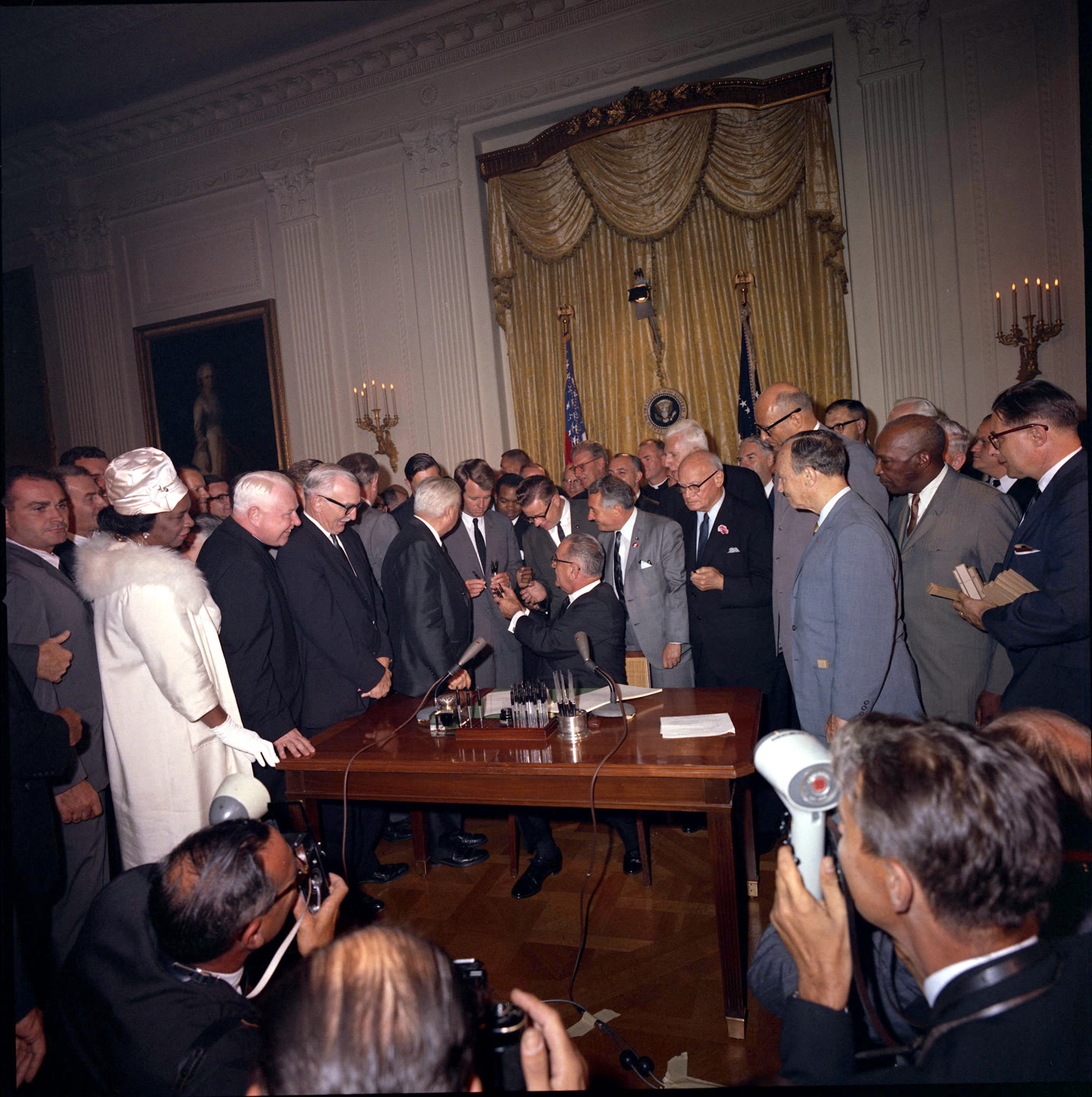
The Civil Rights Act of 1964 is usually remembered as a moral landmark, and that memory is justified.[1][2] It outlawed segregation in major public settings, attacked discrimination in employment, and became the most sweeping civil-rights law since Reconstruction.[1] Yet a close reading of the statute shows something more precise than a general national awakening. The act mattered because it translated equality into federal procedure. It sent civil rights through doors, dollars, and jobs: access to public accommodations, conditions on federally assisted programs, and a new employment-discrimination regime tied to the Equal Employment Opportunity Commission.[1][2]
That design is visible from the opening purpose line. The statute does not present itself as one abstract declaration. It announces a bundle of tasks: voting-rights protection, jurisdiction for injunctions in public accommodations, suits concerning public facilities and education, nondiscrimination in federally assisted programs, and a commission for equal employment opportunity.[1] From that structure, I infer that Congress was not merely stating a principle. It was building multiple federal entry points into ordinary segregation.
Image context: the cover uses a real LBJ Library signing photograph from the East Room on July 2, 1964.[5] It fits this essay because the act was written as an operating system for repeated enforcement, not as a self-executing sermon. Johnson is passing out pens, but the larger historical point is that the law was being handed into institutions.
Timeline anchors
- June 11, 1963: President John F. Kennedy urges federal civil-rights legislation after a nationally televised address on equal treatment.[1]
- January 1964: as the second session of the 88th Congress opens, proposed civil-rights legislation is still bottlenecked in the House Rules Committee.[4]
- March 26, 1964: H.R. 7152 becomes the Senate's pending business, and Southern opponents begin the filibuster phase in earnest.[3]
- June 10, 1964: the Senate invokes cloture after a long filibuster, clearing the path toward final passage.[3][4]
- June 19, 1964: the Senate passes the compromise bill.[4]
- July 2, 1964: the House adopts the Senate version and Lyndon B. Johnson signs the act into law just hours later.[1][2][5]
These dates matter because they show that the act's layered structure was not accidental. It had to survive committee obstruction, a Senate filibuster, and the final work of coalition assembly before it could become law.[2][3][4]
The statute's title reads like an enforcement map
The first revealing thing about the Civil Rights Act is that it is long, sectional, and administrative.[1] Some famous historical texts compress their force into a single sentence or a few ringing propositions. This law does the opposite. Its opening language strings together powers, jurisdictions, facilities, programs, and commissions.[1] That shape tells the reader where Congress thought the real fight would occur.
The act does not assume that social prejudice will fall because the nation has finally found the right words. Instead, it assumes that discrimination is lodged in recognizable sites and routines: hotel desks, lunch counters, school systems, payroll offices, and agencies spending federal money.[1][2] The law therefore creates several ways for the federal government to re-enter those routines. On close reading, the act is less a single prohibition than a portfolio of mechanisms.
That is why the statute still reads as modern. It understands that inequality survives through repeated transactions. A person is refused a room, denied a meal, blocked from a job, or excluded by an institution living on federal assistance.[1] The law's answer is to create repeated points of federal leverage in return.
Public accommodations turned ordinary exclusion into a federal case
Title II is the most publicly visible part of the act, and for good reason.[1][2] This is the section that made discrimination in places such as hotels, restaurants, theaters, and other covered public accommodations legally vulnerable.[1][2] On the page, Title II looks narrower than the whole moral vocabulary of the movement. It does not promise to cure every injury. It targets specific sites where segregation had been defended as routine business practice.
That narrowness is exactly why it mattered. The law converts everyday humiliation into something the federal courts can reach.[1] A lunch counter or motel desk is no longer just a local custom or a private owner's whim. It becomes a location where federal rights claims can be made and enforced. Title III extends the same logic by authorizing the Attorney General to protect equal use of certain public facilities, while Title IV strengthens federal involvement in school desegregation.[1]
From that architecture, I infer a central lesson of the act: Congress did not wait for local goodwill to mature. It built a route by which routine exclusion could be turned into litigation, injunctions, and compliance pressure.[1][2] The act therefore made access portable. A rights claim could move from the doorway to the courthouse.
Title VI moved civil rights through the federal purse
The most underrated part of the statute may be Title VI, the provision directed at discrimination in federally assisted programs.[1] This title does not work mainly through a dramatic confrontation at a single doorway. It works through money. If public institutions or other covered programs wanted federal assistance, they now faced a legal condition attached to that support.[1]
This mechanism matters historically because it widened the field of enforcement beyond direct courtroom contests over one restaurant or one waiting room.[1][2] Federal aid had become a normal feature of American governance by the mid-twentieth century. By connecting nondiscrimination to that stream of assistance, Congress gave civil rights an administrative path into schools, hospitals, and other institutions that depended on federal funds.[1]
That design is less theatrical than the images most often associated with the movement, but it is one of the act's most durable achievements. A public-accommodations rule tells a proprietor what cannot be done at the counter. A funding condition tells large institutions that discrimination can threaten their operating model.[1] In practical terms, Title VI made equality part of the bookkeeping of the state.
Title VII created a recurring federal employment forum
The act's third major lever is Title VII, which made employment discrimination illegal and created the EEOC.[1][2] Here again, the law does not rely on persuasion alone. It establishes a continuing forum. Complaints can be filed, patterns can be examined, and employers can no longer treat discrimination as a personnel matter outside federal concern.[1]
This does not mean the 1964 law solved job discrimination on contact. The first version of the EEOC was more limited than later Americans would assume from hindsight.[1] Even so, the institutional break is unmistakable. Employment inequality had been one of the hardest barriers to attack because it was spread across thousands of workplaces and often hidden beneath neutral-looking hiring language. Title VII pulled that problem into a national legal frame.[1][2]
The act also helps explain why civil-rights history cannot be told only through speeches and marches. Jobs are governed through forms, interviews, discipline, promotion, and pay. Congress answered that reality with a body designed to revisit the problem repeatedly rather than once.[1] The law made civil rights bureaucratic in the strongest sense: it forced equality into the paperwork of American work.
The legislative fight explains why the act reads as a bundle rather than a slogan
The Senate's own history page shows how hard the act was to pass.[3] When the bill reached the chamber as pending business on March 26, 1964, Southern senators vowed to fight it to the bitter end, and the coalition behind the bill had to secure the votes for cloture before it could even reach final passage.[3] The National Archives summary and the Library of Congress exhibition together show the same pressure from another angle: the bill had already been delayed in the House Rules Committee, then survived compromise, floor management, and an exhausting public contest before it emerged intact.[2][4]
That history matters for interpretation. The act reads like several laws stitched together because, in effect, it is a coalition law. Public accommodations, federally assisted programs, school desegregation, public-facility suits, and employment discrimination were not random additions.[1] They were distinct enforcement lanes assembled into one durable statute.
The Library of Congress exhibition adds one final revealing detail.[4] Immediately after signing the act, Johnson met with civil-rights leaders and urged careful cooperation when the law was tested, asking for restraint in demonstrations and careful selection of court cases while promising Justice Department support.[4] That moment shows how the law was understood on day one. Everyone in the room knew passage was not completion. The statute had opened the channels; now those channels had to be used.
Why the act still feels structurally alive in 2026
The Civil Rights Act of 1964 endures because it did more than condemn segregation in principle.[1][2] It taught the federal government to attack discrimination through recurring sites of leverage: who gets served, who gets funded, and who gets hired.[1] That is why the act can look less poetic on the page than some other canonical texts while proving more durable in practice.
The sharpest way to read the statute is therefore not as a single moral thunderclap. It is as an enforcement design. Doors, dollars, and jobs were the channels through which equal citizenship could be made administratively real.[1][2][4] The movement had supplied the pressure, Congress assembled the machinery, and the signing ceremony only made public what the text already showed: American civil rights had entered the age of repeat federal enforcement.[3][5]
Sources
- U.S. National Archives, "Civil Rights Act (1964)" - full text and transcript of the act, including its opening purpose line, Titles II, IV, VI, and VII, and the creation of the EEOC.
- U.S. National Archives, "Civil Rights Act, July 2, 1964" - legislative-context summary on the bill's passage, immediate signing, and the law's scope across public places, schools, and employment.
- U.S. Senate, "The Civil Rights Act of 1964 | Debate & Filibuster" - on the bill becoming Senate business on March 26, 1964, Southern opposition, and the centrality of cloture and Everett Dirksen's support.
- Library of Congress, "The Civil Rights Act of 1964" - exhibition page covering the House Rules Committee bottleneck, cloture, the signing ceremony, and Johnson's immediate post-signing meeting with civil-rights leaders about enforcement and test cases.
- LBJ Library, "Signing of the Civil Rights Act of 1964" - source page for the public-domain East Room signing photograph used as this article's cover image.