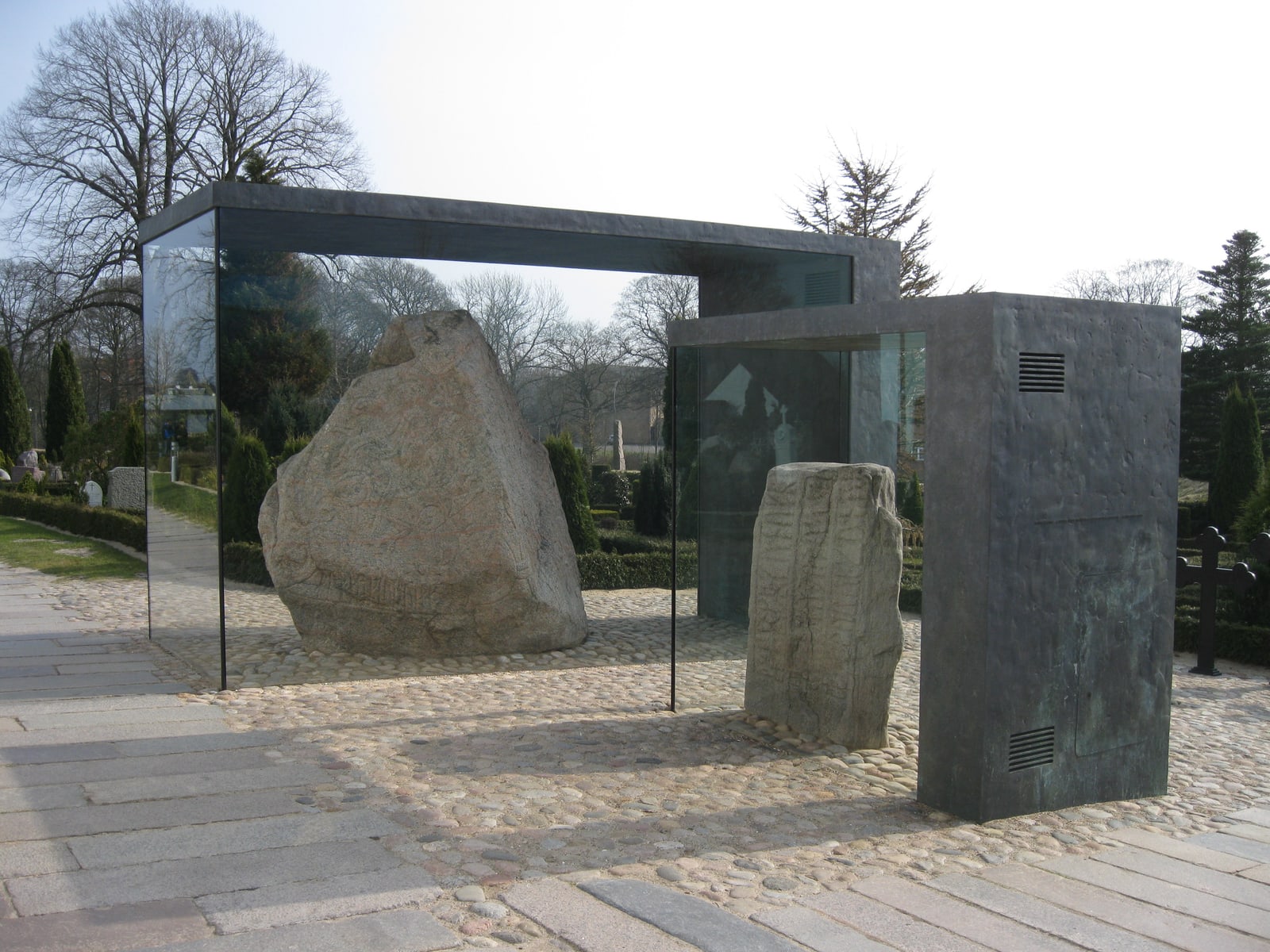
The newest part of Jelling's famous rune stones is something visitors look through. Glass shelters surround the two monuments beside the church in this Danish town. Installed in 2011, they keep wind and weather away from surfaces that had become dangerously fragile.[3][5] The arrangement makes an old question visible: how much must a place change so that the things people remember there can remain?
The stones are still encountered outdoors, in the landscape that gives them meaning. Yet each now has an interior. Their survival depends on a boundary that their makers never imagined. The glass belongs to the history of Jelling, even when a visitor tries to see past it.
A king's memory became a country's beginning
Harald Bluetooth raised the larger stone around 965, commemorating his parents, Gorm and Thyra, while proclaiming his own achievements. Its inscription claims Denmark and Norway for Harald and credits him with making the Danes Christian. One face carries an image of Christ; another shows an animal entangled with a snake.[1] A family memorial also became a statement about who had the authority to describe the kingdom.
The National Museum calls it, in its English account, “Denmark's birth certificate.” That familiar description needs the qualification the museum itself supplies: Christian objects indicate that the faith circulated before Harald's official adoption of it.[1] The stone gives a ruler's declaration a durable surface. It cannot tell us the moment at which every household changed its beliefs.
Jelling's setting enlarges that declaration. The larger stone stands between two great mounds, beside a church whose predecessors occupied the site. The smaller stone, raised by Gorm for Thyra, has stood in its present position since about 1630; its original location is unknown.[2] Keeping the stones here therefore preserves a historically accumulated arrangement. It does not freeze one perfectly recoverable Viking-age scene.
That distinction matters whenever a monument is asked to represent a beginning. Visitors meet a place assembled across centuries, while a national origin story encourages them to imagine a single decisive moment.
The danger of leaving things alone
On 3 January 2009, the National Museum published an account of investigations whose results had been announced the previous autumn. After a year and a half of study, conservators had found cracks and cavities, with some carved details already lost. The smaller stone's condition was especially critical. Continued exposure under an open sky was no longer compatible with passing the inscriptions and images to future generations.[3]
Deterioration was also an injury to the monument's ability to speak. A boulder can remain standing after a shallow carved line becomes unreadable. For these stones, apparent solidity offered a poor measure of survival. The museum described rain, frost and biological growth among the agents affecting their surfaces.[3]
The response had to account for place as well as material. UNESCO's account records an architectural competition launched in autumn 2009, with a winner announced early in 2010, to provide weather protection while keeping the stones where they stood.[2] Shelter allowed the historic objects and their surroundings to remain part of the same encounter.
This is the compromise the cases make tangible. A visitor accepts a pane of glass in exchange for seeing the vulnerable stones beside the church and mounds. Preservation introduces a conspicuous modern object into the view because maintaining the old view without intervention would consume the inscriptions it celebrates.
A surface that could not simply be cleaned
In February 2011, green graffiti added a sudden crisis to the slower damage. The National Museum reported that prompt treatment removed about 97 percent of the paint, but pigment remained deep in the larger stone's surface. Further experiments produced an unacceptable choice: treatments either failed to remove enough paint or removed mineral grains as well.[4]
Conservators chose reversible gouache retouching to disguise the remaining traces. Because that paint was water-soluble, they waited until the cases were complete and their climate regulation adjusted, so rain or condensation would not undo the work. The museum's announcement of 28 November 2011 described the finishing touches and scheduled the official unveiling for 4 December.[4]
The order of events matters. Weather protection was being planned before the graffiti attack; vandalism made another benefit of enclosure painfully clear. And the treatment was camouflage, not complete extraction of the contaminating pigment. The surviving surface carried a recent injury even when that injury became difficult to see.[2][4]
Here, an immaculate appearance and an undamaged object were different things. The conservators' account lets us recognize the care behind the appearance without mistaking it for a return to an untouched past.
Another way to get close
Before the shelters went up, runologist Lisbeth Imer and photographer Roberto Fortuna photographed the Jelling stones in autumn 2010. The work became the starting point for the National Museum's wider runestone project, which combined detailed photographs and explanations for digital publication.[5] Documentation created another form of access as physical contact became more restricted.
The photograph accompanying this article, taken by Alicudi on 17 March 2012, records the new arrangement: the ancient stones and their modern cases occupying the churchyard together.[6] It is evidence of how Jelling was being preserved, as well as a picture of what survived.
The shelters ask visitors to notice two kinds of authorship. Harald commissioned a memorial that shaped how his reign would be remembered. Later custodians shaped the conditions under which that memorial could still be read. Looking through the glass brings both acts into view: the ambition to leave a lasting statement, and the work required to keep its surface from disappearing.
Sources
- National Museum of Denmark, “The Jelling Stone” — Harald's inscription, imagery, approximate date and the limits of the national birth-certificate metaphor.
- UNESCO World Heritage Centre, “Jelling Mounds, Runic Stones and Church” — monument setting, the smaller stone's relocation, and the 2009–2010 protection competition.
- National Museum of Denmark, “Jellingstenene under lup,” 3 January 2009 — contemporary account of the deterioration investigations; Danish.
- National Museum of Denmark, “Graffitien renset af runestenen i Jelling,” 28 November 2011 — paint removal, reversible retouching, completed cases and the announced unveiling; Danish.
- National Museum of Denmark, “Oplev Danmarks runesten med din smartphone,” 3 October 2013 — photography before enclosure and the subsequent digital documentation project; Danish.
- Alicudi, “Runesten i Jelling,” 17 March 2012, Wikimedia Commons — photograph of both stones after construction of their glass shelters; CC BY-SA 3.0.