Joseph-Marie Jacquard died in 1834. Five years later, in a silk workshop in Lyon, Michel-Marie Carquillat wove him sitting in a chair. The source for the likeness was a painting by Jean-Claude Bonnefond, commissioned by the city while Jacquard was still alive. The means of reproducing it was Jacquard’s own invention. Look at Jacquard’s right hand. He holds a pair of dividers above a strip of cards that hangs over the edge of the table. Those cards are the one detail in the picture that can tell us how the picture itself was made. [1][2]
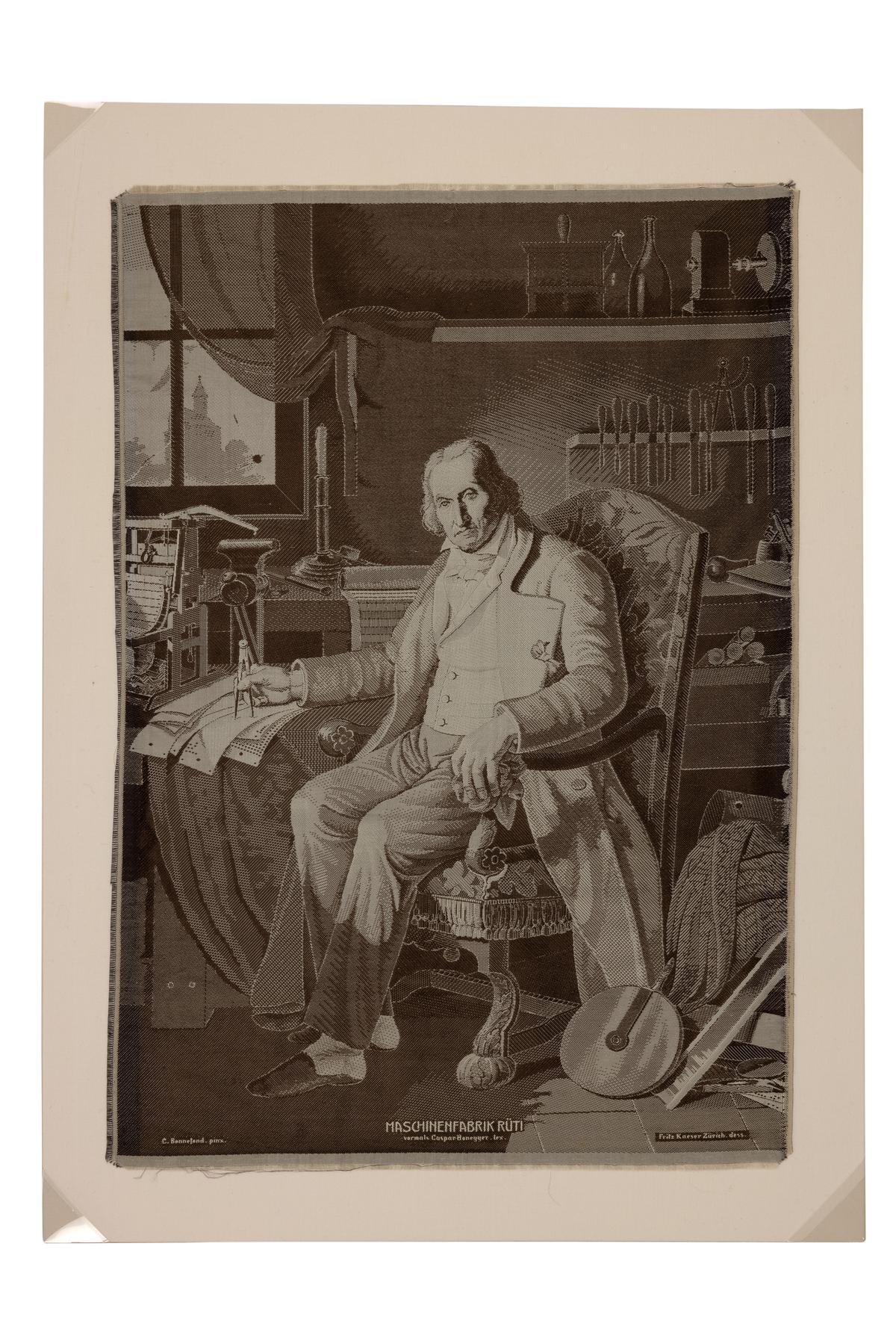
One pass across the face
Consider what happens where the edge of the sitter’s cheek meets the background. A painter can trace that boundary in a stroke. A weaver comes up against it again on every trip across the width of the cloth. A little higher on the face, the boundary falls in a slightly different place. To carry the likeness from paint into silk, somebody had to work out which threads should show at each of those crossings. The Powerhouse collection record puts the scale of the job at 24,000 cards, each with room for a thousand hole positions. [2]
The cards went to a mechanism mounted above the loom. Its workings are particularly clear on a surviving Coventry ribbon loom. A card meets a bank of pins. Where a pin finds a hole, the corresponding hook can lift its warp thread. Where the card is solid, the pin meets resistance and the thread stays down. The shuttle carries a crosswise thread, the weft, through the gap between the two sets of warp threads. Then the next card comes up. A single hole has a modest job. Only after many trips of the shuttle does the edge of a cheek emerge. [3]
On earlier figured looms an assistant had to lift the required combination of threads as the weaver worked. Jacquard, who patented his mechanism in 1804, made it possible to decide those combinations before weaving began. That shifted the hardest part of copying Bonnefond’s painting to a stage a customer ordering the silk was unlikely to see. Someone still had to decide how much of a pale thread to expose to suggest the light falling across a sleeve. The loom could faithfully repeat a poor decision, too. [1][2][3]
What the workshop could keep
The Powerhouse estimates that preparing the pattern took several workers months. Its estimate for weaving one portrait, assuming a usual pace of roughly 48 shuttle passes a minute, is a little over eight hours. These are reconstructions of the work involved. The distinction matters when imagining a second order arriving in Lyon. The next customer still needed silk and a substantial stretch of loom time. But the positions of the holes had already been settled, punched and put in sequence. The workshop could bring out the cards and begin again. [2]
A humbler piece of weaving equipment shows what it meant to keep a pattern on a shelf. The Science Museum Group holds bundles of cards for James Heywood’s miniature ribbon loom. One cover bears the words “1894 Bath Exhibition” and has a piece of the ribbon attached. Another bundle has a dragon motif on its cover and its own woven sample. Imagine opening the case in search of a particular ribbon. A scrap on the outside lets a person recognize in a glance what it takes a loom a whole sequence of cards to read. [4]
That pairing helps explain what a buyer got when Carquillat finished a portrait. The silk held every visible consequence of the workshop’s decisions. A customer could hang it up and study Jacquard’s face. The cards held those same decisions in the order another weaving would require. A workshop that parted with the silk could still make the face again. [2][4]
Sources
- The Henry Ford, “Portrait of Joseph-Marie Jacquard, 1839,” object 39.173.1.
- Powerhouse Collection, “Woven portrait of Joseph Marie Jacquard,” object 549969.
- Science Museum Group, “Ribbon loom with jacquard head,” a Coventry loom made around 1900.
- Science Museum Group, “Jacquard cards,” including the bundles, cover sheets and ribbon samples for Heywood’s model loom.