The Iroquois Theatre fire is often remembered through one brutal number: 602 dead in Chicago on December 30, 1903.[1][2] That number is necessary, but by itself it can make the disaster sound like a sudden accident with a single cause. The more useful history is causal. A stage fire became a mass-fatality event because several protections that were supposed to stay independent all failed in sequence: combustible scenery ignited, the fire curtain did not isolate the stage, a draft drove flame toward the audience, routes out of the balconies were confusing or blocked, and the city's inspection regime had let an unfinished safety system operate as if it were complete.[1][2][3]
That mechanism matters because the Iroquois was not an old, neglected hall. It had opened only weeks earlier on West Randolph Street, advertised as "absolutely fireproof," and celebrated as a civic showpiece.[1][2][3] The tragedy therefore exposed something sharper than the danger of fire alone. It showed how a modern public building could be rhetorically safe and operationally unsafe at the same time. The steel, brick, marble, and publicity did not protect patrons when the working parts of escape and compartmentation failed.[1][3]
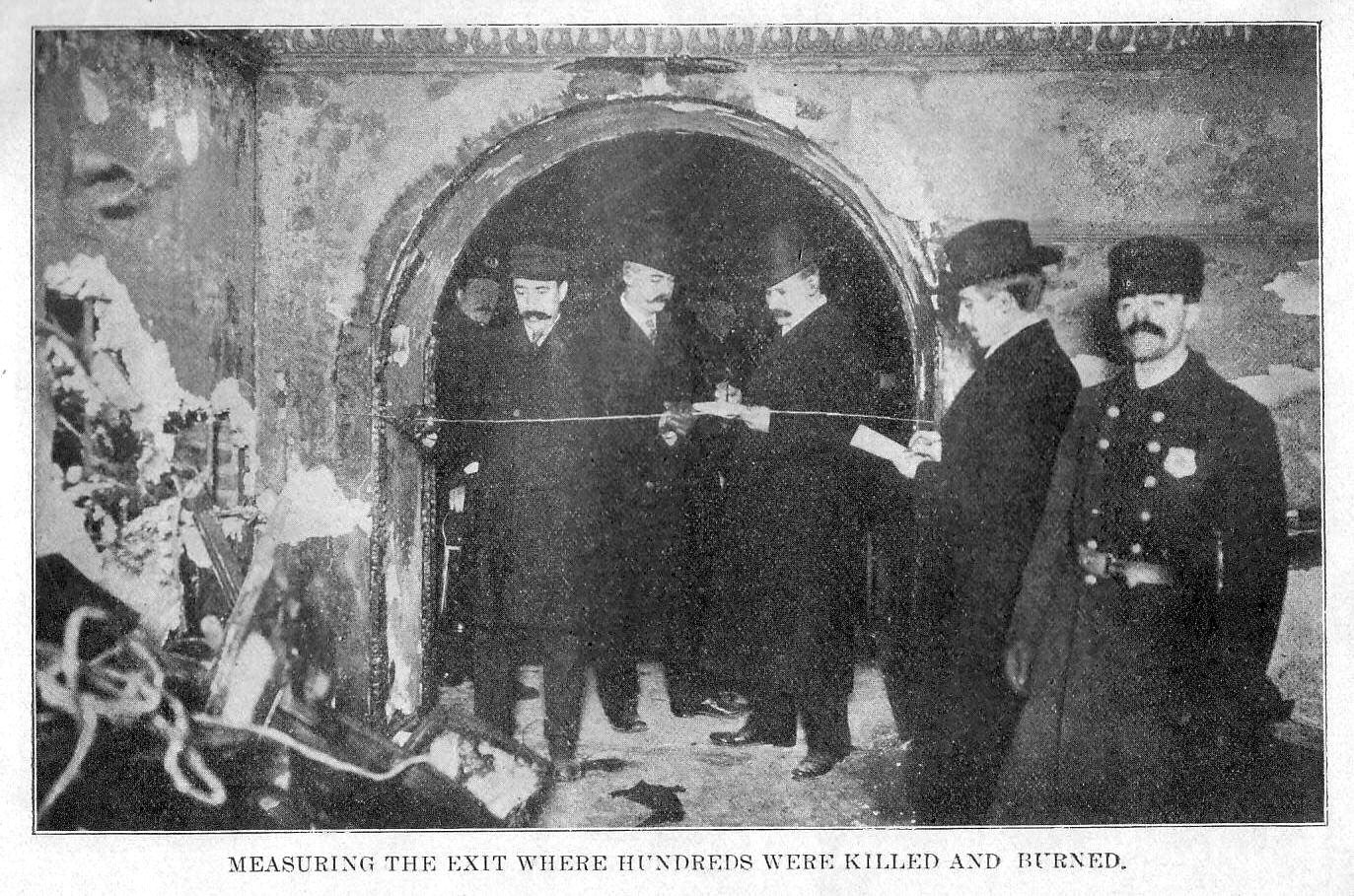
The cover image fixes the argument in the right place.[5] It does not show flames or theatrical spectacle. It shows an exit after the event, labeled "death trap" by Allen Ayrault Green. That is the correct visual emphasis. The fire began onstage, but the disaster became historic at thresholds: doors, gates, aisles, stairways, curtains, and the unseen administrative permission that allowed those details to remain dangerous.[1][2][5]
Timeline anchors
- November 23, 1903: the Iroquois Theatre opened in Chicago's Loop, behind schedule but promoted as a grand new house.[1][3]
- December 30, 1903, afternoon: a holiday matinee of Mr. Blue Beard drew a packed audience, including many women and children during school vacation.[1][2][4]
- Around the second act: an arc light or nearby stage lighting ignited hanging scenery or curtain material near the stage.[1][2][3]
- Within minutes: attempts to control the fire failed; the protective curtain jammed; people pushed toward exits that were hard to find, blocked, locked, or mechanically hostile under crowd pressure.[1][2][3]
- January 1904: civic and newspaper commentary treated the fire as a national safety lesson, while Chicago shut public venues for inspection and debated new rules.[3][4]
1. The first failure was not flame; it was combustible theater machinery
The Iroquois fire started in a world where stage illusion required fuel. Painted canvas, scenery flats, drapery, ropes, drops, and lighting effects were part of the production system. The Iroquois Theatre Fire Historical Society places the ignition during the second act, when scenery near a stage light began burning.[1] Smithsonian's account similarly emphasizes the spark from stage lighting and the rapid spread through elaborate stage material.[3]
That distinction is important. A small ignition does not automatically become a building disaster. The relevant question is what the building and its operating routines do next. At the Iroquois, the stage environment created rapid vertical and lateral spread before staff could suppress the fire. Stagehands reportedly tried available extinguishing powder, but the fire moved faster than that small-scale response could handle.[1][2] The problem was not simply that fire existed in a theater. The problem was that a theater designed around spectacular combustible effects depended on protective systems that were not ready to carry the load.
2. The curtain was supposed to convert catastrophe into delay
In a proscenium theater, the safety curtain is not decorative. Its job is to buy time by separating a stage fire from the audience. The Iroquois was advertised as having such protection, and officials later pointed to it as one reason the building had appeared safe on paper.[3] But the curtain did not complete that job. The historical society describes the asbestos curtain as snagging before it could fully descend; Smithsonian likewise notes that the device meant to shield the house did not work as promised.[1][3]
This is the central mechanical lesson of the fire. A protection can exist and still fail operationally. It may be installed, listed, or praised, yet not tested under realistic conditions, not aligned with the stage equipment around it, or not usable at the moment it matters. Once the curtain jammed, the audience no longer had a compartmented stage fire in front of them. They had heat, smoke, falling material, and spreading flame entering the same volume as the crowd.[1][3]
That turns the familiar phrase "absolutely fireproof" into evidence against the building's safety culture. The claim treated fireproofness as a property of the structure. The event showed that life safety depended on moving systems: a curtain that had to drop, doors that had to open, signs that had to remain legible, staff who had to know what to do, and inspectors who had to insist that every one of those parts work before the house filled with people.[1][3][4]
3. Draft turned a stage event into an auditorium event
Several reconstructions emphasize a further sequence: backstage exits opened, cold air rushed in, and flame was driven under or around the incomplete curtain into the audience space.[1][2] This detail is sometimes told theatrically, but its historical importance is practical. The disaster was not just a fire growing larger. It was a building airflow problem. Openings, pressure, cold outside air, and the geometry of the stage combined with the jammed curtain to carry heat and smoke where the audience had been told it was protected.
That mechanism helps explain why the Iroquois disaster moved with such speed. People in the audience did not have a long, orderly evacuation interval. They had a fast transition from entertainment to threat, with lights, smoke, flame, and fear arriving before the exit system could absorb the crowd. History.com's summary emphasizes blocked exits and the absence of a workable fire-safety plan as central reasons the death toll grew.[4] That observation matters because it shifts attention from fire damage alone to crowd movement under architectural constraint.
4. The exit system failed as information, hardware, and policy
The deadliest part of the sequence was not a single locked door. It was a whole exit system that behaved badly under stress. The historical society describes gates, unfamiliar latches, and inward-opening doors that became fatal under crowd pressure.[1] Smithsonian describes narrow and obstructed aisles and doors, locked metal gates, and exit routes concealed or difficult to use.[3] The Library of Congress guide to contemporary newspaper coverage points readers to reporting on "false exits" and barred or inward-opening doors, a phrase that captures the cruelest feature of the event: some apparent routes did not function as escape.[2]
That is why blaming "panic" alone is historically weak. Panic was real, but panic became lethal because the building translated urgency into blockage. Doors opening inward are manageable when one person tries them calmly. They become traps when a crowd presses from behind. Gates meant to enforce seating class or ticket control can look administratively harmless during normal operations. Under fire conditions, they become barriers. Draped or poorly marked exits may satisfy a decorative interior; in smoke and darkness, they erase the path out.[1][2][3]
The Iroquois therefore belongs to the history of wayfinding as much as to the history of fire. A safe exit must be visible before people need it, intuitive when they reach it, and mechanically openable under pressure. If a patron has to find a hidden latch, negotiate a gate, reverse against crowd force, or distinguish a real exit from a false one, the building has already spent time the crowd does not have.
5. Inspection failure made the technical failures possible
The last causal layer sits before the matinee. The theater had opened under pressure, with owners eager to operate and the city still struggling to supervise a fast-growing building and entertainment economy.[1] The historical society's account frames the aftermath around lax public-safety oversight and indictments that did not produce meaningful compensation for victims' families.[1] Smithsonian quotes contemporary reporting and later historians to show that the official explanation after the fire leaned on the building's fireproof materials and nominal exits, even though the actual safety devices did not protect the audience.[3]
This is the institutional lesson. The Iroquois was not unsafe only because one stage light sparked. It was unsafe because a public venue could pass from promise to operation without the safety system being treated as a tested system. Fireproof materials were counted as if they could substitute for evacuation design. An advertised curtain was counted as if it were a proven barrier. Multiple exits were counted as if quantity alone answered usability, visibility, direction of swing, and staff control.[1][2][3]
The aftermath confirms that officials understood the issue in systems terms. Chicago closed theaters and other public venues for inspection after the disaster, while later safety reforms pushed outward-opening doors, clearer exit marking, fire drills, better fire curtains, and panic-hardware adoption into wider use.[1][3][4] The Iroquois did not invent every safety idea it later popularized, but it supplied the urban proof that public assembly buildings needed escape hardware and operating discipline that worked under crowd pressure.
The bounded conclusion
The Iroquois Theatre fire should not be reduced to a spark, a bad curtain, or a panicked audience.[1][2][3][4] Its historical force comes from the chain. A new theater sold confidence before it had earned it. A stage ignition met combustible scenery. A safety curtain failed at the moment it was supposed to create time. Airflow drove the threat into the audience. Exit routes then converted confusion into pileups, crushing, and suffocation. Inspection and enforcement failures had allowed those weaknesses to coexist in a packed holiday matinee.
That is why the disaster still reads as a code history rather than only a tragedy narrative. Building codes are often remembered as paperwork until they are absent. The Iroquois fire made the missing pieces visible: not abstract regulation, but doors that open the right way, gates that are not locked against escape, signs that remain findable, staff who have rehearsed emergency movement, and devices that are tested before a crowd trusts them. The lesson was written at the exit, which is why Green's photograph still carries such force.[5]
Sources
- Iroquois Theatre Fire Historical Society, "Iroquois Theatre" - reconstruction of the theater's opening, ignition sequence, jammed curtain, draft, exit failures, official death toll, inquest, and aftermath.
- Library of Congress, "Iroquois Theater Fire: Topics in Chronicling America" - guide to contemporary newspaper coverage, including barred doors, failed curtain, false exits, and the final death toll exceeding 600.
- Smithsonian Magazine, "A 1903 Fire at a Chicago Theater Killed 602 People, Prompting Enduring Safety Reforms" - overview of the fire, official fireproof claims, failed safety measures, culpability problems, and post-fire regulation.
- History.com, "Fire breaks out in Chicago theater" - concise account of the December 30, 1903 fire, blocked exits, lack of a fire-safety plan, failed asbestos curtain, and subsequent safety changes.
- Wikimedia Commons, "File:Iroquois Theatre fire - DPLA - c9e2f3b69954059bcfebf35bf12d84b9.jpg" - source page for Allen Ayrault Green's 1903 archival photograph of an Iroquois Theatre exit after the fire.