The Great Exhibition of 1851 is often remembered as a confident Victorian tableau: Queen Victoria opening the Crystal Palace, Prince Albert's improving faith in industry, glass and iron glittering in Hyde Park, and a crowd walking through the first great world fair. That picture is not wrong, but it is too still. The sharper history is an event reconstruction. The Exhibition mattered because its organizers turned an unstable idea into a sequence that could actually run: build a vast temporary hall, classify a world of objects, move people through it at different prices, absorb criticism and crowds, and then convert the profit into institutions that outlived the building.[1][2][3]
That sequence is why the Crystal Palace should be treated as more than a marvel of architecture. It was also a crowd-management device, a catalogue system, a pricing experiment, an imperial theater, and a financial engine. London Museum describes the Exhibition as a celebration of industry, raw materials, art, and design from Britain and abroad, while also noting its explicit imperial message and the racial hierarchy embedded in some displays.[1] The event's success therefore has to be read with two truths held together. It widened public access to industrial spectacle; it also taught visitors to see empire as orderly display.
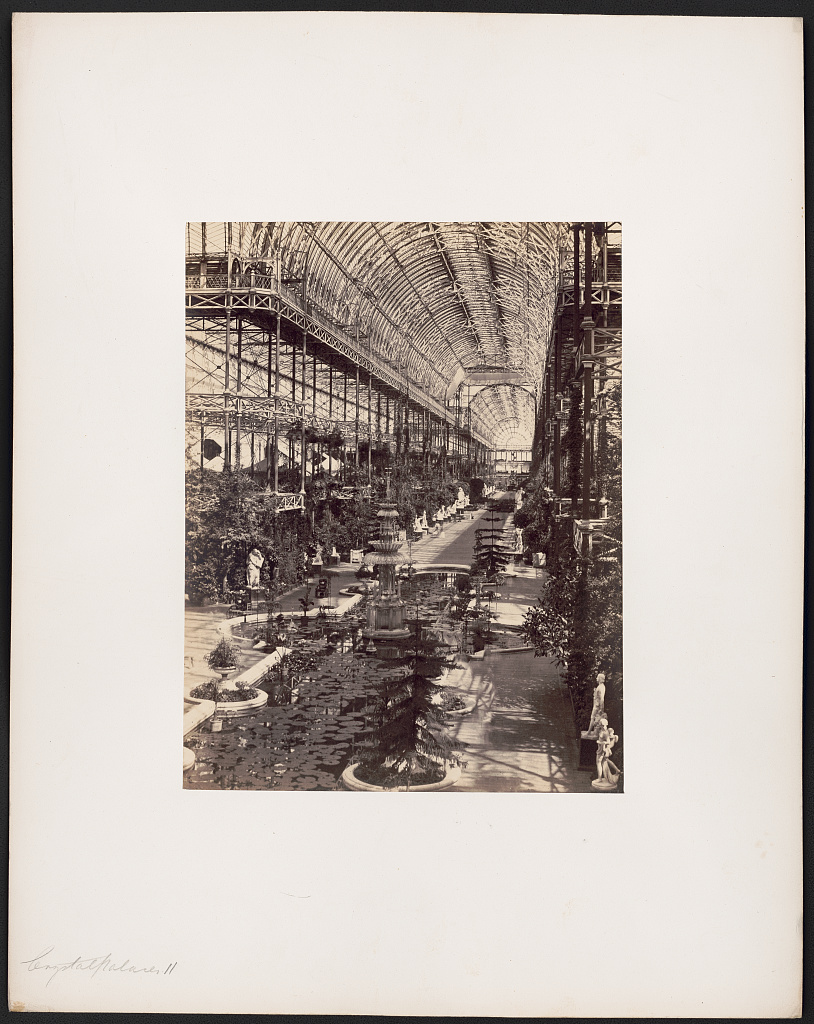
The cover image fixes the article at the right scale.[6] The Library of Congress photograph is not a diagram or a later fantasy of the Crystal Palace. It is an 1851 albumen print of the interior, with glass roof, plants, fountain, and sculpture held inside one constructed environment. It belongs here because this article's subject is not one famous opening moment. It is the machinery that made millions of visits feel navigable.
Timeline anchors
- 1849: the Royal Commission's archive traces the Great Exhibition project back to Prince Albert's work through the Society of Arts before the commission was formally established.[2]
- 1850: the Royal Commission for the Exhibition of 1851 was established with Prince Albert as president to organize the event.[2]
- 1 May 1851: Queen Victoria opened the Exhibition in Hyde Park; The Gazette's retrospective notes that the opening ran to schedule before a large season-ticket audience.[4]
- May 1851: after the early higher-price period, shilling days widened access and changed the Exhibition's social rhythm.[1][5]
- 11 October 1851: London Museum gives the Exhibition's closing date after a long summer season that drew six million visits.[1]
- 1852 and after: published reports, jury reports, and the surplus carried the Exhibition beyond the summer, feeding South Kensington's museum and educational infrastructure.[2][3]
First, build the container
The Exhibition's first problem was physical: where could Britain put a world fair large enough to carry the promise of "all nations" without turning Hyde Park into a permanent scar? London Museum says Joseph Paxton's purpose-built glass and iron structure was completed in nine months by more than 2,000 workers, tall enough to hold full-grown elm trees, a pipe organ, and an 8 metre glass fountain.[1] The Royal Commission's own history compresses the design phase even further, noting that the Crystal Palace took six weeks to design.[2]
Those numbers matter because the building's temporary character was not incidental. A permanent palace would have raised a different political and urban question. A temporary hall promised spectacle without permanent occupation of the park. Yet the structure still had to be legible to visitors who had never seen anything like it. Paxton's conservatory logic solved several problems at once: light, scale, modular construction, interior orientation, and a transept wide enough to make the building feel like a public avenue rather than a warehouse.
The building also became an exhibit. The Institution of Engineering and Technology notes that the Crystal Palace enclosed 7.39 hectares and included a row of huge elm trees; the point is not just size, but the way the building displayed engineering as atmosphere.[7] Visitors did not simply inspect machinery and manufactured goods. They entered a manufactured environment that made modern materials seem civic, transparent, and orderly.
Then sort the world into walkable categories
The second problem was intellectual. A building full of objects can become a market, a warehouse, or a jumble unless somebody supplies categories. The official catalogue did exactly that. Its first volume began with index and introductory material, then raw materials and machinery; later volumes covered manufactures, fine arts, colonies, foreign states, and supplementary material.[8] The catalogue turned abundance into a route.
This was not neutral sorting. London Museum's account is useful precisely because it refuses to treat the Exhibition as innocent wonder alone. It describes more than 100,000 products in the Crystal Palace, but also notes how imperial displays contrasted British industrial superiority with colonial raw materials and helped present empire as a positive public project.[1] The Caribbean section, for example, could make sugarcane and other produce look like educational specimens rather than evidence of exploitative labor systems.[1]
The event therefore worked by making politics appear as arrangement. A visitor walking past fabrics, furniture, locomotives, hydraulic presses, musical instruments, colonial produce, sculpture, and luxury objects was not only seeing variety.[1] The visitor was being given a hierarchy of production: raw material, manufacture, taste, technology, empire, nation. That is why the catalogue and the hall belong to the same mechanism. The hall made the crowd move; the catalogue made the objects mean.
The opening ceremony made order visible
The third problem was legitimacy. On 1 May 1851, the Exhibition had to begin as a royal, national, and international event without losing control of the crowd. The Gazette's anniversary account emphasizes the scheduled nature of the opening: Queen Victoria opened the Exhibition "exactly to schedule," accompanied by Prince Albert, royal family members, politicians, diplomats, and more than 25,000 people inside.[4] That precision is historically important. The first act of the Exhibition was to show that scale could be disciplined.
Ceremony did practical work. A royal procession, gun salute, music, prayer, and an ordered audience helped turn a risky novelty into a sanctioned public ritual.[4] The opening did not prove that every later day would run smoothly, but it gave the Exhibition its first public grammar: this was not a bazaar thrown together by merchants, and not a disorderly crowd experiment. It was a state-blessed display of productive modernity.
The fact that the event could open in this form also protected Prince Albert's project. Critics had feared foreign visitors, crime, disease, class mixing, and disruption. A visibly orderly opening answered those fears with performance before the ordinary crowd even fully arrived. The Exhibition's later popularity rested partly on that first conversion of anxiety into ceremony.
Shilling days changed the event from elite spectacle to mass routine
The fourth problem was access. The Exhibition could not become a national event if it remained primarily a season-ticket and high-price attraction. London Museum notes that shilling days were introduced a few weeks in, reducing entry from five shillings to one shilling from Monday to Thursday, which made the Exhibition affordable to many more people.[1] Its Cruikshank essay adds the social bite: five shillings could equal a skilled workman's daily wage, while the one-shilling price made the Exhibition open to almost everyone regardless of class.[5]
This price change was not a footnote. It altered the event's social composition and its public meaning. Six million visits did not materialize merely because the building was beautiful.[1] The mass audience had to be enabled through price, schedule, and transport. London Museum connects shilling days to Britain's railway network, which allowed visitors from beyond London to reach Hyde Park and carry souvenirs and stories home.[1]
The IET's summary gives the crowd scale from another angle: over 6,000,000 people paid at least a shilling to visit, and at the peak about 40,000 people were admitted per day.[7] Those figures explain why the Exhibition became a routine as much as a spectacle. Once admission was cheap enough and rail movement plausible enough, the question around breakfast tables was not abstract admiration but logistics: who would go, when, and how.
The closing did not end the machine
The fifth problem was afterlife. Many public spectacles vanish into memory once the booths are dismantled. The Great Exhibition did something more durable because it produced a surplus and an administrative future. The Royal Commission says the Exhibition made a surplus of £186,000, after which the Commission received a supplemental charter extending its existence so it could disburse the profits.[2] London Museum links that surplus to South Kensington's transformation into a cultural quarter and to the founding of the Victoria and Albert Museum, the Science Museum, and the Natural History Museum, as well as an educational trust for industrial research.[1]
That afterlife changes the meaning of the event. The Crystal Palace itself was moved from Hyde Park to Sydenham after the Exhibition, later became financially troubled, and was eventually destroyed by fire in 1936.[1] But the administrative surplus survived in another form. The event's profits helped make museums, collections, and research funding part of the permanent civic landscape.
The V&A's archive guide shows the documentary afterlife as well. It says the records of the Great Exhibition are held by the Royal Commission, while the V&A's National Art Library holds extensive printed material relating to the event; the V&A also identifies mounted photographs, annotated publication lists, and thirty-two images among its related archival holdings.[3] In other words, the Exhibition generated not only objects and profits but paperwork, photographs, reports, and catalogues that continued to organize memory.
What the reconstruction shows
The Great Exhibition succeeded because each stage solved a different risk. The building solved the problem of temporary monumental space. The catalogue solved the problem of abundance. The opening ceremony solved the problem of legitimacy. Shilling days solved the problem of access. Railways and daily admission routines solved the problem of scale. The surplus solved the problem of afterlife.[1][2][3][4][5][7][8]
That does not make the Exhibition a simple triumph. Its imperial displays helped naturalize unequal power by turning conquered resources and colonial production into educational scenery.[1] Its categories made the world walkable, but they also made hierarchy feel like common sense. The event's force lies precisely there: it made modern industry, empire, class access, and public instruction appear in the same glass house.
The Crystal Palace was temporary, but the method was not. After 1851, the international exhibition became a repeatable form: a city could build a world indoors, sell timed access to it, organize it through catalogues and juries, and then claim that the public had been educated by spectacle. The Great Exhibition's historical importance is therefore less that it amazed visitors once. It showed how amazement could be administered.
Sources
- London Museum, "What was the Great Exhibition of 1851?" - overview of dates, Crystal Palace construction, 100,000-plus products, imperial display logic, shilling days, visitor scale, surplus, South Kensington legacy, and the building's later move and destruction.
- Royal Commission for the Exhibition of 1851, "History & Archive" - on the 1850 commission, Prince Albert's role, the Exhibition's surplus, supplemental charter, South Kensington estate, and continuing award mission.
- Victoria and Albert Museum, "Archive Research Guide: 19th century international exhibitions" - on V&A and Royal Commission Great Exhibition holdings, printed sources, mounted photographs, and the wider civilizing-mission framing of nineteenth-century exhibitions.
- The Gazette, "The Great Exhibition of 1851" - account of the scheduled 1 May 1851 opening ceremony, royal procession, and large season-ticket audience.
- London Museum, "A caricaturist takes on the Great Exhibition, 1851" - on George Cruikshank's Exhibition satire and the social importance of the wildly popular shilling days.
- Library of Congress, "Great Exhibition of the Works of Industry of All Nations, Crystal Palace, Hyde Park, London, England" - source page for Louis-Emile Durandelle's 1851 albumen photograph used as this article's cover image.
- Institution of Engineering and Technology Archives, "Great Exhibition 1851" - engineering-focused summary of visitor scale, peak daily admission, Crystal Palace area, elm trees, and the later Sydenham reconstruction.
- Great Britain Commissioners for the Exhibition of 1851, Official descriptive and illustrated catalogue, Vol. 1 (Wikimedia Commons / Internet Archive scan) - primary-source evidence for the catalogue's classification of raw materials, machinery, manufactures, fine arts, colonies, and foreign states.