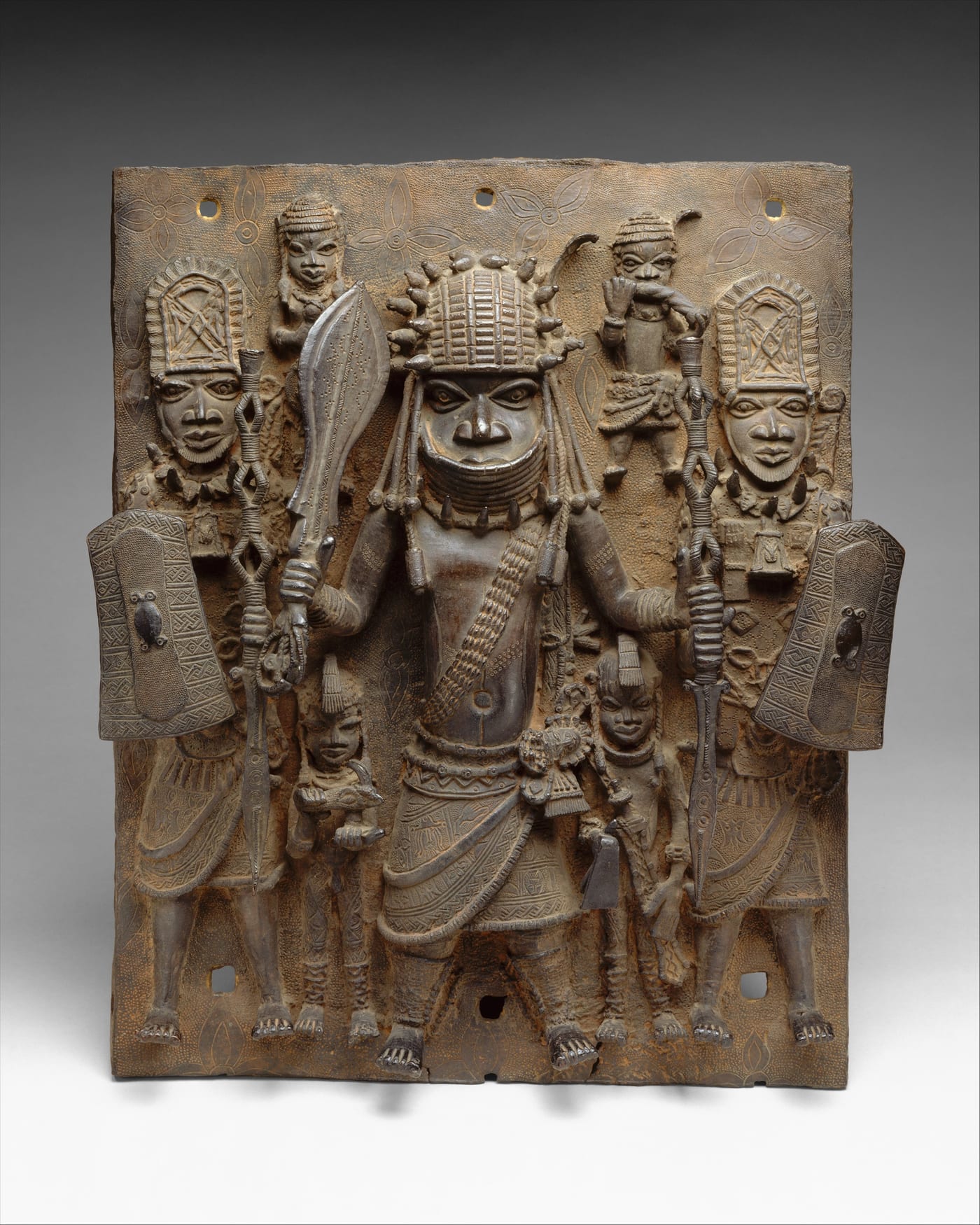
The phrase Benin Bronzes can make the objects sound like a category of museum treasure: beautiful, scarce, disputed, waiting behind glass. That is too small a frame. The objects were not made first as free-floating masterpieces. They were royal arts, court records, ancestral presences, diplomatic memories, ritual tools, and political signs inside the Kingdom of Benin. Their later museum life began after violence, but their deeper history began as a system for making royal memory visible.
That is why restitution has become more than a question of moving things from one building to another. The return of Benin objects asks whether a broken memory system can be partly reassembled after more than a century of dispersal. The British Museum describes the bronzes as works created from at least the 1500s onward by specialist guilds for the Oba's court, including cast relief plaques, commemorative heads, animal and human figures, regalia, and personal ornaments.[1] Digital Benin now tracks 5,304 objects across 139 institutions in 21 countries, focused on the works looted by British forces in February 1897 and distributed afterward.[2] Those two facts belong together. The bronzes were once concentrated enough to serve a court. They became scattered enough to require a global database.
The history is therefore a memory-and-commemoration problem in three stages: how the objects remembered Benin before 1897, how imperial collecting made them remember conquest instead, and how restitution has turned them into tests of whether public institutions can name violence without keeping its benefits permanently in place.
The palace plaques were not neutral decoration
The Met's Plaque with Warrior and Attendants is a useful single object because it refuses the idea that Benin art was only ornamental. The plaque is attributed to the Igun Eronmwon brass-casting guild artists of the Edo court, dated ca. 1540-70, and made in brass, with a central warrior and attendants compressed into a formal court image.[3] Its scale is modest enough to hold in the mind: about 18 3/4 inches high and 15 inches wide.[3] Yet the image carries rank, retinue, weapons, posture, and performance in one dense surface.
The British Museum's broader description explains why plaques like this mattered. The palace plaques once decorated pillars in the palace compounds and recorded court life, ritual, trade relationships, and military campaigns.[1] That makes them historical media, not merely luxury goods. Their brass surfaces helped organize dynastic memory in a place where kingship, guild labor, ancestor veneration, and political authority were not separate departments. To see a plaque in that setting was to see a court remembering itself.
The word "remembering" is important because it changes the restitution argument. If an object was only a commodity, restitution can sound like a property dispute. If an object was also a node in a historical record system, dispersal becomes an archival injury. The damage was not only that valuable objects left Benin City. It was that a palace's internal memory architecture was broken apart and reorganized under foreign labels, accession numbers, auction histories, and donor names.
1897 turned court memory into imperial evidence
The break came through the British expedition of 1897. The British Museum states that a provocative British trade mission was attacked in January, after which a large retaliatory force captured Benin City in February.[1] The occupation brought widespread destruction and pillage: the Oba's palace was burned and partly destroyed, shrines and compounds were looted, thousands of ceremonial and ritual objects were taken to Britain as official "spoils of war" or distributed among members of the expedition, and the Oba was captured and sent into exile.[1]
That sequence changed what the objects were made to commemorate. Before 1897, a plaque could point inward toward royal order, court hierarchy, ancestral legitimacy, and Benin's external relationships. After 1897, the same plaque in a European or American collection also pointed to military conquest, colonial power, and the market routes that turned looted works into museum holdings.
The early display history makes the conversion stark. In the autumn of 1897, the British Museum displayed 304 Benin plaques on loan from the Secretary of State for Foreign Affairs and later received 203 of them as a donation.[1] By 1898, some objects were formally entering the museum's collection world. By 1950 and 1951, the British Museum deaccessioned 29 plaques then understood as duplicates, with many going to Nigeria and others entering further dealer and collector networks.[1] These dates show how quickly court objects became administratively mobile: loan, donation, sale, exchange, display, accession, deaccession.
That administrative mobility is part of the memory problem. Museums did not simply preserve Benin's history. They also rewrote the route by which Benin's history would be encountered. Visitors learned the kingdom through fragments separated from palace architecture, ritual sequence, language, and local authority. Labels could explain some of that loss, but the room itself still taught a new order: Benin as collection, Europe as keeper.
Digital repair is useful, but it is not return
Digital Benin is one of the strongest signs that commemoration has changed. Its platform brings together objects, historical photographs, documentation, oral histories, Edo-language catalogue work, provenance names, maps, and institutional records.[2] That matters because dispersal made the objects hard to study as a related field. A researcher, descendant community, curator, or interested reader can now see patterns that no single museum gallery could show: where objects are, how they are named, how they moved, and how they connect back to Benin's own categories.
This is repair, but it is not a substitute for return. The site itself is explicit that the objects were looted in February 1897 and distributed in the aftermath.[2] Digital reconnection can make that history legible; it cannot undo the fact that physical custody, ritual proximity, and cultural authority were displaced. A database can help rebuild knowledge across borders, but it should not become the polite endpoint of a history that began with forced removal.
That distinction is why Nigerian institutional voices matter. Nigeria's National Commission for Museums and Monuments described repatriation work through the Benin Dialogue Group and emphasized that provenance research should not delay return, that Nigeria expected full return rather than only a substantial part, and that repatriated works could help inspire Nigerian cultural and creative life.[4] The language is not only about ownership. It is about what returned objects can do once they are no longer trapped in the role of overseas evidence.
Restitution turned museum ethics into public ritual
By the early 2020s, restitution was no longer only a specialist debate. In June 2022, the Smithsonian Board of Regents voted to deaccession 29 Benin bronzes from the National Museum of African Art and transfer title and return them to Nigeria's National Commission for Museums and Monuments.[5] The Smithsonian tied that decision to a newly adopted ethical returns policy, making the Benin case a public test of whether a museum could act on ethical grounds as well as legal title.[5]
The symbolic weight came from the ceremony as much as the paperwork. Restitution ceremonies take place in the present, but they are staged around a much older sequence: production in the royal court, looting in 1897, dispersal through museum and market systems, requests for return, institutional hesitation, and eventual transfer. Each handover compresses that chain into a visible act. It tells the public that the object did not simply "end up" abroad. It was taken, kept, studied, displayed, debated, and finally reclassified as something whose continued possession required justification.
The practical questions remain hard. Where should returned objects be housed? Which Nigerian institutions, royal authorities, federal agencies, local communities, and scholars should shape access? How should conservation, loans, public display, ritual status, and education be balanced? Those questions should not be minimized. But they are different from the older museum posture that treated custody in Europe or North America as the stable default and African return as the risky exception.
Benin City is becoming an archive again
One reason the restitution debate should not be reduced to gallery politics is that historical work is also happening in Benin City itself. The MOWAA Archaeology Project describes a five-year program, in collaboration with the British Museum and NCMM, aimed at deepening understanding of Benin City's urban development, artistic chronology, and material history.[6] Its work includes pre-construction archaeology at the MOWAA Campus and has uncovered stratified settlement remains dating back at least 600 years.[6]
That kind of archaeology matters because it shifts attention from isolated masterpieces back toward urban history. The bronzes are extraordinary, but they are not the whole archive. Benin's palace district, guild traditions, settlement layers, moats, oral histories, and surviving rituals all challenge the old museum habit of making displaced objects carry the full burden of explanation. Restitution is strongest when it helps reconnect object history to city history.
This is also why the return of objects does not close the story. It opens a more demanding one. A plaque that once helped a palace remember can now help a city, a kingdom, a nation, and a global public argue about how memory should be repaired after conquest. The object has not stopped being art. It has become art with its route restored to the center of interpretation.
The Benin Bronzes became famous abroad because they were broken out of context. Their future significance depends on reversing that lesson. Not by pretending the last century did not happen, and not by treating digital access, museum loans, or scholarly cooperation as meaningless. The better standard is more exact: every label, database, gallery, return agreement, and excavation should make the chain visible. Court memory, colonial seizure, global dispersal, and restitution all belong in the same frame.
That is the real commemoration work. The bronzes do not only ask where they should sit. They ask who gets to make history whole enough to be seen.
Sources
- British Museum, "Benin Bronzes" - institutional account of the objects' court functions, the 1897 expedition and looting, early display history, deaccessions, and current contested-object position.
- Digital Benin, homepage and project scope - catalogue and documentation platform connecting 5,304 objects across 139 institutions in 21 countries, focused on works looted in February 1897.
- The Metropolitan Museum of Art, "Plaque with Warrior and Attendants" - object record and public-domain image source for the article image, with date, maker, medium, dimensions, and accession details.
- National Commission for Museums and Monuments, "Efforts at Repatriation" - Nigerian institutional account of repatriation negotiations, Benin Dialogue Group work, and expectations for full return.
- Smithsonian Institution, "Smithsonian Board of Regents Votes To Return 29 Benin Bronzes to Nigeria" - June 13, 2022 news release on deaccession, ethical returns policy, and transfer to NCMM.
- MOWAA, "MOWAA Archaeology Project" - description of the Benin City archaeology program, collaboration with the British Museum and NCMM, and settlement evidence dating back at least 600 years.
Editor’s Pick Review
This piece earns an editor’s pick because it makes a familiar restitution subject feel structurally new. The article’s strongest move is to treat the Benin Bronzes as a memory system twice over: first as palace records of royal authority, lineage, ritual, and contact, then as scattered objects whose forced museum afterlife now has to be rebuilt through catalogues, claims, returns, and public ceremonies. That frame gives the essay moral weight without reducing it to a generic looting summary.
It also clears the stricter visual bar. The image is a real Benin object tied directly to the article’s argument, not an analytical graphic or decorative museum placeholder. The sourcing is institutionally strong, and the Chinese version carries the same conceptual spine with clean rhythm, stable terminology, and enough texture to stand as a curated bilingual reading rather than a secondary mirror.