Churchill's Fulton address is usually remembered as if it were one sentence long. The surviving public memory is the image of an iron curtain descending across Europe, followed by a retrospective verdict that Churchill had somehow predicted the Cold War before everyone else.[1] That memory catches one true thing, but it flattens the speech's internal order. Read closely, The Sinews of Peace does something more deliberate. It begins with homes exposed to war and tyranny, moves into a concrete argument for a privileged Anglo-American security partnership, and only then turns to the famous map of Soviet influence across Central and Eastern Europe.[1][2]
That order matters because it changes what the iron-curtain line is doing. The sentence is not the whole speech's meaning. It functions as evidence inside a larger case. Churchill first defines what must be protected, then names the kind of power he thinks can protect it, and only then points to the European landscape that justifies urgency.[1] The later Soviet reading captured this structure more accurately than much later popular memory. Kennan reported from Moscow on March 11, 1946 that Pravda treated the speech as a call for unity among Western democracies under an Anglo-American military alignment directed against the USSR.[4] In other words, contemporaries heard not only metaphor, but program.
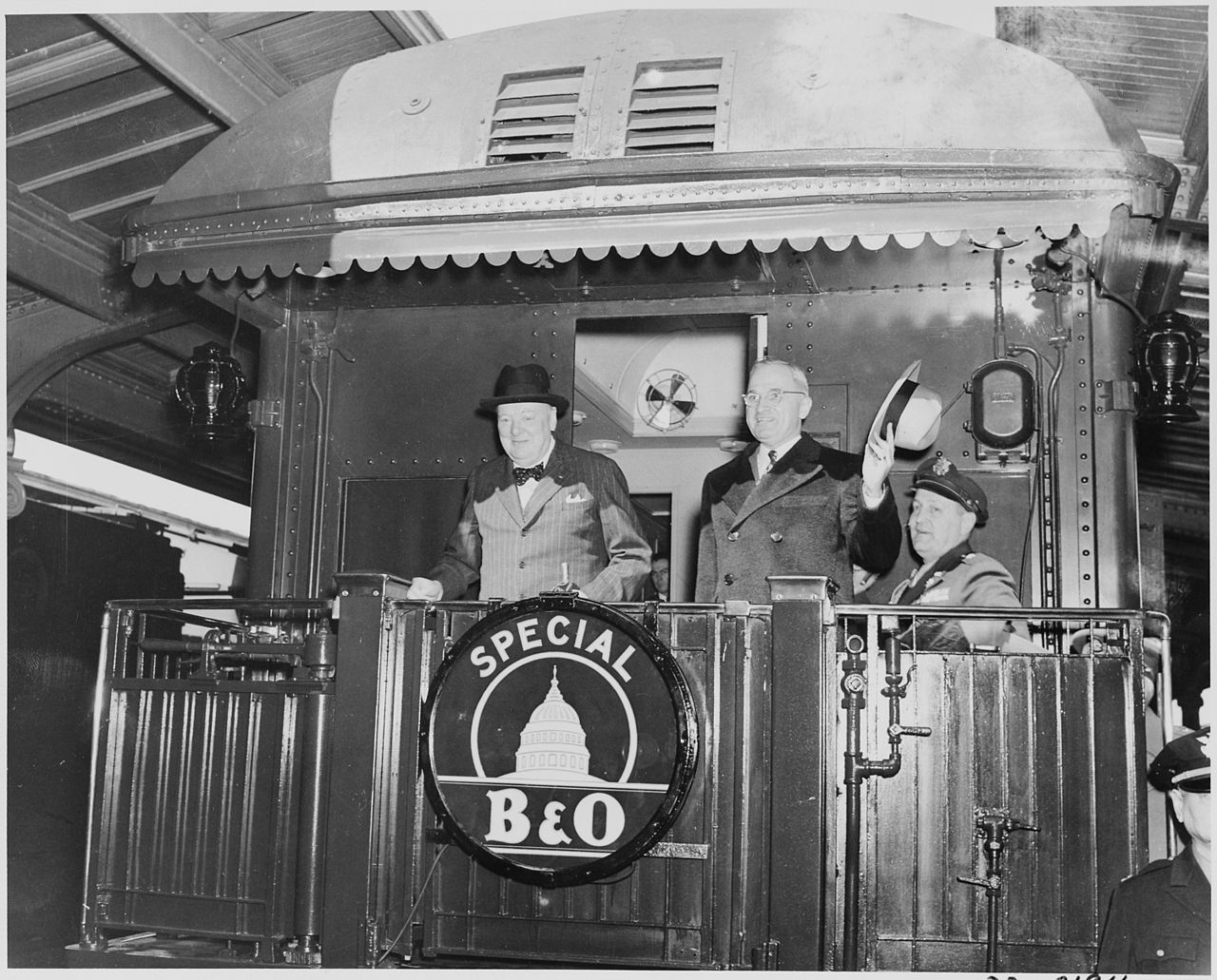
The train photograph used as the cover helps recover that lost dimension. Truman and Churchill are traveling to Fulton together on March 4, 1946, one day before the speech.[5] The image belongs with this article because the speech did not emerge as a private after-dinner reflection or an isolated British lament. It was embedded in an American ceremony, introduced by a sitting U.S. president, and received as a public intervention into the shape of postwar order.[2][5]
Timeline anchors
- March 4, 1946: Truman and Churchill travel toward Fulton, Missouri; the cover photograph records them on the rear platform of the train en route to the event.[5]
- March 5, 1946: Churchill delivers The Sinews of Peace at Westminster College after Truman introduces him before the honorary-degree ceremony.[1][2]
- March 8, 1946: Truman's press conference comments, later cited by Kennan, distance the president from parts of the speech and stress that he would not allow a breakdown of the United Nations.[4]
- March 11, 1946: Kennan reports that the Soviet press has printed large portions of the address and that Pravda is framing it as an Anglo-American alliance proposition aimed at the USSR.[4]
1) The speech begins with ordinary homes, not with Europe's frontier
One reason the speech is often misremembered is that the best-known sentence arrives after a long conceptual setup. Churchill opens by asking for an "overall strategic concept," then answers at the smallest durable human scale: the safety and welfare of homes and families across many lands.[1] That choice is not decorative. It gives the speech a moral unit of measure before any geopolitical map appears. The first danger is not yet Soviet expansion as such. It is the vulnerability of ordinary people to war and tyranny.[1]
This opening matters because it keeps Churchill's argument from starting as pure power politics. He is constructing a chain. Homes require security; security requires legal and political forms that preserve freedom; and those forms, once named, create a standard against which the postwar settlement can be judged.[1] That is why the speech spends time on courts, elections, free speech, and what Churchill calls the "title deeds of freedom."[1] He is marking out the democratic inheritance that he believes the English-speaking world holds in trust.
Seen this way, the famous Europe section later in the speech stops looking like a detached flourish. Churchill has already told the audience what kind of political life matters and what kind of damage war and coercive power do to it. The later list of capitals behind the Soviet line gains force because it follows this prior moral grammar.[1] Without the opening movement through household security and civil liberty, the iron-curtain passage would be only a striking image. With it, the passage becomes an argument about what kind of political space is being lost.
2) The speech's real crux comes before the iron-curtain line
The clearest structural clue in the entire document is Churchill's own signpost. After the opening sections, he says he is coming to "the crux" of what he has traveled to say.[1] What follows is not yet the description of Europe under Soviet pressure. It is the proposition that peace and the growth of world organization require what he calls the "fraternal association" of the English-speaking peoples, meaning a "special relationship" between the British Commonwealth and Empire and the United States.[1]
This section is easy to sentimentalize today because the phrase special relationship later became diplomatic routine. In the speech itself, it is concrete and muscular. Churchill does not stop at civilizational affinity. He specifies continued intimacy between military advisers, common study of danger, similarity of weapons and manuals, exchanges at technical colleges, and the joint use of naval and air bases already held by either power.[1] The proposal is operational before it is rhetorical.
That placement is historically decisive. The speech's most famous line has often been treated as if it generated the alliance logic that followed. The text shows the reverse order. Churchill first argues for Anglo-American strength, military intimacy, and public recognition of that fact; then he turns to the condition of Europe that makes such intimacy necessary.[1] The iron-curtain section is thus not the speech's beginning but its proof.
This also clarifies Churchill's relation to the United Nations. He insists that the special relationship would not weaken the world organization. In his telling, it is the arrangement most likely to give it real "stature and strength."[1] That is a major part of the speech's design. Churchill is not choosing between Anglo-American power and the UN. He is arguing that the latter will remain too thin unless the former supplies discipline, credibility, and deterrent weight.[1]
3) The iron-curtain sentence works as geographic evidence
Only after setting out that alliance proposition does Churchill pivot into the section that later absorbed the entire speech's memory. He begins carefully. A shadow has fallen on the victory scene; he expresses admiration for the Russian people and acknowledges the Soviet desire for security on its western frontier; he welcomes Russia's place among the leading nations.[1] This sequence matters because it narrows the claim he is about to make. He is not saying Soviet anxiety is imaginary. He is saying that security has become domination.
The iron-curtain line then performs its real labor.[1] Churchill draws a visible line across the continent and populates it with capitals: Warsaw, Berlin, Prague, Vienna, Budapest, Belgrade, Bucharest, Sofia.[1] The rhetoric is cartographic. It asks listeners to see Europe not as a blur of postwar uncertainty but as a space already sorted into spheres, police systems, and escalating control from Moscow.[1]
What makes the passage effective is its restraint. Churchill does not call for an immediate war, nor does he advocate forcible intervention in countries the West has not conquered.[1] Instead, he presents the geography of subjection as something already happening in plain sight. The line is powerful because it condenses a sequence of regime changes, coercive pressures, and party takeovers into a form that can be grasped by an American audience in Missouri.[1][2]
That is why the speech repays close reading. The phrase iron curtain became famous, but the sentence is not operating as a free-floating prophecy. It is serving as evidence for an argument that has already been built: democratic inheritance is vulnerable; the UN by itself is too weak; Anglo-American power must be made visible and durable; the map of Europe shows why delay is dangerous.[1]
4) The immediate reception shows how contemporaries heard the speech
The Truman Library's event page is useful because it restores the public staging of the moment.[2] Truman introduced Churchill at Westminster College; the ceremony was folded into honorary degrees and broadcast coverage; and the archived description marks the address as the moment where Churchill introduced the concept of an iron curtain descending across Europe.[2] This was not a stray newspaper essay. It was a high-profile Anglo-American performance under presidential patronage.
Kennan's March 11 telegram from Moscow helps complete the picture by showing how Soviet officials and observers parsed the speech.[4] Pravda did not react as if Churchill had merely coined a memorable phrase. According to Kennan's summary, the Soviet editorial treated the address as a call for the unity of Western democracies under Anglo-American military hegemony, directed against the USSR and threatening the coalition and the UN.[4] Kennan also noted that Moscow had waited to measure American and British reaction before deciding how hard to respond, which meant the Kremlin was reading not just Churchill's words but the political coalition around them.[4]
That reaction is historically revealing. It suggests that the speech's alliance core was perfectly legible at the time. Kennan even remarks on the freedom with which Pravda reproduced some of Churchill's strongest passages and adds a striking observation: against the paper's own doctrinaire language, Churchill's phrasing could appeal "if only by their poetry" to Russian readers.[4] The comment is more than literary. It shows that eloquence and power politics were fused in the document's impact.
The bounded conclusion
The safest conclusion is narrower than the popular legend and stronger than the slogan. Churchill's Fulton address mattered because it tied three things together in a single sequence: a democratic vocabulary of homes, law, and liberty; a concrete Anglo-American security proposition; and a sharply drawn map of Europe's postwar coercive divide.[1][2][4] The iron-curtain line endures because it is memorable. The speech endures because the line was embedded in a full political architecture.
That is why the train photograph is the right cover.[5] It captures the speech before the words themselves took over public memory. Churchill is traveling with Truman toward an American stage, carrying an argument about how peace would need to be organized after victory. Read in that frame, The Sinews of Peace looks less like solitary prophecy and more like an early Cold War design document spoken in ceremonial form.[1][2][4][5]
Sources
- America's National Churchill Museum, "Winston Churchill's Iron Curtain Speech, Fulton, MO" - full text of The Sinews of Peace, including the "title deeds of freedom," "special relationship," and iron-curtain passages.
- Harry S. Truman Library & Museum, "President Truman and Winston Churchill in Fulton, Missouri" - event description, Truman's introduction, ceremony structure, and recording notes for the March 5, 1946 appearance.
- America's National Churchill Museum, "Exhibits Archive of the Winston Churchill Museum in Fulton, MO" - notes on the "Creating the Sinews of Peace" and "Power of Prose" exhibits, including the near-final draft and Churchill's shorthand edits.
- U.S. Department of State, Office of the Historian, Foreign Relations of the United States, 1946, Volume VI, Document 480: Kennan's March 11, 1946 telegram on Soviet press reaction to Churchill's speech.
- Wikimedia Commons, "File: Photograph of President Truman and Prime Minister Churchill standing on the rear platform of a special Baltimore... - NARA - 199349.jpg" - source page for the archival train photograph used as this article's cover.