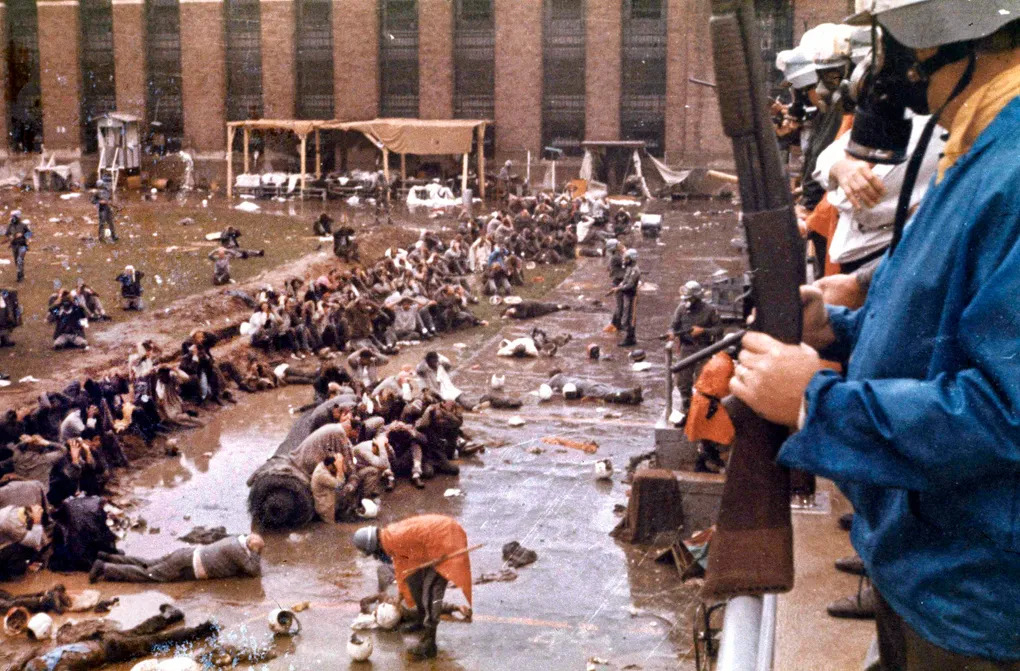
Attica is often remembered through one compressed public-memory formula: prisoners seized a prison, hostages died, and the state restored order.[2][7] The formula is not false in the most skeletal sense, but it hides the part of the story that matters most historically. The lasting scandal of Attica was not only that incarcerated men rebelled in September 1971. It was that New York retook the prison with overwhelming armed force on September 13, then allowed a false story about mutilated hostages to dominate the first account of what had happened.[2][4][5]
That false story mattered because it changed the moral geometry of the event. If the hostages had in fact been butchered by prisoners, then the retaking could be framed as a terrible but necessary rescue. If, instead, the dead hostages were killed by shots fired by the assaulting force, the event reads differently: as a prison uprising followed by a state action that was both lethal and immediately misdescribed to the public.[3][4][5] Attica therefore belongs in myth-vs-evidence history not because the uprising was simple, but because the first widely believed explanation of the deaths was wrong in exactly the place where public judgment was sharpest.
Image context: the cover uses the widely circulated Associated Press photograph of state police during the retaking, not a later memorial image or a generic prison exterior. That choice fits the article because the historical question here is about what the public thought it was seeing in the assault's immediate aftermath, and how that first visual scene was paired with an inaccurate official narrative.[4][8]
Timeline anchors
- September 9, 1971: prisoners seize control of Attica; Officer William Quinn is fatally injured in the initial takeover.[2][7]
- September 10: prisoners elect representatives, and civilian observers are allowed into D Yard to help negotiate.[2]
- September 11: prisoners present 28 demands; Commissioner Russell Oswald accepts many conditions but not the requested amnesty.[2][5]
- September 12: Governor Nelson Rockefeller refuses repeated requests to come to Attica in person.[2][5]
- September 13: state police and other forces retake the prison; 29 inmates and 10 hostages are killed in the assault, with many more wounded.[2][7]
- September 13 to 14: medical findings and later formal investigation show that the dead hostages were killed by gunfire from the assault, not by inmate throat-cutting or castration stories that had raced through early reports.[3][4][5]
The uprising began as a prison-conditions crisis, not as a ready-made atrocity script
The evidence base on Attica starts well before the assault. The New York State Museum's Open Wounds exhibition and the State Archives overview both place the uprising inside overcrowding, racial tension, coercive routine, and a prison system that had become increasingly combustible by the late 1960s and early 1970s.[1][6] Attica had a predominantly Black and Puerto Rican inmate population overseen by mostly white guards from the surrounding region, and the prison's daily conditions had already made it a symbol inside the larger crisis of American corrections.[1][6]
That context does not excuse hostage-taking or the violence of the takeover. It does explain why the prisoners' position in D Yard became legible to outside observers as more than a simple riot. On September 10 and 11, citizen observers entered the yard, prisoners elected spokesmen, and a structured list of demands emerged.[2][5] The confrontation was violent and unstable, but it was also political, public, and negotiative. Once the observers were inside and the demands were on the table, the crisis no longer looked like a sealed interior disturbance. It looked like a legitimacy test for the state.[2][5]
This point matters because myths often gain force by flattening sequence. If Attica is told only as a sudden eruption of inmate savagery, the negotiations become a footnote and the final assault becomes easier to treat as an inevitable answer. The timeline says otherwise. There were several days in which the state weighed demands, resisted amnesty, considered whether Rockefeller would come, and watched the crisis become a national spectacle.[2][5] The retaking was a decision made in that sequence, not a reflex outside politics.
The myth was born in the hours after the assault
The sharpest myth in the Attica story was not about whether the uprising had been serious. It was about how the hostages died. In the immediate aftermath of the September 13 assault, public statements and rapid press circulation created the impression that prisoners had slit hostages' throats, castrated some of them, and committed other mutilations inside D Yard.[4][5] That version fit the emotional needs of the moment almost perfectly. It turned a chaotic armed retaking into a rescue from barbarism, and it pushed the main burden of horror back onto the prisoners.
PBS's American Experience oral-history material preserves the speed of that first framing. One participant recalled that the first reaction, even with the obvious bloodshed, was that the operation had been ugly but successful.[5] The same source also captures what happened once the coroner's findings began to circulate: the interpretive ground shifted fast because the core claim about the hostages did not hold.[5] In other words, the myth was not some later distortion added by distant memory. It was baked into the first public explanation.
That timing is why the error had such force. Early accounts shape the emotional archive that later corrections struggle to overcome. Once newspapers and television viewers had absorbed an image of mutilated hostages and animalized prisoners, the event's public meaning was already leaning toward justification of the assault.[4][5] Corrections could come later, but they had to fight through a story people had already metabolized.
The evidence is narrower than the myth, and much more damning
The best evidence does not produce a clean innocence tale. It produces a stricter, more defensible account. The New York State Archives timeline records the key fact plainly: during the assault, 29 inmates and 10 hostages were killed.[2] The McKay Commission's official report and its televised presentation then pushed the matter further by making clear that the dead hostages had been killed, or fatally wounded, by shots fired by the assaulting force rather than by inmate mutilation.[3][4] That is the decisive correction.
The narrower evidence also imposes important boundaries. Officer William Quinn did die from injuries sustained in the initial takeover on September 9.[2][7] Three inmates were killed by fellow prisoners before the retaking.[4][7] Some surviving hostages did suffer serious wounds from sharp instruments.[4] Those facts are real, and leaving them out would only create a counter-myth. But none of them rescues the first public story. They do not change the central forensic point that the dead hostages in the final assault were not killed by the throat-slitting and castration narrative that gave the retaking its first moral cover.[3][4][5]
This is what makes Attica historically instructive. The evidence does not ask us to pretend the yard was peaceful. It asks us to separate two different claims that were fused together in the first reporting wave: first, that a violent prison uprising had occurred; second, that the hostage deaths in the final bloodshed were the prisoners' doing. The first claim is true. The second, in its widely circulated form, was false.[2][3][4]
Why the false story mattered so much
Attica's hostage-death myth had a long afterlife because it solved several political problems at once. It shifted attention away from prison conditions and toward prisoner monstrosity. It reduced Rockefeller's refusal to appear at Attica on September 12 to a secondary issue.[2][5] It also softened scrutiny of the decision to use state police gunfire, tear gas, and a full armed retaking in a confined yard full of hostages.[3][5]
The New York State Archives description of the later legal record shows how durable the credibility crisis became.[1][2] Investigations, prosecutions, sealed reports, civil litigation, and settlements stretched on for decades. That legal afterlife is part of the historical meaning, not a bureaucratic appendix. When a state kills in the course of retaking a prison and the first public explanation is materially wrong, the event no longer belongs only to prison history. It enters the history of official truth production.
The museum framing is useful here because it keeps Attica tied to race, governance, and memory rather than to spectacle alone.[6] The uprising happened in a prison, but its afterlife belongs to a larger American pattern: public violence becomes easier to defend when the people on the receiving end can be represented as beyond ordinary moral regard. The mutilation myth helped perform exactly that reduction. It made it harder, in the first hours when sympathy and outrage were still fluid, to see incarcerated men as rights-bearing subjects at all.[5][6]
The bounded conclusion
The most responsible conclusion is not that Attica was secretly simple. It is that the strongest myth about Attica was attached to the most consequential deaths. Prisoners did seize the prison, hold hostages, and commit violence.[2][7] The state did face a real crisis. But the public was also told a story that made the final assault look morally cleaner than the evidence allowed.[3][4][5]
That is why Attica still matters. The event tests whether historical memory can hold two truths at once: the uprising was dangerous, and the state's own retaking produced the deaths that were initially laid at the prisoners' feet. Once that distinction is kept in view, Attica stops being a generic riot parable. It becomes a case study in how official narrative can move faster than forensic truth, and how that gap can shape national memory for decades.[1][3][6]
Sources
- New York State Archives, "The Attica Uprising and its Aftermath, 1971-2015" - overview of the records, investigations, and long legal afterlife of the uprising.
- New York State Archives, "Timeline of Events of the Attica Prison Uprising of 1971 and Subsequent Legal Actions" - dated sequence for the takeover, demands, Rockefeller's refusal, the retaking, and the later litigation.
- Civil Rights Litigation Clearinghouse, "Attica: The Official Report of the New York State Special Commission on Attica" - resource page linking the McKay Commission's official report.
- American Archive of Public Broadcasting, "Attica: The Official Report of the New York State Special Commission" - televised presentation and transcript material summarizing the McKay Commission's conclusions on the deaths and the state's response.
- PBS American Experience, "Attica Prison Riot" - oral-history material on the negotiations, Rockefeller's refusal to come, the assault, and the collapse of the first official story.
- New York State Museum, "Open Wounds: The Fifty-Year Legacy of the Attica Prison Uprising" - public-history framing of prison conditions, racial tensions, and Attica's long political legacy.
- Encyclopaedia Britannica, "Attica prison revolt" - concise synthesis of causes, chronology, and the death toll.
- Wikimedia Commons, "File:Attica Prison Riot, 1971.jpg" - file page and provenance for the Associated Press image used as this article's cover photograph.