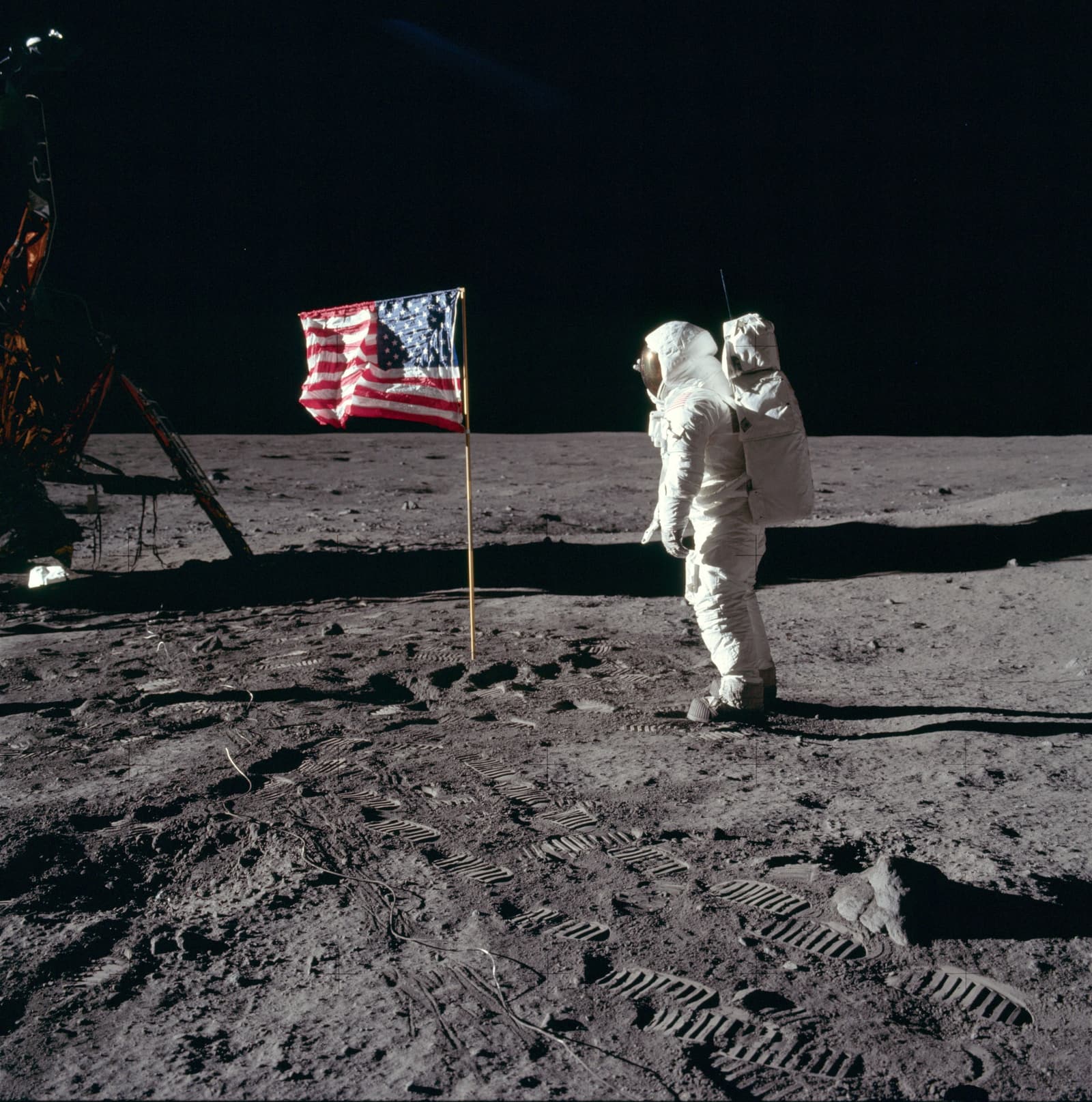
The useful historical question is not whether Apollo 11 had computer alarms during descent—it did—but why a mission that was hearing repeated alarm codes still produced a confident GO for landing call instead of an abort.
An event reconstruction is the right mode here because public memory usually compresses the landing into one iconic line. The risk logic was decided earlier, in a tight sequence of telemetry, voice loops, and pre-committed alarm doctrine.
Reconstructing the decision window (about 102:38–102:46 GET)
1) The context before the alarms: descent already inside a narrow control envelope
Apollo 11’s powered descent began around 102:33 GET in the mission timeline.[1] By this phase, the Lunar Module guidance stack was already balancing throttle management, radar updates, and crew monitoring tasks, while mission rules still left room for continuation if specific classes of computer alarm were judged non-fatal to core guidance/control.[1][3]
This matters because the later GO calls were not improvised bravado; they sat on preflight analysis and role-defined responsibilities.
2) First alarm burst: 1202 appears in real time
In the technical air-to-ground transcript, one key call lands at about 04:06:38 mission-day format (roughly 102:38 GET): Armstrong reports “It’s a 1202.” Mission Control responds moments later with the decisive phrase: “We’re GO on that alarm.”[2]
That exchange is operationally important for two reasons:
- it confirms the issue was recognized as a known alarm class, not an unknown catastrophic failure;
- it shows the control room still had enough confidence in guidance continuity to stay in the landing profile.[2]
3) Alarm recurrence under shrinking altitude margins
The mission report and timeline table show that this was not a one-off anomaly. Multiple alarms appeared during the descent sequence, including 1202 and 1201, while altitude fell through major gates and the crew continued handling trajectory and landing-point redesignation tasks.[1]
In the transcript, at about 04:06:42, another critical exchange appears: “1201 alarm… We’re GO. Same type. We’re GO.”[2]
By then, the lander was already in the low-altitude terminal phase (thousands of feet, then hundreds), where delay penalties rise quickly.[1][2]
4) Final seconds: touchdown chain closes
The same transcript captures the final sequence in tight order:
- 04:06:45:40 — “Contact light”
- 04:06:45:43 — “Engine stop”
- 04:06:45:59 — “Houston, Tranquility Base here…”
- 04:06:46:04 — “The Eagle has landed.”[2]
So the historical reconstruction is clear: repeated alarm acknowledgments and repeated GO calls happened before touchdown confirmation, not after.[2]
What the primary record says about the alarms themselves
Apollo 11’s mission report records five descent-phase computer alarms and states that these were interpreted as symptoms of potential computer overloading, yet not judged to have degraded primary guidance/control performance in a way that required immediate abort.[1]
The same report’s later discussion (computer alarms during descent) characterizes the executive-overflow alarms as normal for the actual situation and consistent with proper guidance-computer behavior under that workload condition.[1]
A practical reading is that the decision was not “ignore alarms,” but “classify alarm type, check whether core control functions remain valid, then continue or abort accordingly.”
Mechanism: why continuation was still rational
A defensible causal chain, based on mission documentation and descent-guidance literature, is:
- workload pressure in LM guidance-computer task scheduling triggers overflow-class alarm signaling,
- alarm semantics indicate overload handling rather than immediate loss of flight-control authority,
- mission-control evaluation loops confirm same-type recurrence with stable enough control state,
- crew continues descent while still ready to break to abort if control-quality boundaries are crossed.[1][2][4]
This chain also explains why the same event is often misremembered. In hindsight, survival makes the call look obvious. In real time, it was a classification problem under a collapsing altitude clock.
Two interpretations, and what would change the assessment
Interpretation A: software architecture resilience was decisive
This interpretation gives primacy to computer design behavior: overload alarms were surfaced while critical guidance continued, enabling continued descent rather than blind failure. Supporting evidence comes from the mission report’s treatment of executive-overflow alarms and postflight guidance analysis.[1][4]
What would weaken A: recovered evidence that core guidance variables were actually diverging beyond acceptable bounds at the same timestamps while controllers believed they were stable.
Interpretation B: decision-tempo governance was decisive
This reading emphasizes human-system operations: alarm recognition, rapid CAPCOM/Guidance loop coordination, and repeated GO/NO-GO decisions in seconds. The transcript’s cadence strongly supports this operational layer.[2]
What would weaken B: evidence that GO calls were made without a validated rule basis, or that continuation was mostly luck unrelated to loop discipline.
The strongest synthesis is that Apollo 11 needed both: resilient alarm behavior and fast, bounded decision procedure.
Why this seven-minute episode still matters
The episode remains high-value outside space history because it shows a pattern common to modern high-risk systems: alerts are only useful when teams can classify them, tie them to known boundaries, and keep a pre-defined abort path live while continuing mission objectives.
The historical takeaway is therefore not “be bold under alarms.” It is: design for graceful degradation, then train institutions to decide quickly inside that envelope.
Sources
- NASA Technical Reports Server (NTRS), Apollo 11 Mission Report (Document ID 19710015566)
- NASA Technical Reports Server (NTRS), Apollo 11 Technical Air-to-Ground Voice Transcription (GOSS NET 1) (Document ID 20160014392)
- NASA Technical Reports Server (NTRS), Apollo 11 Lunar Landing Mission – Press Kit (Document ID 19690022248)
- Klumpp, A.R., Apollo Lunar Descent Guidance (Automatica reprint; NTRS Document ID 19740044219)
- NASA, Apollo 11 mission overview
- NASA History, Apollo Lunar Surface Journal / Apollo Flight Journal portal
- Smithsonian National Air and Space Museum, Apollo guidance computer context
- Wikimedia Commons source image (“Buzz salutes the U.S. Flag”)