The Great Molasses Flood is usually remembered as Boston's strangest disaster, a story so odd that it risks being filed under civic folklore. That framing misses the sharper historical point. What happened on January 15, 1919 was not a random freak event. It was an industrial failure that had been advertising itself in public for years, then turned a working immigrant district into a rescue field in a matter of seconds.[1][2][4]
Read closely, the chronology is brutally clear. A tank built in wartime haste began leaking almost as soon as it entered service in 1915. Residents and workers noticed the seepage, the noises, and the vibration. Those warnings never became a shutdown. When the tank finally burst, roughly 2.3 million gallons of molasses surged through Commercial Street, killing 21 people, injuring around 150, and forcing Boston into a long argument about engineering responsibility, corporate power, and what counted as acceptable risk in a crowded city.[1][2][3][4]
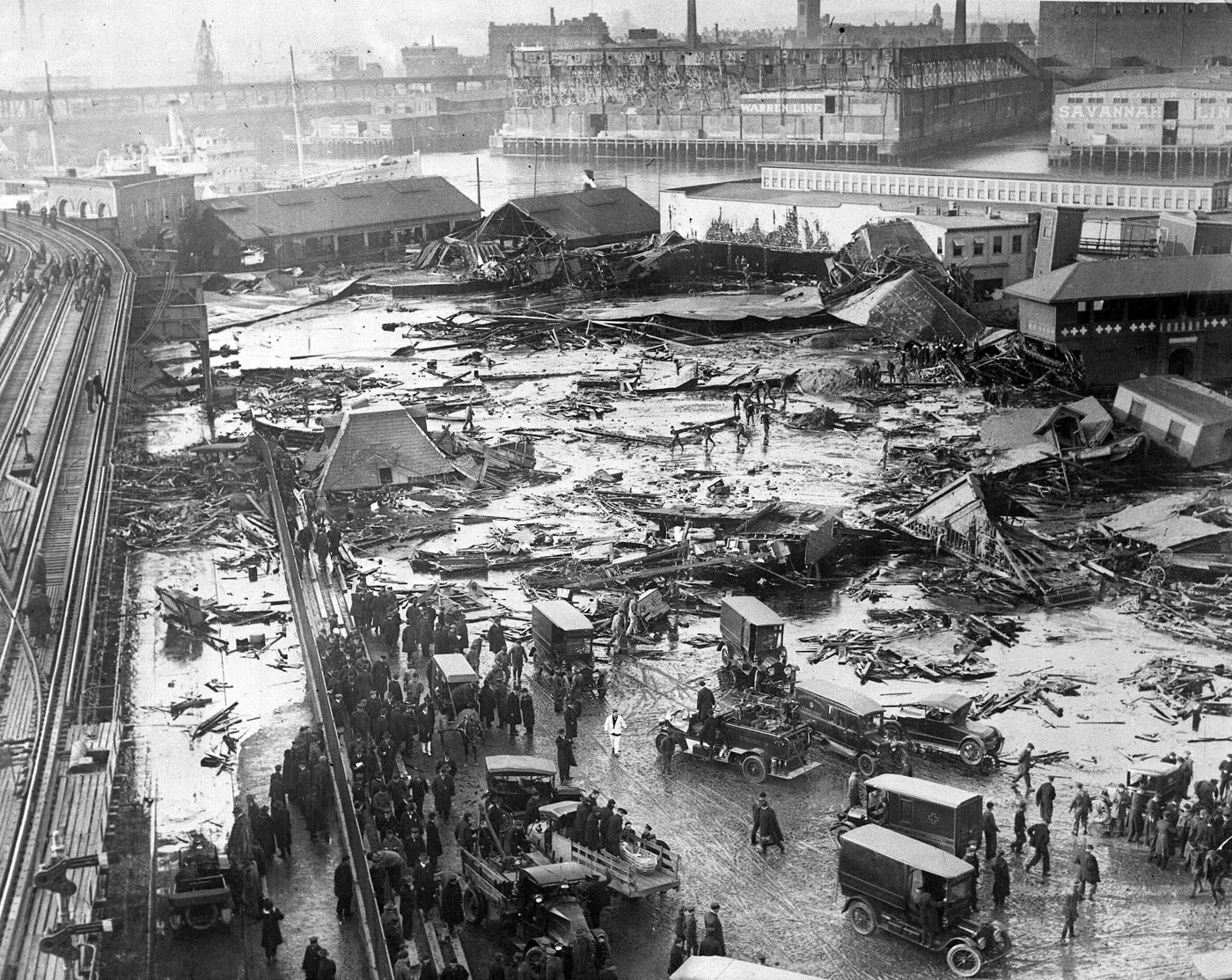
Image context: the cover photograph is the Globe Newspaper panorama taken on January 15, 1919, showing the destroyed site on Commercial Street after the rupture. The frame matters because it captures the event at city scale: elevated rail, warehouses, responders, and the wrecked tank zone all remain visible at once.[5]
Timeline anchors: the disaster was years in the making
- 1915: Purity Distilling's molasses tank was built in Boston's North End under pressure to meet rising alcohol demand tied first to industrial production and wartime uses.[2][4]
- 1915-1918: According to later claims collected by survivors and families, the tank repeatedly leaked or "wept" molasses, made ominous sounds, and was patched rather than taken out of service.[2]
- January 13, 1919: A near-capacity refill arrived from Puerto Rico, leaving the tank heavily loaded just two days before failure.[4]
- Shortly after noon, January 15, 1919: The tank ruptured and a fast-moving molasses wave crossed the district, crushing buildings, damaging the elevated railway, and trapping residents and workers.[1][2][5]
- 1919-1925: A massive legal proceeding followed, with expert reports, thousands of pages of testimony, and eventual liability imposed on the companies that owned the tank.[2][3]
Those dates matter because they shift the event from spectacle to sequence. The flood itself lasted moments. The conditions that made it possible accumulated over years.
Before the rupture: a tank that failed in public
The most important feature of the story is not the wall of molasses. It is the ordinary visibility of danger before the wall arrived.
Mass Moments summarizes the later plaintiffs' case in plain language: the tank had leaked since construction, emitted strange noises, and visibly shook under pressure. Instead of treating these signals as stop-work warnings, the company patched leaks and even painted the tank brown, a detail that became historically durable because it suggested not ignorance but concealment.[2] History.com's reconstruction adds the broader industrial context: the tank had been erected quickly in the winter of 1915, with strong demand for molasses-derived industrial alcohol and little appetite for delay.[4]
That combination of haste and public warning is what makes the event historically legible. Plenty of industrial accidents begin in places ordinary people cannot inspect. This one sat over a busy North End landscape of homes, stables, workshops, and transport lines. Residents did not need expert instruments to know something was off. They saw the leaks. They heard the structure. Children reportedly gathered dripping molasses. In that sense, the pre-disaster years already contained a crude social audit, and the audit failed because observation never translated into binding authority.[2][4]
This is also where class enters the story without needing rhetorical inflation. The district around Commercial Street was not an empty industrial buffer. It was a dense working neighborhood populated heavily by Irish and Italian laboring families, along with municipal workers and waterfront traffic.[1][2] The hazard sat close to people with little leverage over corporate decision-making. That spatial fact shaped both the body count and the later moral force of the lawsuits.
January 15, 1919: when the whole neighborhood lost its footing
By the time the tank burst shortly after noon, the district was in the middle of a normal workday rhythm. Public-works employees were outside for lunch. Laundry was being hung. Traffic moved through the area. The elevated railway carried passengers above the street. Then witnesses heard a deep rumbling failure and the tank came apart.[1][2]
Descriptions differ on the exact height of the wave at different points in its path, but the core sequence is stable across sources. A huge brown mass surged outward at extraordinary speed, traveling over roughly two blocks and hitting buildings, vehicles, rail supports, animals, and people almost immediately.[1][2][5] The Commons panorama used for the cover shows why this was so destructive. The tank did not fail into open ground; it failed into a built urban corridor with very little room to dissipate force.[5]
The disaster's mechanics mattered. Molasses is heavy enough to hit like moving freight and sticky enough to keep harming after impact. History.com notes modern engineering analysis that treats the flood as a compound event: flawed materials and poor design made rupture possible, while temperature and flow behavior helped turn the release into something closer to a moving wall than a simple spill.[4] That is useful because it explains why the event could behave violently at first and then become a rescue trap almost immediately afterward.
This is the moment when "odd disaster" becomes a misleading label. A strange material was involved, but the structure of harm was familiar: stored industrial mass, poor oversight, crowded surroundings, and a failure pathway that crossed directly into civilian life.
Rescue in syrup, debris, and cold
Boston Public Library's disaster guide is especially strong on what came next. Rescuers struggled to reach victims because the scene hardened as they moved through it. The sticky residue coated bodies, obscured faces and clothing, trapped horses, and made identification slow and grim.[1] Mass Moments likewise emphasizes that the wave engulfed everything in its path, leaving survivors and responders to work in a field where every step resisted them.[2]
That post-impact environment matters historically because casualty counts alone cannot show what kind of emergency this was. Fire, floodwater, and collapsing masonry each produce distinct rescue logics. Molasses created one more layer: the thing that had already struck the district kept acting on it after movement slowed. Boston Public Library notes that rescuers eventually gave up the search for survivors after four days, not because the city lacked concern, but because the conditions of the site had become nearly unworkable.[1]
The damage reached well beyond a single tank lot. BPL highlights the elevated structure twisted by the force of the event, the firehouse thrown off its foundations, and the narrow avoidance of an even worse rail catastrophe.[1] The panorama reinforces that scale visually: vehicles, responders, and wrecked buildings share the same muddy field, making the neighborhood look less like a street after an accident than like a war-damaged logistics zone.[5]
The liability fight: sabotage as defense, negligence as finding
The legal afterlife is not an appendix to the disaster. It is part of the event reconstruction because it determined how the flood would be interpreted in public memory.
In the immediate aftermath, the companies involved pushed an anarchist sabotage theory. Mass Moments records that claim directly and then sets it against the plaintiffs' counter-story: the tank had been hastily built, overloaded, and allowed to deteriorate in plain view.[2] History.com shows why the sabotage line had political traction in 1919. Boston was living through wartime tensions, labor conflict, and the first Red Scare, so attributing failure to radicals offered a culturally available way to shift blame off engineering and management.[4]
The hearings that followed were enormous. Lehigh University's description of the Albert Ladd Colby collection is especially useful here because it preserves the scale of the technical battle. Colby was hired as an expert for the defense; the archive contains test reports, blueprints, steel photographs, and summaries of testimony created to explain "what caused the explosion."[3] That is important evidence even beyond the specific conclusions, because it shows that the case became a contest over expert authority, not just eyewitness grief.
The proceeding ran for years. Lehigh notes 125 lawsuits, more than $1 million eventually paid by Purity Distilling and United States Industrial Alcohol, and a hearing remembered as the longest in Massachusetts court history.[3] Mass Moments summarizes the public outcome more bluntly: after five and a half years, Colonel Hugh Ogden found the company liable.[2] The sequence matters because it turned neighborhood complaint into legally recognized negligence. Boston did not simply mourn the dead; it was forced to document failure.
Why the flood still matters
The Great Molasses Flood belongs in urban history not because it was bizarre, but because it exposed a recurring governance problem: visible risk can remain non-actionable when the people who see it are not the people empowered to stop it.
This is why the pre-rupture leaks matter as much as the rupture itself. They reveal a city in which warning signs were socially legible but institutionally weak. The lawsuits then helped close that gap by turning neighborhood observation, expert metallurgy, engineering drawings, and courtroom procedure into one chain of accountability.[2][3][4]
That longer reading also explains why the event survives so strongly in Boston memory. The smell, the absurdity, and the image of streets running brown make it memorable. The deeper reason it endures is that the flood compressed three histories into one scene: immigrant neighborhood vulnerability, industrial negligence, and the slow construction of modern safety oversight. Once those layers are visible, the disaster stops looking like a curiosity and starts looking like a very early twentieth-century lesson in what happens when a city lets a known hazard sit in plain sight.[1][2][3][4][5]
Sources
- Boston Public Library, Boston Disasters: Molasses Flood (overview, neighborhood damage, rescue conditions, and aftermath resources).
- Mass Moments, January 15, 1919: Great Molasses Flood (warning signs, sabotage claim, casualty figures, and liability outcome).
- Lehigh University Special Collections, Albert Ladd Colby Report on the Boston Molasses Tank Explosion (defense expert archive, lawsuit count, settlement scale, and court-history note).
- History.com, The Science Behind the Great Molasses Flood, One of Boston's Strangest Disasters (tank construction context, refill timing, and later engineering interpretation).
- Wikimedia Commons, BostonMolassesDisaster.jpg (Globe Newspaper panorama metadata and image provenance).