
By the time Soviet force returned to Budapest on 4 November 1956, the Hungarian Revolution had already become easy to compress into a familiar Cold War sentence: a reformist national uprising, briefly hopeful, then crushed by tanks.[2] That summary is true, but the archival footage preserves something the summary flattens. For several days, the revolution was experienced not as doctrine but as a change in how the city itself worked. Streets were blocked, trams were wrecked, stars were torn down, books and papers burned in piles, civilians ran for cover, and the ordinary routes of urban life became a visible argument about who governed Hungary.[1][2]
That is why the British Pathé reel below still matters.[1] It does not explain the uprising through a retrospective voice-over full of geopolitical hindsight. It shows a city mid-conversion. Budapest appears as a place where public surfaces have lost neutrality: tanks hold intersections, civilians watch from doorways, Red Cross vehicles race through damaged streets, and bodies, wreckage, and propaganda debris occupy the same frame. The film catches the revolution at the point where state power has not vanished, but its monopoly on the street has clearly fractured.
The strongest way to read the footage, then, is not as a generic clip of East Bloc unrest. It is a document of brief civic repossession.[1][2] What had been controlled by the party-state becomes, in those few days, physically negotiable. The camera keeps returning to roads, curbs, squares, and facades because that is where authority has to prove itself. Budapest in 1956 was not only a capital under pressure. It was a city whose infrastructure was temporarily rewritten by insurgency.
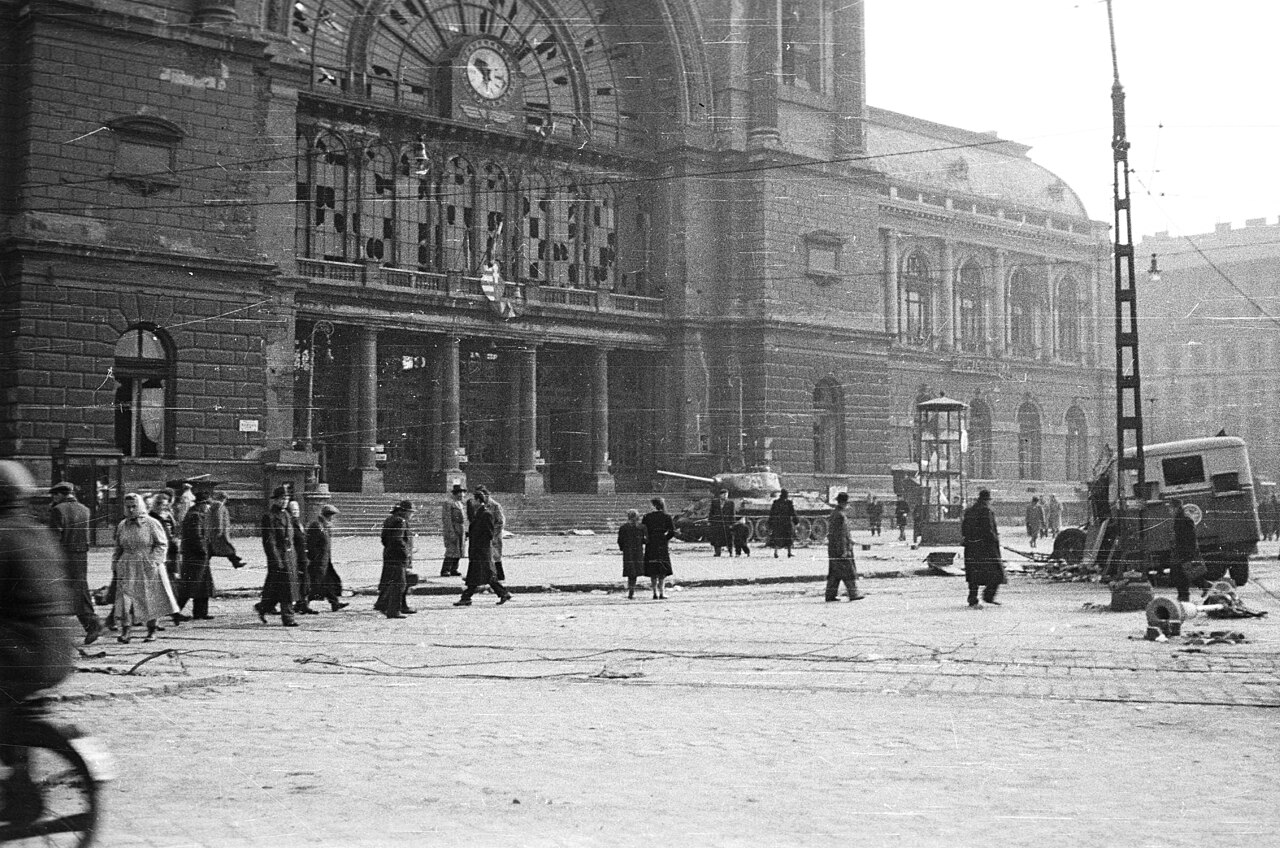
Image context: the cover uses a real Fortepan/Wikimedia Commons photograph of damaged Keleti railway station during the 1956 uprising.[4] It fits the article because the point is urban before it is abstract. The revolution changed meaning once transport nodes and public buildings looked damaged, permeable, and newly political. A station facade, no less than a parliament speech, became evidence that the regime had lost hold of the everyday city.
Historical context: the uprising opened a short window in which Budapest stopped behaving like a governed Soviet-bloc capital
Wilson Center's retrospective on 1956 remains one of the clearest concise frames for the event.[2] Student-led demonstrations erupted in Budapest on 23 October 1956, drawing in wider public anger toward Stalinist rule, Soviet domination, censorship, and economic hardship. Reform communist Imre Nagy returned to power as the crisis widened, and for a moment the revolution looked as if it might force a different settlement: less terror, more national autonomy, and some escape from the rigid Soviet order.[2]
That short opening is crucial. The revolution did not begin as a clean military confrontation between two fully formed armies. It began as a public political rupture inside the city. Demonstrations widened; symbols of communist rule were attacked; armed resistance formed unevenly; and the streets themselves became the stage on which competing claims to legitimacy were tested.[1][2] This is why archival imagery from Budapest feels so crowded with mixed roles. Civilians, militia, soldiers, ambulances, tanks, and bystanders all occupy the same urban frame. The event had not yet been sorted into stable categories.
The later Soviet intervention on 4 November gave the story its terminal shape, but the footage shows why that intervention had to be so overwhelming.[1][2] Budapest had ceased, however briefly, to behave like a city whose public grammar was settled. Roads did not simply carry traffic. They carried barricades, tank columns, rescue runs, and panic. Buildings did not simply house offices or apartments. They became sniper points, cover, targets, hospitals, and propaganda surfaces. Once authority is challenged at that level, repression has to retake not only institutions but routes.
The aftermath confirms how short and how consequential that window was. USCIS's archival account of Operation Safe Haven notes that the uprising and Soviet suppression drove roughly 200,000 Hungarians to flee the country, creating one of the earliest major refugee crises of the Cold War and eventually bringing thousands to the United States through emergency resettlement efforts centered on places such as Camp Kilmer in New Jersey.[3] The revolution therefore belongs to two histories at once: the history of urban revolt inside Budapest and the history of Cold War displacement beyond Hungary.
Video provenance
The embedded video is "The Battle Of Budapest: Hungarian Revolution (1956)", published on YouTube by British Pathé.[1] That provenance matters for an archival spotlight. British Pathé is not adding a modern interpretive essay over recreated visuals. It is circulating period newsreel footage from the crisis itself, preserved under the archive's film catalog and accompanied by shot-level description. The clip is therefore useful not only for what happened in Budapest, but for how a mid-century newsreel archive framed the event: tanks, streets, crowds, wrecked trams, damaged buildings, and the uneasy closeness between civilians and combat.
Close reading: what the footage shows about revolution as a battle over civic surfaces
The clip opens with streets that no longer read as infrastructure first.[1] Tanks sit in the same visual field as wrecked vehicles and shelled facades. The camera does not treat the road as a neutral strip between buildings. It treats it as the revolution's main instrument panel: this is where motion is interrupted, where armor announces force, and where civilians learn, in seconds, whether a corner is still passable. The uprising becomes visible as a change in the usability of the city.
That is why the damaged architecture matters so much. A shattered wall or blown-out facade is more than background texture.[1][4] It records a broken boundary between military power and civilian life. The Keleti station photograph used for the cover carries the same meaning.[4] Stations and major squares usually stabilize a city by organizing flow. Here, one of Budapest's major transit fronts appears broken, crowded, and uncertain. The revolution is legible not only because people proclaim it, but because the built environment stops performing normal order.
The footage also keeps insisting on proximity.[1] Civilians stand beside tanks, peer from doorways, run along pavements, or cluster around wreckage. That closeness is one of the clip's deepest historical facts. The revolution was not fought somewhere outside the city while residents watched from safety. It unfolded inside ordinary circulation space. Women running for cover, a Red Cross lorry speeding past, people pushing a stranded car out of danger, and armed men moving cautiously along the roadway all suggest the same thing: urban routine and armed emergency had collapsed into one another.
One of the sharpest sequences in the Pathé description is not even the tank movement itself, but the symbolic work happening in the same streets.[1] A woman tries to pull down a red star from a building. Communist books and papers burn in a pile in the road. These are not side details. They show that the uprising was aimed not only at bodies and positions, but at the visible language of regime ownership. The revolution attacks symbols where symbols live: on facades, on signs, in paper, in street names, in monuments, and in the visual assumptions of public space.
Another revealing detail is the recurring mix of speed and pause.[1] Tanks advance, vehicles race, people sprint for cover, and then the camera lands on stillness: a bandaged man, bodies in the street, civilians staring, wrecked trams lying at angles that make forward motion impossible. That alternation helps explain why the footage feels more unsettling than a conventional battle reel. It is not a front line moving cleanly in one direction. It is a city repeatedly trying to resume itself and failing.
Even the newsreel's limitations are historically useful.[1] It does not give viewers a full constitutional explanation of Nagy, party reform, or Soviet bloc doctrine. Instead it records the material consequences of those struggles. That is precisely why the clip works so well as a primary texture for this article. Political systems are often easiest to misremember at the level of slogans. The camera forces a harder memory. It shows what happens when a regime's crisis reaches the curb, the tram track, the hospital wall, and the station entrance.
Legacy: why this footage still matters now
In later Cold War memory, Hungary 1956 is often folded into a morality tale of hope and betrayal, and there is good reason for that.[2][3] The revolt opened real expectations, Soviet power returned, and the refugee aftermath spread Hungarian lives across Europe and North America. But the footage adds a more precise lesson. Revolutions are not only judged by who wins at the end. They are also judged by whether they briefly change the ownership of public reality. In Budapest, for a short span, they did.
That is why the clip still holds in 2026.[1][2][3] It preserves the moment before the uprising was reduced to an after-action verdict. The film shows Budapest as a city in which transit, shelter, symbolism, and danger were all being renegotiated at once. The later refugee history recorded by USCIS gives the story its human afterlife beyond Hungary.[3] The Fortepan station photograph gives it a fixed urban face.[4] Together they make the revolution harder to flatten. It was not only a Soviet suppression story. It was also a brief and violent experiment in taking the city back into public hands.
Sources
- British Pathé, "The Battle Of Budapest: Hungarian Revolution (1956)," YouTube video.
- Wilson Center, "Looking Back at the Cold War: 1956" - overview of the Hungarian Revolution's place in the wider crises of 1956, including Budapest, Imre Nagy, and Soviet repression.
- USCIS, "Operation Safe Haven: The Hungarian Refugee Crisis of 1956" - on the refugee flight after the Soviet crackdown and the U.S. resettlement response.
- Wikimedia Commons, "File:Baross tér, Keleti pályaudvar. Fortepan 24702.jpg" - archival Budapest 1956 photograph used for the cover image.