Haymarket is remembered less as a single event than as a quarrel over what an event should mean. On the evening of May 4, 1886, a labor meeting near Chicago's Haymarket Square was nearly over when police advanced, a bomb exploded, and gunfire followed.[2][3][5] That sequence produced deaths, arrests, a trial, executions, pardons, statues, cemetery rituals, May Day speeches, and finally a city memorial designed to hold more than one interpretation at once.[2][4][5][7]
The memory problem begins there. If Haymarket were only a bombing, commemoration would center on the police killed by the blast and gunfire. If it were only a labor martyr story, commemoration would center on the eight accused anarchists and the courtroom that convicted them. The historical record keeps both claims in view. Seven police officers died; civilians also died; the bomb thrower was never positively identified; the trial of the "Chicago Eight" turned speeches, writings, and political fear into a murder case.[3][5] The public memory of Haymarket was built from that unresolved mixture.
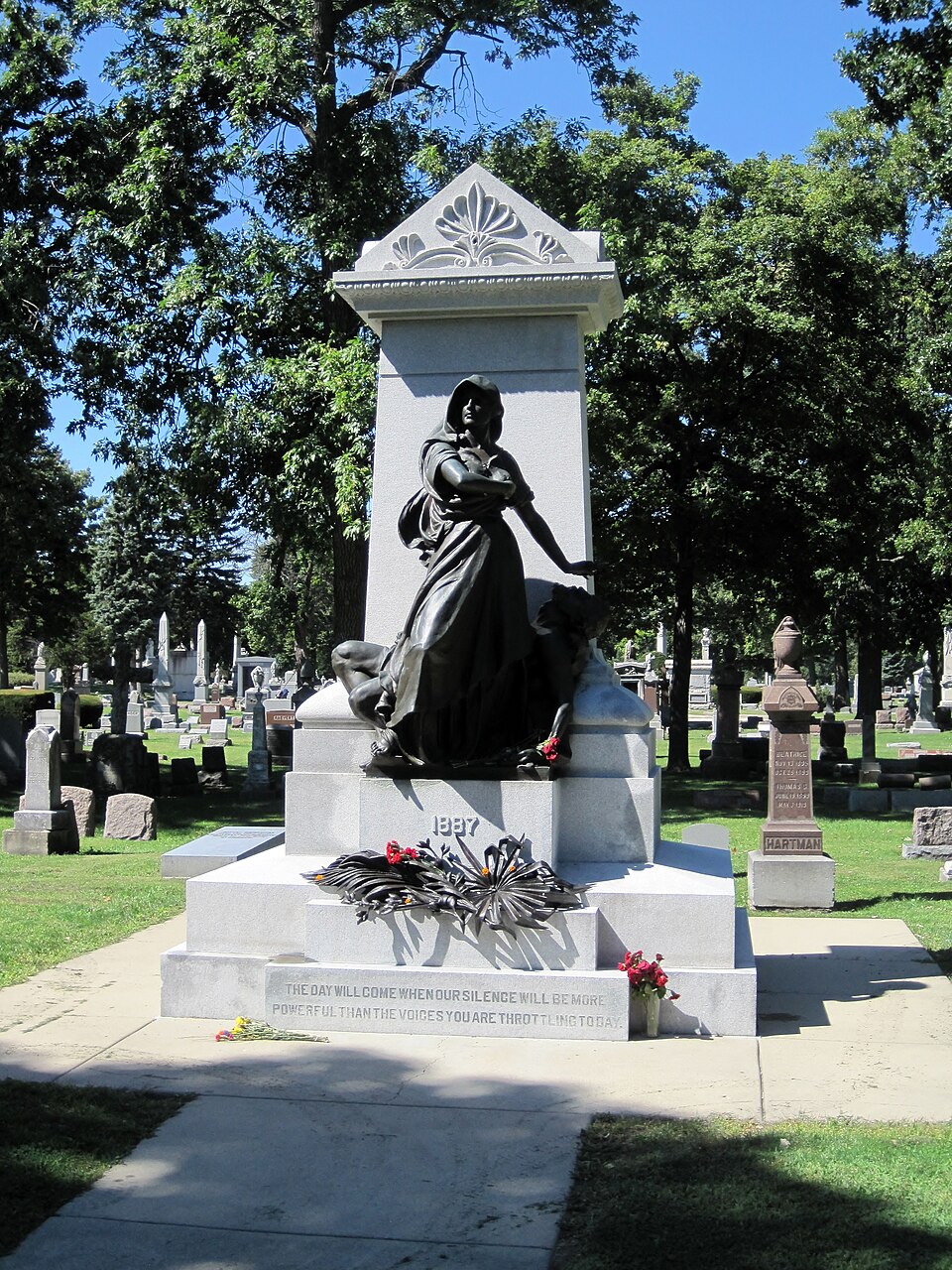
Image context: the cover image is a real photograph of the Haymarket Martyrs' Monument in Forest Home Cemetery. It is useful here because the monument marks memory's displacement: the most durable labor memorial to the Haymarket Affair stands away from the original street site, at the graves of the executed men and their circle of remembrance.[1][2]
The square made one kind of memory
The event itself was tied to the eight-hour-day movement. In 1884, the Federation of Organized Trades and Labor Unions called for May 1, 1886 to open a nationwide campaign for the eight-hour day; when the date arrived, Chicago became one of the movement's centers.[2] The Encyclopedia of Chicago describes a week of meetings, parades, and workplace mobilization between April 25 and May 4, with tens of thousands joining walkouts and marches.[4]
Violence at the McCormick reaper plant on May 3 moved the story from industrial action to public outrage. Police fired at strikers, killing at least two, and anarchists called a protest meeting for the next evening at the West Randolph Street Haymarket.[4] Mayor Carter Harrison attended the May 4 meeting and regarded it as peaceful before leaving; later, as the crowd dwindled, police under Inspector John Bonfield ordered the remaining gathering to disperse.[4][5]
Then the bomb changed the scale of interpretation. Britannica summarizes the enduring uncertainty: the person who threw it was never positively identified.[5] That uncertainty mattered because the legal aftermath did not depend on proving that the defendants had thrown the bomb. It depended on a theory of conspiracy, political incitement, and shared responsibility.[4][5] From the beginning, then, Haymarket memory attached itself to a question that was larger than the blast: how much danger could a society assign to language, association, and radical politics when a violent act had no known hand?
The first memorial grammar was therefore civic alarm. Chicago newspapers, police officials, and anxious business leaders could read Haymarket as proof that labor radicalism, immigrant politics, and anarchism had crossed into public terror.[4][5] That memory had a street address, uniforms, dead officers, and a warning attached to it. It made the city site itself feel like a place where order had been attacked.
The trial made another memory
The second memory formed around the courtroom and the scaffold. Chicago History Museum's Haymarket Digital Collection shows why the trial became an archive almost immediately: broadsides, weapons, badges, cabinet-card photographs, trial transcripts, evidence books, and autobiographical manuscripts all survived as material traces of the struggle to define what happened.[3] The collection notes that photographic portraits of the defendants and sites connected with the bombing circulated widely during and after the trial, at a moment when photography carried a special claim to literal truth.[3]
That visual circulation mattered. A trial about conspiracy needed faces. Portraits of August Spies, Albert Parsons, Adolph Fischer, George Engel, Louis Lingg, Samuel Fielden, Michael Schwab, and Oscar Neebe turned defendants into portable icons, whether the viewer saw criminals, radicals, victims, or martyrs.[3][5] The same medium could serve prosecution memory and defense memory. A photograph did not settle the meaning of a face; it made the face repeatable.
Gilder Lehrman's spotlight on Dyer D. Lum's A Concise History of the Great Trial of the Chicago Anarchists points to the defense-side memory being made in print while the case was still raw.[6] Lum treated the defendants as victims of an inquisition against labor radicalism, a reading that later labor memory would carry forward. The Encyclopedia of Chicago is blunt about why that reading endured: prosecutors lacked credible evidence that the defendants threw or organized the bomb throwing, focused instead on writings and speeches, and secured convictions through a conspiracy theory that the entry describes as legally unprecedented.[4]
On November 11, 1887, four defendants were hanged: Spies, Parsons, Fischer, and Engel; Lingg died in his cell the previous day.[2][4][5] Two other death sentences had been commuted, and Neebe had received a prison term.[2][5] When Governor John Peter Altgeld pardoned the remaining imprisoned defendants in 1893, he condemned the trial as unjust and helped make the martyr interpretation more than a partisan memory.[2][4][5] The pardon did not erase the dead police. It changed the public status of the convicted men.
The cemetery turned defeat into ritual
The Haymarket Martyrs' Monument gave that second memory a durable place. The National Park Service identifies the monument as a National Register of Historic Places and National Historic Landmark site in Forest Home Cemetery, Forest Park, Illinois, and describes its dedication in June 1893 by the Pioneer Aid and Support Association, a group organized to support the accused men's families.[2] Its bronze composition presents Justice placing a wreath on a fallen worker.[2]
That design made a sharp argument without needing a long inscription. It did not show the bomb. It did not show the police line. It did not stage the chaos of Des Plaines Street. It moved the emotional center to death, sacrifice, and vindication. The worker lies fallen; Justice stands over him. The verdict implied by the sculpture is moral rather than forensic.
The cemetery location also mattered. A grave monument gathers visitors differently from a street marker. It invites pilgrimage, speeches, flowers, anniversaries, and names spoken aloud. By standing with the dead rather than at the original conflict site, the monument turned Haymarket into a memory of political suffering and labor inheritance.[1][2] The place says that the aftermath belongs inside the event.
This is why Haymarket traveled so well into May Day. Britannica states that in 1889 the Second International connected May 1 with International Workers' Day in commemoration of Haymarket, and the Encyclopedia of Chicago notes that workers' organizations around the world made May Day an international labor holiday.[4][5] The event's global afterlife depended on portability. Most May Day marchers would never stand in Forest Home Cemetery or at Randolph and Des Plaines. They could still inherit the story as a ritual date: May 1 as the day the eight-hour demand, police violence, trial injustice, and labor solidarity were compressed into a calendar.
The police monument carried a rival claim
Haymarket also produced a police memory with its own monument. The Encyclopedia of Chicago records that in 1889 a statue honoring the dead police was erected at the Haymarket site.[4] That statue made a different civic claim: the public dead to be named were officers; the site to be marked was the place of attack; the warning was against disorder and violence.
The later history of the police statue shows how unstable that memory became. The Encyclopedia's 2005 Haymarket Memorial source page says the police statue was bombed in 1969 and 1970 and eventually moved inside the Chicago Police Academy.[7] The older monument did not simply age into consensus. It became an object in later fights over police power, protest, and the politics of public space.
That relocation changed the commemorative map. The labor martyrs' monument remained public in a cemetery, while the police monument moved into an institutional setting. The original street site, for a time, carried absence as much as memory. That absence was itself an interpretation: Haymarket had become too contested to be held by one inherited statue.
The 2004 memorial accepted contest as the subject
The city returned to the site in 2004 with Mary Brogger's Haymarket Memorial, a speakers' wagon form near the original location. The Encyclopedia of Chicago describes it as intended to accommodate multiple views of the event.[7] That is the key. By the early twenty-first century, a single heroic figure could no longer carry the whole story.
The wagon form shifts attention from verdict to public speech. It recalls the meeting itself: workers gathered, speakers addressing a crowd, police authority approaching, rain and darkness closing in, and a city unsure how to distinguish dissent from danger.[5][7] It does not require the viewer to choose one memory before entering the space. Instead, it makes public assembly the shared fact from which the competing memories grow.
This is the most useful way to read Haymarket now. The event generated at least three durable commemorations: the police memorial, the martyrs' monument, and May Day. Each preserved a real part of the record. The police memory preserved the dead officers and the fear of political violence. The martyrs' memory preserved the trial's injustice and the executed radicals' afterlife in labor politics. May Day preserved the eight-hour-day movement and turned Chicago's local crisis into international ritual.
Haymarket never settled because its sources never fully settle. The bomb thrower remains unnamed. The trial record preserves procedure and prejudice together. The monuments stand in different places because they answer different questions. What happened on May 4, 1886, belongs to event history. What people did with it afterward belongs to memory history. Haymarket's power lies in the fact that the second history has lasted almost as long, and traveled farther, than the first.
Sources
- Wikimedia Commons, "File:Haymarket Martyrs Monument (7402970314).jpg" - source page for the photographed Haymarket Martyrs' Monument used as the article image.
- National Park Service, "Haymarket Martyr's Monument" - official place page covering the Forest Home Cemetery monument, June 1893 dedication, landmark status, and Haymarket chronology.
- Chicago History Museum, "The Haymarket Affair Digital Collection: Highlights of the Collection" - primary-source artifacts, photographs, trial records, and material evidence surrounding the incident and trial.
- Encyclopedia of Chicago, "Haymarket and May Day" - local historical synthesis of the 1886 events, trial, monuments, police statue, and May Day memory.
- Encyclopaedia Britannica, "Haymarket Affair" - overview of the bombing, casualties, trial, pardons, and International Workers' Day afterlife.
- Gilder Lehrman Institute of American History, "The Haymarket Affair, 1886" - primary-source spotlight on Dyer D. Lum's contemporary defense-side account of the trial.
- Encyclopedia of Chicago, "Haymarket Memorial, 2005" - local source page on the 2004 Mary Brogger memorial, contested memory, and relocation of the police statue.