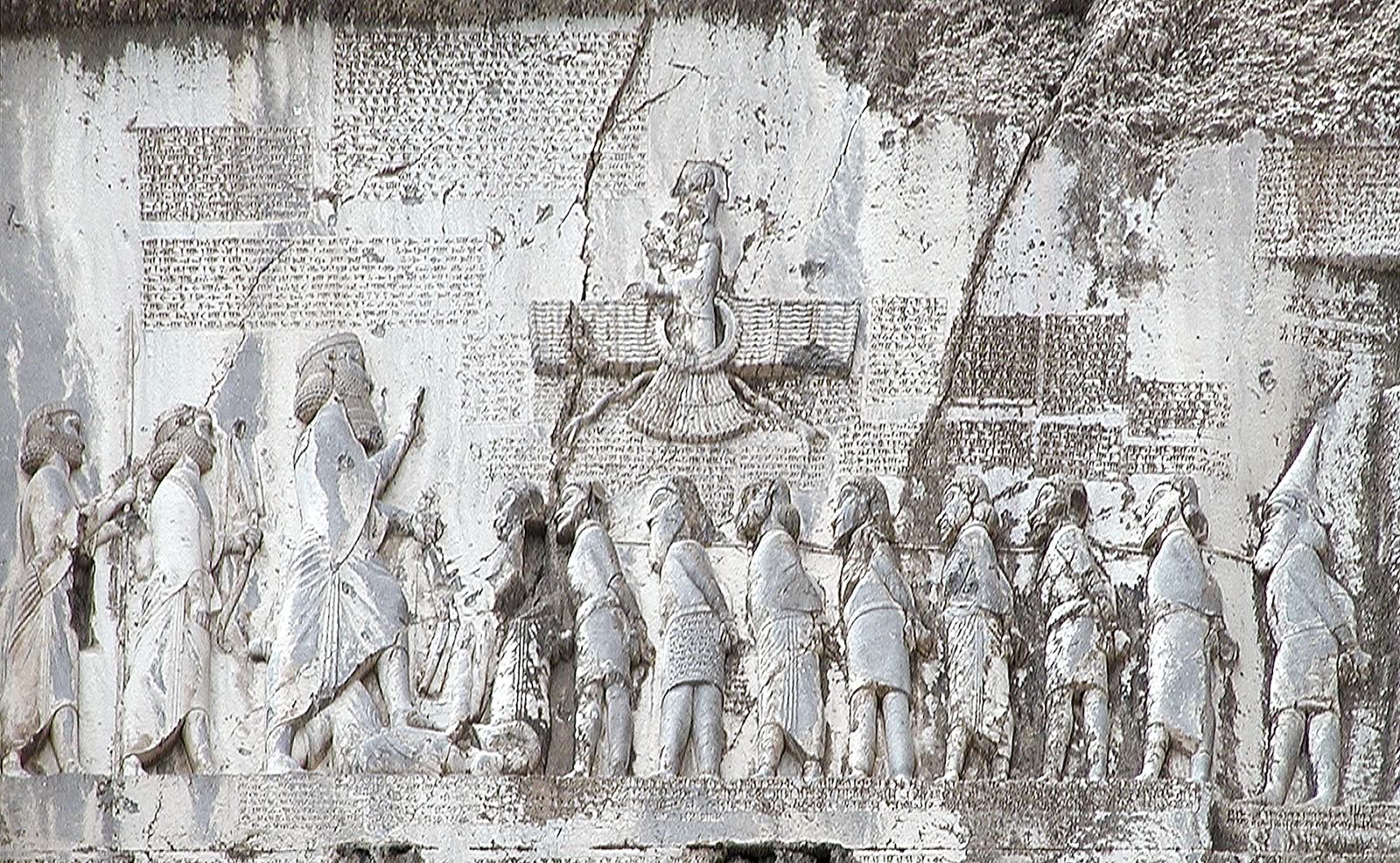
The Behistun inscription is often introduced as a key to cuneiform, the Near Eastern cousin to the Rosetta Stone. That afterlife is real, but it can hide the text's original work. Before nineteenth-century scholars used it to recover scripts, Darius I used it to solve a political problem: how to make his seizure of power look like restoration rather than usurpation.[2][3][4][6]
The monument sits high on the Bisotun cliff in western Iran, on an old route between the Iranian plateau and Mesopotamia. UNESCO dates the principal relief and inscription to Darius's accession moment in 521 BCE and describes roughly 1,200 lines of text arranged below and around the royal scene.[2] Livius's text pages preserve the repeated opening formula in which Darius names himself, his father Hystaspes, his Achaemenid ancestry, and his royal rank before the story of revolt begins.[3] Read closely, that sequence is the argument. The inscription does not merely report a civil war. It builds a filing system for legitimacy.
Image context: the cover image is a real photograph of the Behistun relief and inscription. It is useful here because the political message is inseparable from the medium: a ruler's body, bound rebels, and columns of writing fixed to a cliff above a road.[1][2]
The scene says authority before the text explains it
The relief gives the reader a verdict before the narrative starts. Darius stands upright with a bow, one foot placed on the defeated Gaumata, while a line of bound opponents faces him.[2] The image is not a neutral illustration. It is a compressed court scene: the king is already vertical, armed, and recognized; the challengers are already reduced to captives. The text then teaches the viewer how to name that tableau.
That order matters. A passerby did not need to read Old Persian, Elamite, or Babylonian to register the political grammar. A king, a divine sign above, a defeated pretender below, and a procession of rebels create a hierarchy in stone.[2][5] The inscription supplies the administrative expansion of that hierarchy. It names people, provinces, months, campaigns, and punishments, converting visual domination into a sequence that can be repeated in language.
This is why Behistun is more than royal boasting. Boasting can be vague. Behistun is obsessively indexed. The repeated formula "King Darius says" keeps pulling the story back to an authorized speaker, while the lists of kinship and rebels keep turning unstable events into categories.[3][4] The monument's first move is to decide who has standing to narrate the crisis.
Lineage comes first because the accession was vulnerable
The first column does not begin with battles. It begins with identity. Darius names himself as king, then works backward through Hystaspes, Arsames, Ariaramnes, Teispes, and Achaemenes.[3] The logic is simple and urgent: if the succession can be contested, the first proof must be genealogy.
That genealogical opening does two things at once. It presents Darius as part of an old royal house, and it narrows the audience's choices. The reader is not invited to consider a field of possible claimants. The inscription says, in effect, that there is a recognized line and that Darius stands inside it.[3] Only after that frame is in place does the story move to Cambyses, Bardiya or Smerdis, and Gaumata.
The vulnerable point is visible in the narrative Darius gives. Cambyses, he says, killed his brother Smerdis in secret before going to Egypt; then Gaumata rose up claiming to be Smerdis, and the peoples went over to him.[4] Whether one accepts Darius's version in full is a separate historical question. The important point for close reading is that the inscription knows where the problem lies. Darius has to explain why a man who was not the direct heir could kill the man ruling in the heir's name and still be the legitimate restorer of order.
The text answers by making fraud the center of the story. Gaumata is not treated as a rival with a competing claim. He is a false name attached to stolen sovereignty.[4] Once the opposition is defined as deception, Darius's violence can be framed as correction.
The empire becomes readable through a revolt list
After the accession story, the inscription widens from palace crisis to imperial map. Livius's column-two translation has Darius naming provinces that revolted while he was in Babylon: Persia, Elam, Media, Assyria, Egypt, Parthia, Margiana, Sattagydia, and Scythia.[3] UNESCO likewise places the campaigns in 521-520 BCE, against governors and rebels who tried to break apart the empire Cyrus had founded.[2]
The list is not decorative. It is the administrative core of the monument. Civil war is frightening because it spreads faster than any single witness can grasp. Behistun reduces that spread to entries. Province by province, pretender by pretender, Darius's narrative takes what could look like a general collapse and turns it into a set of addressable disturbances.[2][3]
That is the hidden mechanism of the text. Darius does not need readers to remember every rebel in equal detail. He needs them to accept a pattern: revolt appears, the king sends or leads force, Ahuramazda grants favor, the rebel is captured or killed, and the province is returned to order.[3][4] Repetition is not poor style here. Repetition is governance. It trains the reader to see unrest as a series of cases already mastered by the king's procedure.
This also explains why the inscription's language of truth and lie carries so much weight. The political world of Behistun is not divided simply into winners and losers. It is divided into truthful order and deceptive revolt. A rebel is dangerous not only because he commands men, but because he claims a name, lineage, or kingdom that the inscription assigns elsewhere.[4][5]
Three languages turn victory into an imperial document
The trilingual form is not just a gift to modern scholars. It was part of the Achaemenid claim. UNESCO identifies the inscription's three languages as Elamite, Babylonian, and Old Persian, and notes the special importance of the Old Persian version in Darius's record of his deeds.[2] Livius's broader Achaemenid Royal Inscriptions page says Darius ordered a new alphabet around 521 BCE, used for a small corpus of royal inscriptions.[3]
That matters because Behistun addresses an empire that cannot be imagined as one speech community. Britannica's account of ancient Iranian epigraphy describes Achaemenid royal inscriptions as frequently trilingual, with Akkadian and Elamite alongside Old Persian in its simplified wedge-shaped system.[5] The monument therefore performs power in translation. It lets the same royal story occupy several administrative and cultural channels at once.
The Old Persian version has a special role because it gives the Persian king's own language monumental form.[2][3][5] Yet the Elamite and Babylonian versions keep the message inside older imperial scribal worlds. The result is not a simple celebration of one language replacing others. It is a layered document: new royal self-presentation, old bureaucratic reach, and a cliffside setting that makes both hard to ignore.
The later survival of duplicate or related versions strengthens this reading. Britannica notes that the Bīsitūn text had circulation beyond the cliff, including a partial Akkadian duplicate from Babylon and Aramaic fragments from Elephantine.[5] The inscription, then, should not be imagined only as remote rock writing. It also belonged to a wider documentary ecosystem in which Darius's version of the crisis could travel.
The nineteenth-century decipherment changed the afterlife, not the original function
Behistun's modern fame rests heavily on Henry Rawlinson. Britannica says Rawlinson worked on the Bīsitūn inscription in the 1830s, published early translations in 1837, returned in 1844 for impressions of the Babylonian script, and issued his major Behistun work in 1846-1851.[6] By 1857, Rawlinson and other scholars had succeeded in deciphering Mesopotamian cuneiform.[6]
That achievement explains why Behistun now appears in language-history narratives. The trilingual arrangement let scholars move from the more accessible Old Persian toward Elamite and Babylonian cuneiform, opening large bodies of ancient Near Eastern evidence.[6] But the decipherment story should not flatten the monument into a tool made for modern readers. Darius did not carve a classroom exercise. He carved a political document whose usefulness to scholars came from the same feature that made it useful to empire: the disciplined repetition of one claim across languages.
The afterlife also sharpens a caution. Once deciphered, the inscription became a source for Achaemenid history, but it remained Darius's source. Britannica's epigraphy essay points out that the text lets scholars compare Darius's account with Greek literary traditions such as Herodotus and Ctesias.[5] That comparison is necessary because Behistun is not an innocent record of what happened. It is a royal self-statement designed to control how what happened could be known.
What the close reading changes
The strongest reading of Behistun does not choose between "propaganda" and "evidence." It is both. As propaganda, it frames Darius as the restorer chosen by Ahuramazda, surrounded by liars who had to be subdued. As evidence, it preserves the names, geography, languages, administrative habits, and political anxieties of a newly consolidated empire.[2][3][4][5]
The close reading therefore changes the object from a famous decipherment aid into a working machine of rule. First, the image settles hierarchy. Second, the genealogy establishes standing. Third, the Gaumata story makes violence look corrective. Fourth, the revolt list converts civil war into a managed sequence. Fifth, the trilingual form lets the same claim move across the empire's scribal channels. Finally, the monument's cliffside placement fixes that claim above a route where power, travel, and memory met.[2][3][5]
Behistun made Darius readable as king by making rebellion readable as lie. That was its original force. The fact that it later made cuneiform readable to modern scholars is not a separate miracle. It is the afterlife of a monument built to repeat, classify, and authorize power.
Sources
- Wikimedia Commons, "Behistun inscription reliefs.jpg" - source page for the photographed Behistun relief used as the article image.
- UNESCO World Heritage Centre, "Bisotun" - site description, chronology, relief description, trilingual inscription, and World Heritage context.
- Livius, "Behistun, Persian Text" and Achaemenid Royal Inscriptions pages - adapted King/Thompson translation links, text structure, and inscription catalogue.
- University of Texas Linguistics Research Center, "Old Persian: excerpt from DB I" - transliteration and translation excerpt from the Behistun inscription's first column.
- Encyclopaedia Britannica, "Epigraphy: Ancient Iran" - Achaemenid trilingual inscriptions, Bīsitūn's documentary value, duplicate circulation, and comparison with Greek traditions.
- Encyclopaedia Britannica, "Sir Henry Creswicke Rawlinson" - Rawlinson's work on Bīsitūn and the nineteenth-century decipherment of Old Persian and Mesopotamian cuneiform.