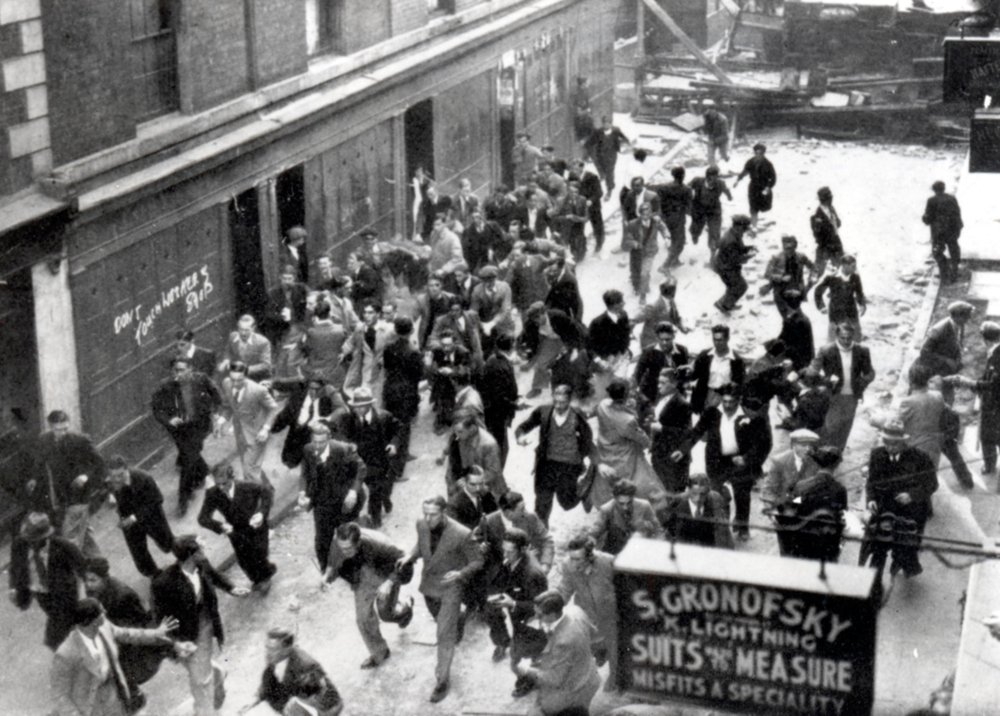
The Battle of Cable Street is often remembered as one clean sentence: East London stopped fascism. The sentence is true enough to explain why the day still carries force, but it is too smooth for what happened on Sunday, 4 October 1936. Cable Street was not only a clash between Oswald Mosley's British Union of Fascists and anti-fascist demonstrators. It was a routing crisis: a planned procession, a refused ban, a local petition campaign, several blocked streets, a police command trying to preserve public order while protecting an inflammatory march, and a final decision to turn the procession away from the East End.[1][2][3]
That reconstruction changes the event's shape. The BUF wanted a march through districts with large Jewish communities, at a moment when its anti-Semitic organizing had already made the East End a political target.[1][2] Opponents wanted the Home Secretary to prohibit the march before it began. Police leadership tried to manage it as a public-order operation. Local residents, Jewish groups, Communists, Labour activists, dockers, Irish workers, and others treated the route itself as the issue. If the march entered Whitechapel and Stepney under police protection, it would convert state order into a corridor for intimidation. If the route could be made unworkable, the procession would lose its political point.[1][2]
Image context: the cover image is a real archival photograph from London Museum's Cable Street story page, captioned there as anti-fascist protesters and their barricade at the Battle of Cable Street. It belongs here because the argument is spatial. The historical action sits in the blocked street, not in a later monument alone.[1]
Before the march, the dispute was already administrative
Cable Street began before Cable Street. In the week before the march, local mayors pressed Home Secretary Sir John Simon to ban it, arguing that a procession through a heavily Jewish area would provoke disturbance and danger.[2] The Jewish People's Council collected about 100,000 signatures in two days, asking for a prohibition on marches that could incite hatred against sections of the population.[2] Simon refused to call the march off, leaving the police and the street to absorb the consequences.[2]
That refusal did not settle the matter. It merely moved the decision from the Home Office to the street. A march can be lawful in the abstract and still depend on thousands of small acts of clearance: traffic held back, pedestrians pushed aside, intersections opened, police reserves placed, mounted officers deployed, alternative routes tested. The state had not only permitted Mosley's organization to speak. It had accepted the burden of making a route through a neighborhood that had signaled, loudly and in writing, that the route itself was a provocation.[2][3]
The BUF's plan sharpened the stakes. The National Archives account says the summer campaign was to be marked by a march and meetings in Shoreditch, Limehouse, Bow, and Bethnal Green, and notes that some fascists framed the action in explicitly anti-Jewish terms.[2] London Museum likewise places the march inside the BUF's effort to scapegoat the East End's Jewish community during economic stress.[1] The route therefore carried meaning before the first baton was raised. It was not a neutral line on a map.
The first blockage was not on Cable Street
On the day itself, Mosley's supporters gathered near the Tower of London. London Museum gives the approximate scale as 3,000 fascists and 7,000 police; either way, the escort was a major public-order deployment.[1] The Guardian's contemporary report, published from the 1936 archive, described "extraordinary scenes" in the East End long before the procession was due to start, with huge crowds along the proposed route, broken shop windows, injuries, and arrests.[3]
The initial plan was not simply to push down Cable Street. The National Archives account says the original route would have taken the march down Commercial Street toward the East End. A large anti-fascist crowd blocked the intersection of Whitechapel High Street and Leman Street, forcing police to consider a new route via Cable Street toward Stepney.[2] That detail matters because it shows the event as a sequence of failed openings. Cable Street became decisive after another route had already stopped functioning.
The anti-fascist strategy did not require one centralized command to be effective. Its strength was distribution. Crowds occupied approaches. Barricades appeared. London Museum describes barriers made from mattresses, corrugated iron, and furniture; the National Archives account highlights an overturned brick-laden truck on Cable Street.[1][2] These were not symbolic props. They changed the geometry of the operation. A mounted police charge is built for open space and momentum. A narrow East End street with barricades, windows, missiles, side streets, and dense bodies turns that advantage into exposure.
Police discretion became the hinge
The police were not passive referees. They were the force trying to clear a path for the march, and much of the street fighting was between police and anti-fascist demonstrators rather than between demonstrators and BUF columns.[1][2][3] The Guardian reported that both mounted and foot police used truncheons while trying to clear the roadway, and that buses and trams were held up around Whitechapel High Street and Leman Street.[3] London Museum notes mounted charges and missile throwing, with at least 73 police officers injured, about 80 anti-fascists arrested, and 15 people sent to hospital.[1]
Yet police discretion also ended the march. The Guardian's report printed Scotland Yard's explanation: because of the very large crowds and the likelihood of further breaches of the peace, the Commissioner of Police for the Metropolis decided the procession through the East End should not be permitted.[3] The National Archives account places the decisive conversation between Sir Philip Game, the Metropolitan Police commissioner, and Mosley after the Cable Street route also failed; the fascists abandoned the planned route and turned west toward the Embankment.[2]
This is the event's central mechanism. Opponents did not need to defeat every fascist in a direct fight. They needed to make every usable route costlier than cancellation. Once the police could no longer clear a path without escalating disorder, their own public-order logic turned against the march they had been protecting. The procession's legality mattered less than its workability.
Why the barricade mattered politically
The barricade was effective because it translated moral opposition into an operational problem. Petitions could be refused. Warnings could be ignored. Advice to stay away could be rejected by those who believed absence would leave the street open.[1][2] But a barricade forced the authorities to answer a concrete question: how much violence should be used to move an inflammatory procession through a resisting neighborhood?
The answer on 4 October was: not enough to force it through. That is why Cable Street became a victory in local memory. The fascists did not march through Whitechapel. They were diverted west. The intended performance of power, uniform, and territorial intimidation failed at the point where it needed visible passage.[1][2][3]
But the reconstruction also keeps the victory from becoming too tidy. The National Archives notes that BUF membership increased by a little over 2,000 by 27 October 1936, especially in East End branches, according to a confidential report.[2] That does not undo the day. It complicates its immediate aftermath. Cable Street was a practical defeat for the march and a lasting symbolic defeat for British fascism, but it did not instantly dissolve the movement's local appeal. Street victories can halt an action without ending the structure that produced it.
The law changed because the old public-order tools were inadequate
Cable Street also belongs to the history of public-order law. London Museum says the Public Order Act 1936 was rushed through after the battle and required march organizers to seek permission, while banning political uniforms.[1] The enacted text, dated 18 December 1936 and coming into operation on 1 January 1937, made it an offence to wear a uniform in a public place or meeting to signify association with a political organization, restricted quasi-military organizations, gave police powers to impose route conditions on processions, and created rules for prohibiting processions where serious disorder was feared.[4]
That legal aftermath is important because it shows what officials learned from the event. The problem was not only violence in one street. It was the difficulty of managing political theater conducted through uniformed movement. Mosley's Blackshirts had made clothing, discipline, and street procession part of their message. Cable Street exposed the gap between older assumptions about public assembly and a newer style of provocative mass politics.[2][4]
The law did not simply endorse the anti-fascist crowd's method. It strengthened state control over future marches in ways that could also limit other political groups. The National Archives account notes that the Independent Labour Party objected when its youth movement's red shirts and blouses were treated under the same uniform logic.[2] That is the hard edge of the aftermath: a street action that blocked fascist intimidation also helped justify broader state power over political display and procession.
What the reconstruction changes
Reading Cable Street as an event reconstruction does not drain its moral force. It makes the force more precise. The day mattered because a coalition turned a fascist procession from a permitted event into an impossible route. The petitions established that the risk was known before the march.[2] The crowds at Whitechapel and Leman Street showed that the first route could fail.[2][3] The barricades on Cable Street made the alternative route fail as well.[1][2] Police discretion, once committed to avoiding greater disorder, finally redirected the march away from the East End.[2][3]
That sequence also explains the endurance of the memory. Cable Street was not a parliamentary vote, a court judgment, or a military victory. It was a neighborhood refusing to become scenery for an intimidation march. The later mural, plaque, anniversaries, and museum accounts matter because they preserve the spatial lesson: politics sometimes turns on who gets to pass through whose street, under whose protection, and at what social cost.[1][2]
The concise memory, then, needs one extra clause. East London stopped fascism on Cable Street by making the route fail. That was the day's practical achievement. Its larger historical meaning came from the same fact: a lawful procession lost its route when the people living around the route refused to let legality become passage.
Sources
- London Museum, "The Battle of Cable Street" - event summary, route stakes, crowd estimates, casualties, aftermath, Public Order Act context, and the archival photograph used as the article image.
- The National Archives blog, "'No pasaran': the Battle of Cable Street" - archival reconstruction using Home Office and Metropolitan Police records, including petitions, route changes, Game's account, BUF aftermath, and the Public Order Bill.
- The Guardian archive, "Fascist march on Cable Street stopped after disorderly scenes" - contemporary 5 October 1936 reporting on the abandoned procession, Scotland Yard statement, arrests, injuries, and street conditions.
- Legislation.gov.uk, "Public Order Act 1936" - enacted text covering political uniforms, quasi-military organizations, procession route controls, and public-order powers.