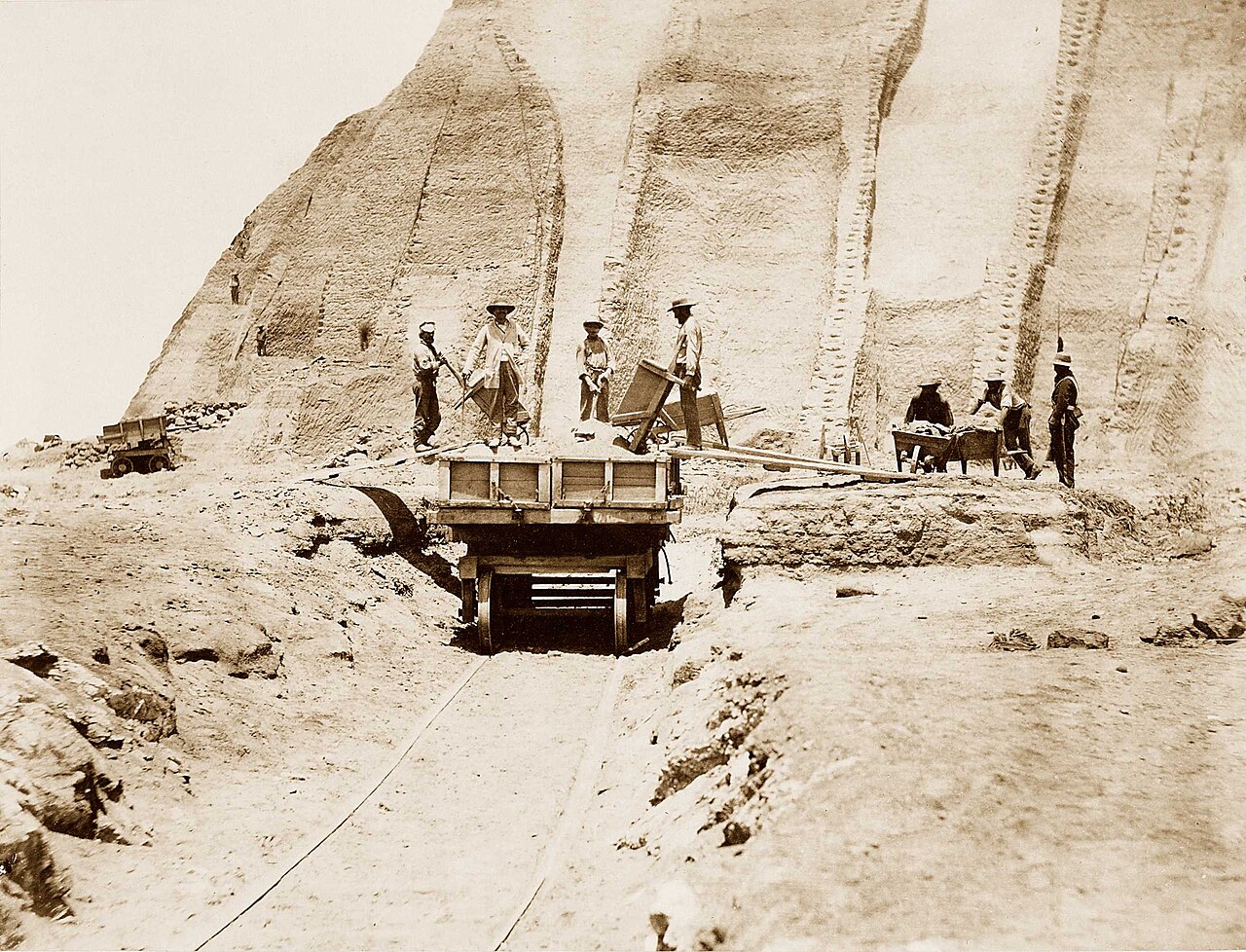
The strangest noun in the Guano Islands Act is guano. Its most revealing verb is may.
Approved on August 18, 1856, the law began with an offer to any U.S. citizen who found a deposit of seabird manure on an island, rock, or key beyond another government’s lawful jurisdiction and occupation. Take peaceable possession, occupy the place, report the evidence—and the island “may, at the discretion of the President” be considered “appertaining to the United States.”[1] The citizen could start the claim. Only the executive could convert it into a relationship with the state.
That relationship was deliberately adjustable. Congress could let the discoverer extract the deposit, restrict its sale to the U.S. market, cap its price, protect the venture with military force, and extend federal criminal law over the site. Yet the final section said the United States need not keep the island once the guano was gone.[1] Read from first clause to last, the act did not build a miniature republic offshore. It built a supply system in which private initiative could trigger public power without requiring permanent public responsibility.
The distinction became a matter of life and death on Navassa Island in 1889–1890. After violence between Black laborers and white company officers, the Supreme Court used the act to sustain federal jurisdiction over a murder conviction and death sentence. The Court also held that a company’s possible violation of its commercial bond could cost the company its private privileges without dissolving U.S. dominion or the authority of U.S. courts.[2] Possession was optional; punishment was not.
Image context: Moulton’s photograph was made on Peru’s Chincha Islands, whose deposits remained under Peruvian jurisdiction and therefore fell outside the act’s stated conditions. That boundary matters. The image shows the international commodity world to which the U.S. law responded: workers, hand tools, cut faces, rails, and carts turning an accumulated ecology into cargo. The statute makes “discovery” sound like a moment; the photograph makes extraction look like the industrial labor it was.[3][7]
A fertilizer shortage becomes a territorial instrument
Guano had entered U.S. agricultural commerce during the 1840s, when depleted soils and growing knowledge of plant nutrients gave concentrated seabird deposits an extraordinary reputation as fertilizer. Peru’s arid Chincha Islands supplied the most prized material. American ships could carry it around Cape Horn, but access, price, and foreign control made supply a political issue as well as a commercial one.[3]
The Guano Islands Act answered that problem without purchasing Peruvian territory or challenging Peru’s jurisdiction over the Chinchas. Instead, it invited U.S. citizens to search elsewhere. The first section set five linked conditions: a citizen had to discover guano; the place had to lie outside another government’s lawful jurisdiction; no other government’s citizens could occupy it; the claimant had to take peaceable possession; and possession had to become continuing occupation. Notice and proof then went to the State Department.[1]
Those conditions resemble a private claim, but the sentence does not end with a private title. It ends with presidential judgment. The word may prevents discovery from automatically enlarging the United States, while appertaining avoids clearer constitutional language such as annexed, incorporated, or admitted. The law thus separated three acts that a simple “island acquisition” story tends to merge: finding a resource, occupying its location, and obtaining state recognition.
This is a textual inference, not a claim that nineteenth-century officials agreed on one theory of the islands’ status. The statute itself never supplied a settled definition of appertaining. Legal scholars Joseph Blocher and Mitu Gulati use Navassa to show precisely how U.S. officials moved between the languages of property and sovereignty—claiming enough authority to secure value while resisting some of the obligations associated with governing territory.[4] The ambiguity was functional. It let commercial occupation and executive foreign policy meet without promising what the place would eventually become.
The middle sections write a supply contract
Once an island entered the statutory system, the discoverer did not receive ordinary ownership. The exclusive privilege of occupation remained “at the pleasure of Congress,” and its stated purpose was obtaining guano and delivering it to U.S. citizens for use in the United States.[1] Congress even specified ceiling prices: eight dollars per ton delivered alongside a vessel in tubs, or four dollars per ton taken in the deposit. The claimant or assignee had to post a bond promising domestic delivery, the prescribed price, and the necessary facilities.[1]
The design is strikingly specific about cargo and almost silent about community. It names discoverers, widows, heirs, executors, administrators, assigns, purchasers, ships, prices, bonds, and armed forces. It does not create a local legislature, court, municipality, path to citizenship, or plan for permanent settlement. People appear mainly as rights-holders in the extraction franchise, consumers of fertilizer, or subjects of criminal law.
That does not mean the islands were literally empty after a claim began. It means the statute imagined them through the journey of a commodity. Material moved from deposit to tub, ship, U.S. buyer, and exhausted farmland. Legal authority moved in the opposite direction: from citizen petition to State Department proof, presidential recognition, commercial privilege, federal protection, and jurisdiction. The guano was meant to travel; the governing commitment was designed not to harden.
The Smithsonian’s history of the trade adds an institutional detail that fits this architecture. Because the act authorized federal protection, the Navy became involved in guano claims and asked Joseph Henry, the Smithsonian Institution’s first secretary, to analyze samples from Pacific deposits.[3] Chemistry, navigation, commerce, and force were not separate stories. The law connected them.
Protection travels outward; punishment travels home
The act’s hardest power sits near its commercial rules. One section authorizes the President, again at his discretion, to use U.S. land and naval forces to protect the discoverer or the discoverer’s successors.[1] A citizen’s extraction privilege could therefore call military power across an ocean.
Another section solved the jurisdiction problem by legal fiction. Crimes on a covered island or in adjacent waters were to be treated as if committed on the high seas aboard a U.S. merchant vessel, with federal maritime criminal law extended over the land.[1] Congress did not need to build a territorial court on every rock. It could transport the offense into an existing body of law and try a defendant in the district where he was found or first brought.
The combination is more revealing than either provision alone. The United States could project force to protect a private venture, then project law back over the venture’s workers. It could do both without creating the civic institutions normally associated with a governed place. The island was remote for representation and administration, but legally near enough for naval protection and punishment.
Navassa turns the vocabulary into a verdict
Navassa, a small island between Haiti and Jamaica, exposed the consequences of that arrangement. Peter Duncan reported discovering guano there on July 1, 1857, and said he took possession in the name of the United States on September 19. Haiti contested the U.S. position. Nevertheless, President James Buchanan’s administration sent an armed vessel in July 1858 to protect the operation, and Secretary of State Lewis Cass issued a proclamation on December 8, 1859, recognizing the filed notice, occupation, assignment, and bond.[2][4]
By September 14, 1889, the Navassa Phosphate Company occupied the island. The evidentiary record later summarized by the Supreme Court counted 137 Black laborers and eleven white officers or superintendents. The workers blasted and picked phosphate, then pushed it by human-powered rail to ships.[2] The contract reproduced in the opinion gave the company sweeping control: service could last as long as fifteen months, wages were generally payable only on return to Baltimore, refusal to work could forfeit all accrued pay, and workers purported to release the company from liability for injuries caused by accidents or employees.[2]
Violence that September led to the prosecution of Henry Jones for killing supervisor Thomas Foster. The official legal record called the event a riot and treated the jury’s murder verdict as established fact.[2] A Black fraternal organization in Baltimore, the Galilean Fishermen, published a pamphlet before the Supreme Court appeal that preserved a different archive: the trial, defense campaign, portraits, and short biographies of the accused laborers.[6] Those sources do not make the killings disappear, but they change the historical question from Did federal law reach Navassa? to What kind of workplace had federal power reached?
The interpretive line remains contested. In a 2024 study based on workers’ accounts, historian Dennis Patrick Halpin argues that the usual “worker-instigated riot” frame obscures a longer history of Black labor resistance and white violence on Navassa. He reads the 1889 confrontation as a protest against inhumane treatment that became deadly after company officers opened fire.[5] The Supreme Court’s opinion, by contrast, did not adjudicate that broader labor history. It reviewed the jurisdictional challenge after a federal jury had convicted Jones.
That boundary is essential. A close reading of the act cannot by itself settle the sequence of violence. It can show why the legal appeal narrowed toward territorial authority. Jones argued that the statute was unconstitutional and that the federal court lacked jurisdiction. He also sought to introduce evidence that a foreign vessel had loaded Navassa phosphate for non-U.S. users in April 1889, apparently violating the bond’s domestic-market condition.[2]
The Supreme Court rejected both routes on November 24, 1890. It treated the executive branch’s determination about Navassa as conclusive for the courts, upheld Congress’s extension of criminal law, and affirmed Jones’s conviction. Most revealingly, it separated the company’s franchise from U.S. authority: a bond breach affected “private rights only,” not federal dominion or court jurisdiction.[2]
Here the act’s two layers pull apart. Commercial privilege was conditional—dependent on a bond, a market restriction, and congressional pleasure. Public coercion was more durable. Even if the company broke the supply bargain, the Court said, the legal field on which Jones could be tried remained in place. The government could shed its promise to the extractor while retaining its claim over the accused.
The right to leave was written in from the start
The law’s final section is now headed “Right to abandon islands.” It says the United States is not obliged to retain possession after the guano has been removed.[1] That clause is not housekeeping. It reveals the time horizon of the whole instrument.
A conventional territorial law might assume that acquisition creates an enduring political relationship. The Guano Islands Act assumed depletion. Its triggering asset was finite; its commercial privilege was defeasible; its military protection was discretionary; and its national commitment could end with extraction. Blocher and Gulati therefore treat Navassa as an unusually clear case in which property-like reasoning helped the United States claim benefit without first defining the full content of sovereignty.[4]
It would be too neat to call this short statute the single beginning of an American overseas empire. U.S. expansion, Indigenous dispossession, naval reach, and commercial intervention all had longer histories. It would also be wrong to call the act merely a comic curiosity about bird droppings. The text assembled a portable method: let citizens identify value abroad, let the executive decide whether a place attaches to the country, let Congress discipline the franchise, let armed force protect it, let federal law punish there, and reserve the option to leave when the resource is exhausted.
Navassa shows why every step matters. The island could be uncertain enough for officials to debate whether it was property, territory, or something in between, yet certain enough for a Black laborer to be brought to Baltimore and sentenced under U.S. law. The Guano Islands Act made commitment negotiable. It made jurisdiction real.
Sources
- Cornell Law School Legal Information Institute, “48 U.S. Code Chapter 8 — Guano Islands” — codified text and source notes for discovery, proof, exclusive privileges, domestic delivery, criminal jurisdiction, military protection, and abandonment.
- Library of Congress, U.S. Reports: Jones v. United States, 137 U.S. 202 (1890) — official opinion and record excerpts on the Navassa claim, labor contract, federal jurisdiction, bond breach, and affirmed conviction.
- Smithsonian Institution, “How the Gold Rush Led to Real Riches in Bird Poop” — museum-based history of the guano trade, the 1856 act, naval protection, Joseph Henry’s analyses, and the Norie atlas.
- Joseph Blocher and Mitu Gulati, “Navassa: Property, Sovereignty, and the Law of the Territories,” Yale Law Journal 131 (2022) — legal history of Navassa, Haiti’s competing claim, abandonment, and the property-sovereignty problem.
- Dennis Patrick Halpin, “‘All Manner of Cruelty and Slavery’: A Long History of Black Labor and White Violence on Navassa Island, 1857–1898,” Journal of African American History 109, no. 1 (2024) — labor-history reinterpretation of the 1889 violence based on workers’ accounts.
- Galilean Fishermen, Thomas I. Hall, and Columbus Gordon, The Navassa Island Riot (Baltimore, 1889), Library of Congress — contemporary Black fraternal pamphlet on the trial and defense of eighteen laborers.
- Wikimedia Commons, “Guano Mining in Chincha Islands Peru (1865) Moulton” — image record for Henry DeWitt Moulton’s albumen print in the Bibliothèque nationale de France collection, used as this article’s cover.