The Treaty of Guadalupe Hidalgo is usually remembered by looking at the map first.[1][2][3] That habit makes sense. Signed on February 2, 1848, the treaty ended the Mexican-American War and transferred more than 525,000 square miles to the United States.[2][3] But if the document is read closely as a governing instrument rather than as a colored-territory milestone, a different question comes forward. After conquest, what exactly did the treaty say would happen to the people and property left inside the new U.S. border?[1][4][6]
That sharper question changes the center of gravity. Article V drew the boundary, but Articles VIII and IX did the harder political work.[1][6] They laid out a sequence for Mexicans who remained in the ceded territories: stay or leave, keep Mexican nationality or slide into U.S. nationality, keep property, and wait for Congress to decide when full citizenship rights would actually mature.[1] The treaty therefore did not simply annex land. It built a staged regime for incorporation.
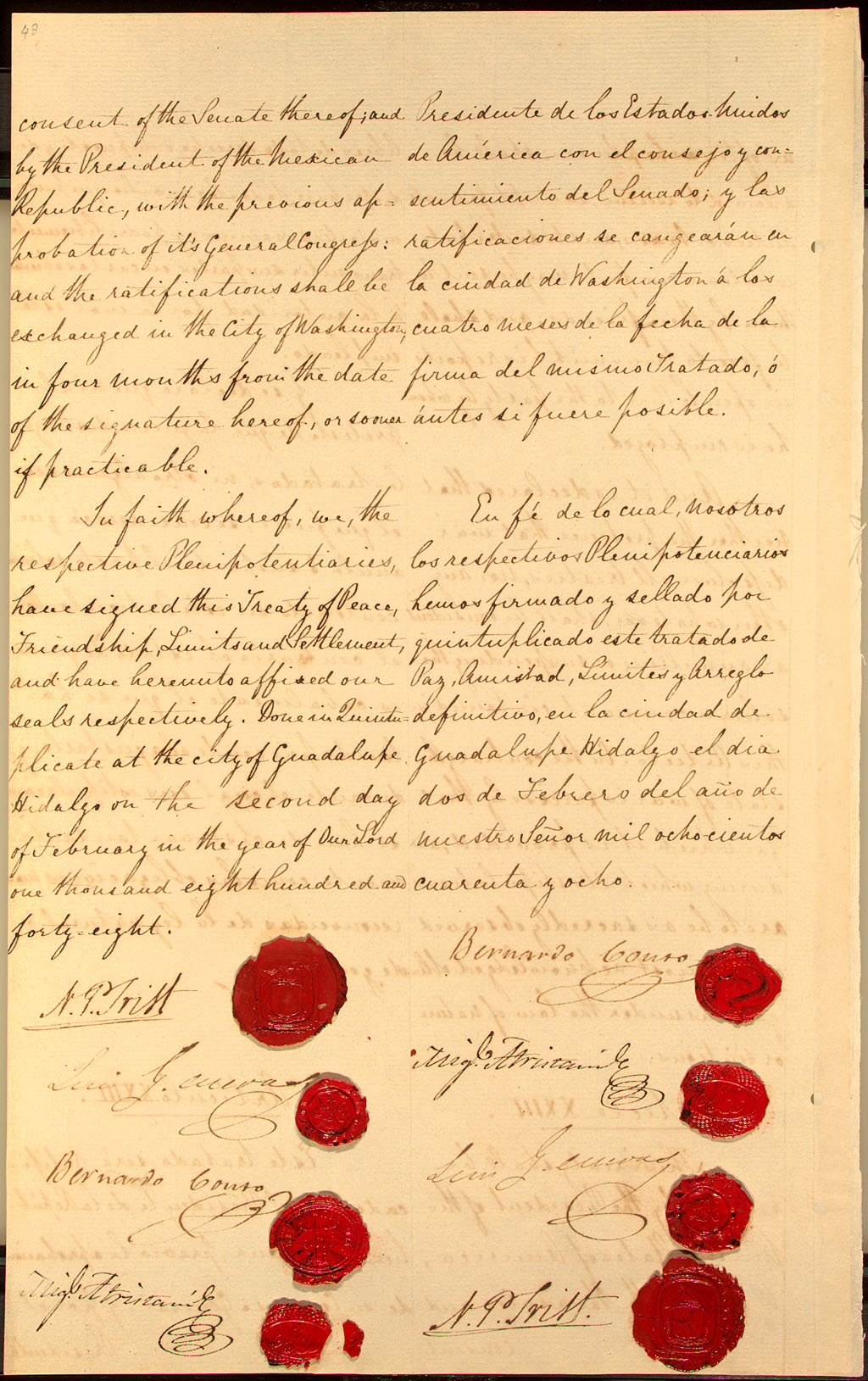
The cover image, a real archival image of the treaty's last page with signatures and seals, suits that argument exactly.[5] It is easy to treat this document as a finished ending. The text reads more like a beginning: a border settlement that also created a long administrative afterlife around election, status, proof, and rights.
Timeline anchors
- 1848-02-02: the treaty is signed at Guadalupe Hidalgo, ending the war in principle.[1][2][6]
- 1848-03-10: the U.S. Senate advises ratification with amendments, including the removal of Article X.[1][2]
- 1848-03-16: President James K. Polk ratifies the amended treaty.[1]
- 1848-05-30: ratifications are exchanged at Querétaro.[1]
- 1848-07-04: the treaty is proclaimed in the United States.[1]
- 1854-1904: later U.S. land-grant confirmation procedures become the core arena in which treaty-era property promises are tested and disputed.[4]
Those dates matter because they show that the treaty did not become historically significant all at once. It moved through stages: negotiation, Senate revision, exchange, proclamation, and then decades of implementation disputes.
1. Article V drew the line, but Articles VIII and IX tried to govern the aftermath
The broad diplomatic setting is clear enough. The Office of the Historian states that Nicholas Trist pushed ahead with negotiations despite Polk's recall, and the final treaty delivered the largest territorial expansion of Polk's presidency.[2] The Library of Congress guide compresses the result cleanly: the treaty fixed the Rio Grande as the border, transferred the territory that would become all or parts of several western states, paid $15 million to Mexico, and committed the United States to assume certain claims by U.S. citizens against the Mexican government.[3]
If that were the whole story, the treaty would read mainly as an exchange of land for cash and peace. The text itself is more complicated. The National Archives transcript shows Article VIII giving Mexicans in the ceded territories a one-year election window.[1] They could remain where they were or remove themselves to Mexico while retaining or selling their property. If they stayed, they could either retain Mexican nationality or move toward U.S. nationality, and if they remained after one year without declaring an intention to stay Mexican, the treaty treated that silence as an election of U.S. citizenship.[1]
That is already more than a border clause. It is a status machine. The treaty assumes that conquest has created a population problem and answers it through paperwork, time, and implied choice. The line on the map is fixed in Article V; the social consequence of that line is routed through Article VIII.
Article IX takes the argument one step further.[1][6] For those who did not preserve Mexican nationality, the treaty said they would be incorporated into the Union and later admitted to the rights of U.S. citizens, with Congress judging the proper time. In the meantime, the text promised protection in liberty, property, and religion.[1] This is the hinge. The treaty promised belonging, but it made belonging sequential rather than immediate.
2. The document offered protection, but it also delayed and filtered that protection
This is where close reading begins to matter. Article VIII sounds strong on property. The National Archives text says property of every kind belonging to Mexicans in the ceded territories would be "inviolably respected," and that owners and heirs would enjoy guarantees as ample as those of U.S. citizens.[1] Standing alone, that language suggests a broad security promise. It tells readers that conquest will not legally dissolve ownership.
Article IX, however, adds a second register.[1] Political membership is not automatic in the practical sense, even if it is strongly anticipated in the legal sense. Congress controls the timetable. The treaty does not say, in effect, "you are now fully citizens." It says incorporation is coming, rights are to be protected in the interim, and the United States Congress will decide when full political enjoyment properly arrives.[1]
That distinction is the document's deepest structural fact. The treaty tries to calm the transition by offering both presumptive citizenship and civil protection, yet it also keeps a gate in place. The gate is not at the border. The gate is inside U.S. constitutional process.
The Senate amendments make the gate more visible. The National Archives summary notes that when the Senate ratified the treaty on March 10, 1848, it removed Article X, the clause that had explicitly guaranteed protection of Mexican land grants.[1] That removal matters because it pushed property security onto the more general language of Articles VIII and IX and onto later U.S. adjudication. The treaty still spoke the language of protection, but one of its clearest original land-grant assurances was gone before the agreement fully took effect.[1]
The result is a document that works in two directions at once. It offers continuity for residents who stay, but it also translates continuity into forms that the conquering state will administer. Choice, silence, congressional timing, and later proof all become part of the new order.
3. The later land-grant record shows why Article X mattered so much
This is the point at which the treaty stops being only a diplomatic artifact and turns into a long legal afterlife. The GAO report on longstanding community land grant claims in New Mexico is useful because it states the dispute plainly: whether the United States fulfilled its obligations under the treaty's property-rights promises has remained controversial for more than a century.[4] The report identifies the treaty as the relevant source of property protection and then traces how U.S. confirmation procedures between 1854 and 1904 produced durable grievance around grants, acreage, and title recognition.[4]
That later controversy does not prove the treaty was insincere. It proves the treaty was not self-executing in the practical sense most people imagine.[4] Rights promised in the diplomatic text still had to move through survey practices, language barriers, documentary proof, court procedures, and federal institutions that were not neutral containers. The article's property language was broad; implementation was procedural, local, and often adversarial.
This is why the removal of Article X cannot be treated as a technical footnote.[1][4] Once that specific guarantee disappeared, the stronger protection story depended more heavily on the general shield of Article VIII and on the idea that later U.S. institutions would faithfully translate treaty promises into confirmed rights. The GAO's long retrospective shows how unstable that translation became.[4]
The treaty therefore belongs to two histories at once. One is the history of territorial transfer. The other is the history of how a conquest document tried to preserve rights through the very institutions that would later test, narrow, or redefine them.
4. Two serious readings still compete
Reading one: an incorporation treaty with meaningful protections
This reading emphasizes what the text genuinely promised. Mexicans in the ceded territories were not simply ordered out. They received a formal choice to stay or leave, a path toward U.S. nationality if they remained, explicit protection for liberty, religion, and property, and a treaty structure that did not describe them as an expendable conquered residue.[1][3][6] Compared with a pure expulsion or confiscation regime, that is substantial.
This reading also fits the document's diplomatic self-presentation. The text repeatedly speaks in the language of peace, settlement, and reciprocal order rather than bare domination.[1][6] If you read the treaty against harsher alternatives available to nineteenth-century states, it can look like a real, if imperfect, incorporation framework.
Reading two: a conquest treaty that made belonging conditional inside U.S. institutions
This reading emphasizes what the text withheld or deferred. Congress controlled the timing of full political rights under Article IX.[1] Article X was removed before final ratification.[1] Later property protection depended on U.S. confirmation systems that generated enduring conflict.[4] Under this reading, the treaty promised continuity in principle while transferring decisive control over that continuity to the conquering power.
This second reading fits the implementation story better. It explains why a treaty full of protective language could still lead to generations of land-grant dispute, mistrust, and litigation.[4] The problem was not only whether the treaty spoke generously. The problem was who got to operationalize the generosity.
Why the second reading is stronger
The more convincing interpretation is not that the treaty was empty from the start. It plainly was not.[1][3][6] The stronger interpretation is that the treaty created a conditional incorporation regime whose promises were real on paper but structurally vulnerable in practice. Articles VIII and IX mattered because they prevented the ceded population from being treated as legally irrelevant. They also mattered because they routed citizenship and property through delay, administration, and proof.[1][4]
That is why the document is best read not as a border ending but as a constitutional handoff. The treaty said Mexicans who stayed could become part of the United States. It also said Congress would decide when full political enjoyment arrived, and the later land-grant record shows how much depended on who controlled the institutions doing the deciding.[1][4]
The bounded conclusion
The Treaty of Guadalupe Hidalgo did not just draw a border in 1848.[1][2][3] Read closely, it created a staged postwar order built out of election, presumptive citizenship, and promised property protection.[1][6] The line moved immediately; belonging did not. Article VIII turned silence after one year into a nationality choice, Article IX put full political timing in congressional hands, and the Senate's removal of Article X made the later property story more fragile than the map-first memory usually admits.[1][4]
That is the durable payoff of reading the treaty as text rather than as territorial shorthand. The most consequential struggle in the document was not only over where the border would sit. It was over how conquest would be translated into status, rights, and proof after the border was already there.
Sources
- National Archives, "Treaty of Guadalupe Hidalgo (1848)" - exchange-copy transcript, ratification timeline, Article X removal, and the operative text of Articles VIII and IX.
- Office of the Historian, U.S. Department of State, "The Annexation of Texas, the Mexican-American War, and the Treaty of Guadalupe-Hidalgo, 1845-1848" - Nicholas Trist's role, the 525,000-square-mile cession, and Senate ratification context.
- Library of Congress Research Guides, "Treaty of Guadalupe Hidalgo: Primary Documents in American History - Introduction" - border terms, territorial scale, compensation, and Library of Congress source map.
- U.S. Government Accountability Office, "Treaty of Guadalupe Hidalgo: Findings and Possible Options Regarding Longstanding Community Land Grant Claims in New Mexico" - on the treaty's property-rights aftermath and the long dispute over land-grant confirmation procedures.
- Wikimedia Commons, "File:Treaty of Guadalupe Hidalgo, last page.jpg" - source page for the archival treaty image used as this article's cover.
- National Park Service, "Text of the Treaty of Guadalupe Hidalgo" - full treaty text and background page preserving the wording of the articles discussed here.