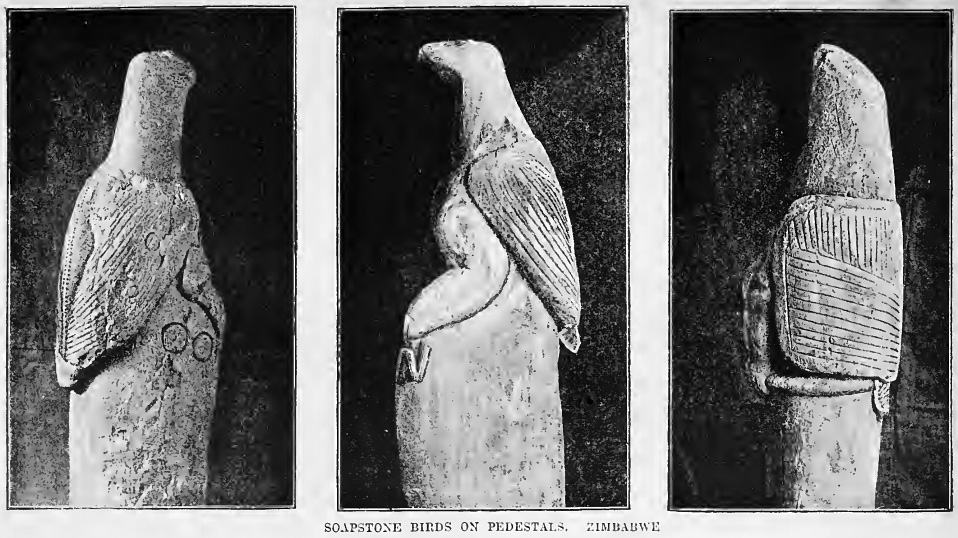
On 15 April 2026, a small grey bird landed in Harare after 137 years away. It did not fly. It arrived by aircraft from South Africa, carved from soapstone and once severed from its pedestal by a hunter in 1889. Eight sets of Zimbabwean ancestral remains travelled with it. At State House, the sculpture was received as the last displaced Zimbabwe Bird to come home.[6][7]
The ceremony looked like an ending. It was also a revealingly unfinished one.
South Africa and Zimbabwe called the transfer a return, and materially it was: the bird left the Cape, reached Zimbabwean soil, and was bound for the museum at Great Zimbabwe where the other known birds are kept. Yet the legal route was a two-year loan, devised while South Africa reviews a 1910 law protecting the contents of Cecil Rhodes's estate.[7] The bird is home before the paperwork has fully stopped treating home as somewhere it may have to leave.
That tension is not a footnote to the commemoration. It is the heart of it. For more than a century, possession of the Zimbabwe Birds has been used to tell competing stories about who made Great Zimbabwe, who could claim its past, and who had authority to move its sacred objects. The 2026 homecoming matters because it reverses the bird's route. The loan matters because it shows that symbolic repair and legal custody still move on different clocks.
Before the emblem, there was a place
Great Zimbabwe was not a mysterious ruin waiting for Europeans to explain it. Built and occupied principally between the 11th and 15th centuries, it was the centre of a powerful Shona state linked to farming, cattle wealth, craft production, gold, and long-distance trade. Its surviving landscape includes the Hill Ruins, the Great Enclosure, and the Valley Ruins; imported glass beads, ceramics, and coins connect the inland city to networks reaching the East African coast and beyond.[1][2]
The famous dry-stone walls can mislead modern eyes because the vanished architecture matters too. Houses of earth and thatch once worked with the granite enclosures, and the stone did not merely defend a city. It organized privacy, authority, ritual, and movement. The eight known soapstone birds likewise belonged to an architectural and spiritual setting. Six were found in the Eastern Enclosure of the Hill Complex, where they had stood on tall columns or monoliths.[1][2]
Their exact original meaning is not recoverable with certainty. Scholars have read them as signs of royal authority, ancestral presence, or sacred mediation; even the species represented remains debated.[2][7] That uncertainty deserves protection. Calling the birds national emblems describes their modern afterlife, not the whole world in which they were carved.
This distinction changes how the 1889 removal should be seen. A bird fixed to a sacred place is not simply the same object in a library, a museum case, a flag, or an airport ceremony. Each relocation preserves stone while rewriting relationship.
1889: a sacred presence became a portable possession
In August 1889, hunter and trader Willi Posselt reached the Hill Complex. He removed one bird, cut it from its pedestal because the whole was too heavy to carry, and later sold the sculpture to Cecil Rhodes. The Oxford legal historian Evelien Campfens reconstructs this episode as part of a broader colonial transformation: birds taken from Great Zimbabwe became collectible antiquities, evidence in racial origin stories, and eventually instruments of state iconography.[4]
Rhodes placed the bird in his library at Groote Schuur in Cape Town. For him, it was not evidence of African statecraft. It was useful precisely because he imagined Great Zimbabwe as the work of a civilization arriving from the north or east. The object could then appear to validate the colonial fantasy that conquest was recovering an older, non-African order rather than invading an African one.[4]
The cover photograph belongs to the next phase of that conversion. Published in James Theodore Bent's 1892 book The Ruined Cities of Mashonaland, it isolates the carved birds against a plain background.[8] Their feathers, human-like lips, pedestals, and scale become unusually legible. Their setting disappears. The image is valuable archival evidence, but its clarity comes from an act of removal: it asks the viewer to study portable specimens rather than encounter objects embedded in a sacred enclosure.
Bent's expedition, commissioned after Rhodes's company occupied Mashonaland, sent additional birds to Cape Town. A cast made from one of them later appeared in a 1930 British Museum loan exhibition, an institutional afterimage of the same journey from sacred site to colonial display.[5] Photography, casting, cataloguing, and exhibition did not merely record the birds. They built a new public memory around who was entitled to interpret them.
Archaeology broke the foreign-builder story, slowly
The claim that Great Zimbabwe required foreign builders did not survive careful excavation. David Randall-MacIver argued for its African and medieval origins after work at the site in 1905–1906. Gertrude Caton-Thompson's 1929 excavations strengthened that conclusion through stratigraphy, pottery, and deposits rather than resemblance hunting. Reporting her findings that year, Nature summarized her judgment that the site's plan, construction, and contents were African and Bantu.[3][4][9]
That correction sounds obvious now because the racist premise has become so exposed. At the time, however, the premise was doing political work. If Black Africans could not have built the walls, settler rule could portray itself as the heir to civilization rather than the agent of dispossession. Archaeology therefore had to recover more than a date. It had to break a story engineered to make African achievement seem impossible.
Even then, knowledge did not automatically repair custody. A museum could accept the African origin of a bird while continuing to hold it. A colonial state could reuse the bird as a regional badge after the foreign-builder theory weakened. Evidence changed faster than ownership.
1980: the same bird faced a different nation
When Zimbabwe became independent on 18 April 1980, the country's chosen name pointed back to the stone city rather than to Rhodes. The Zimbabwe Bird appeared on the new flag and coat of arms and continued across coins, stamps, and banknotes. This was a powerful reversal: an image Rhodes had used to support colonial legitimacy now asserted a precolonial African past and an independent national future.[2][4]
It was not a clean invention. Colonial Rhodesia had already used the bird in official imagery. Independence did not discover an untouched symbol; it contested and recoded an appropriated one. The same silhouette could serve incompatible claims because symbols do not carry one politics forever. Their meaning depends on who displays them, what history accompanies them, and whether the communities tied to them control the terms.
Material returns followed. In 1981, South Africa sent back four birds removed during Bent's expedition.[4][5] A separated pedestal held in Berlin was later reunited with Zimbabwe's collection after another long negotiation.[4][7] Each return made the national image less abstract: the bird on the flag was joined by an actual carved ancestor of that image.
One sculpture remained at Groote Schuur. Rhodes's 1902 will had vested his estate and its contents in the South African state, and the Rhodes' Will Act of 1910 restricted their alienation. A law written to preserve an imperial estate thus outlived both Rhodes and Rhodesia, continuing to govern the mobility of an object removed before either modern state existed.[4][7]
2026: physical return, legal remainder
The April 2026 agreement solved the immediate problem with a loan. South Africa could move the bird without first completing legislative reform; Zimbabwe could receive it before the 46th anniversary of independence. South Africa's government subsequently recorded that it had returned the soapstone bird together with eight ancestral remains.[6] Reporting on the agreement, the BBC described a two-year term and South African assurances that the law would be reviewed so the bird would not have to go back.[7]
Both facts belong in the history. To call the ceremony meaningless because title remains unsettled would ignore the reality of place, access, ritual, and political recognition. To call restitution complete would ignore the continuing legal condition. The return is substantial and provisional at once.
The ancestral remains travelling beside the bird sharpen that distinction. Human beings and sacred objects were made into colonial collections through related habits of classification and possession, but they are not interchangeable. The remains require identification, consultation, and dignified burial; the bird requires conservation, interpretation, and a custody arrangement that recognizes where authority lies.[6][7] Their shared flight turned repatriation into public commemoration, while their different needs prevent ceremony from becoming easy closure.
What homecoming can—and cannot—finish
The strongest memory sites do not erase the route by which their objects arrived. Great Zimbabwe can now display the returned bird beside its counterparts, but a responsible label should not end with “home.” It should also retain Posselt's chisel, Rhodes's library, Bent's photograph, the archaeologists who dismantled the foreign-builder myth, the 1981 returns, the 1910 statute, and the 2026 loan.
That chain guards against two opposite simplifications. One would freeze the bird as an unknowable ancient relic, detached from modern politics. The other would treat it only as a national logo, detached from its sacred and architectural setting. Its history joins both scales: a carved presence made for Great Zimbabwe and a mobile emblem repeatedly recruited by states.
The 1892 plate captures why the homecoming matters.[8] The carved birds stand upright and exquisitely visible, but nowhere. The camera has given them a neutral background that history never did. In April 2026, the last displaced bird crossed that blank space in reverse. It returned to the country named for its city and to the landscape from which its authority had been detached.
Whether the law now catches up will determine if “home” describes custody as well as location. Until then, the Zimbabwe Bird commemorates something more honest than a finished restitution: a return achieved, a claim recognized, and an old instrument of possession not yet fully dismantled.
Sources
- UNESCO World Heritage Centre, “Great Zimbabwe National Monument” — official site history, chronology, architectural zones, trade evidence, and the ritual setting of the soapstone birds.
- Tawanda Mukwende, Metropolitan Museum of Art, “Great Zimbabwe” (May 27, 2025) — archaeological overview of the city, dry-stone and earthen architecture, material culture, and interpretations of the Zimbabwe Birds.
- Nature, “Zimbabwe” 124 (October 26, 1929), DOI 10.1038/124605a0 — contemporary report on Gertrude Caton-Thompson's conclusion that the site's plan, construction, and contents were African in origin.
- Evelien Campfens, “Forced migration: The history of the Great Zimbabwe Birds (1889–1891),” in Confronting Colonial Objects (Oxford University Press, 2024) — removal, colonial interpretation, state symbolism, prior returns, and the Rhodes estate barrier.
- British Museum, collection record CRS.73, “cast; sculpture” — provenance of a 1930 cast, the Zimbabwe Loan Exhibition, Bent's removals, and the 1981 return of four original birds.
- South African Government, “Minister Gayton McKenzie: Sports, Arts and Culture Dept Budget Vote 2026/27” (May 12, 2026) — official confirmation that South Africa returned the soapstone bird and eight ancestral remains in April.
- BBC News, “Zimbabwe's iconic stone birds were taken by colonialists. Finally, they're all back home” (April 18, 2026), republished by The Zimbabwean — reporting on the removal, national symbolism, 2026 ceremony, two-year loan, and intended permanent return.
- Wikimedia Commons, “File:Soapstone birds on pedestals.jpg” — source page for James Theodore Bent's 1892 public-domain archival photograph used as the article image.
- Shadreck Chirikure, “New Perspectives on the Political Economy of Great Zimbabwe,” Journal of Archaeological Research 28 (2020) — open-access archaeological synthesis covering the site's economy and the contest between colonial foreign-origin claims and local-origin research.