The Dreyfus Affair is often described as a scandal. That is too small a word. Between 1894 and 1906, the false conviction of a French Army captain named Alfred Dreyfus for treason split France along lines that had been forming for decades: antisemitism against civic equality, the Army's institutional authority against republican law, the instinct to protect the state against the obligation to correct a demonstrated error.[1][2] The affair was not just a miscarriage of justice. It was a test of whether a modern republic, under public pressure, could reverse a military verdict that the military had gone to great lengths to make irreversible.
The answer took twelve years, required a journalist's calculated act of political provocation, and ended with a court of final appeal overturning two separate courts-martial. By the time Dreyfus returned from exile and had his sword and insignia ceremonially restored, France had passed new laws governing the separation of church and state, the Zionist movement had taken shape partly in response to what its founder witnessed in Paris, and the word dreyfusard had entered the language as shorthand for the position that evidence should override institution.[1][2][3][4]
The bordereau and the arrest, October 1894
In September 1894, a cleaning woman employed by French military intelligence — her role was to retrieve documents from a waste basket at the German Embassy — delivered a torn piece of paper to her handlers. The document, later known as the bordereau, offered unnamed French Army documents to a German contact: artillery manuals, troop mobilization details, a note on a new breach-loading gun.[1][2] The question was: who had written it?
The statistical basis for what followed was thin. Investigators decided the handwriting resembled that of an artillery officer. Alfred Dreyfus, a captain from a wealthy Alsatian Jewish family, was identified as the likely author. A formal handwriting analysis was divided; one expert dissented. On October 15, 1894, Dreyfus was summoned to Army headquarters on a pretext, confronted with the handwriting sample, and arrested. He denied everything.[1][2]
The court-martial in December was secret. The prosecution submitted a dossier secret to the judges without showing it to Dreyfus or his lawyer, a procedure that violated the law governing courts-martial. The evidence inside the secret dossier was thin — largely a fragment of German intelligence cable that mentioned a French source only by an initial — but the judges were told that revealing it fully in open court would compromise intelligence sources. Dreyfus was convicted of high treason by a unanimous verdict and sentenced to public degradation and life imprisonment.[1][2][3]
The degradation ceremony and the silence of Devil's Island, 1895
On January 5, 1895, at the courtyard of the École Militaire in Paris, Alfred Dreyfus underwent a public degradation. His rank insignia were torn from his uniform; his sword was broken. A crowd gathered at the gates shouted antisemitic abuse. Dreyfus maintained his posture and declared his innocence in a voice calm enough that press accounts noted it as either proof of guilt or proof of extraordinary composure.[2][4]
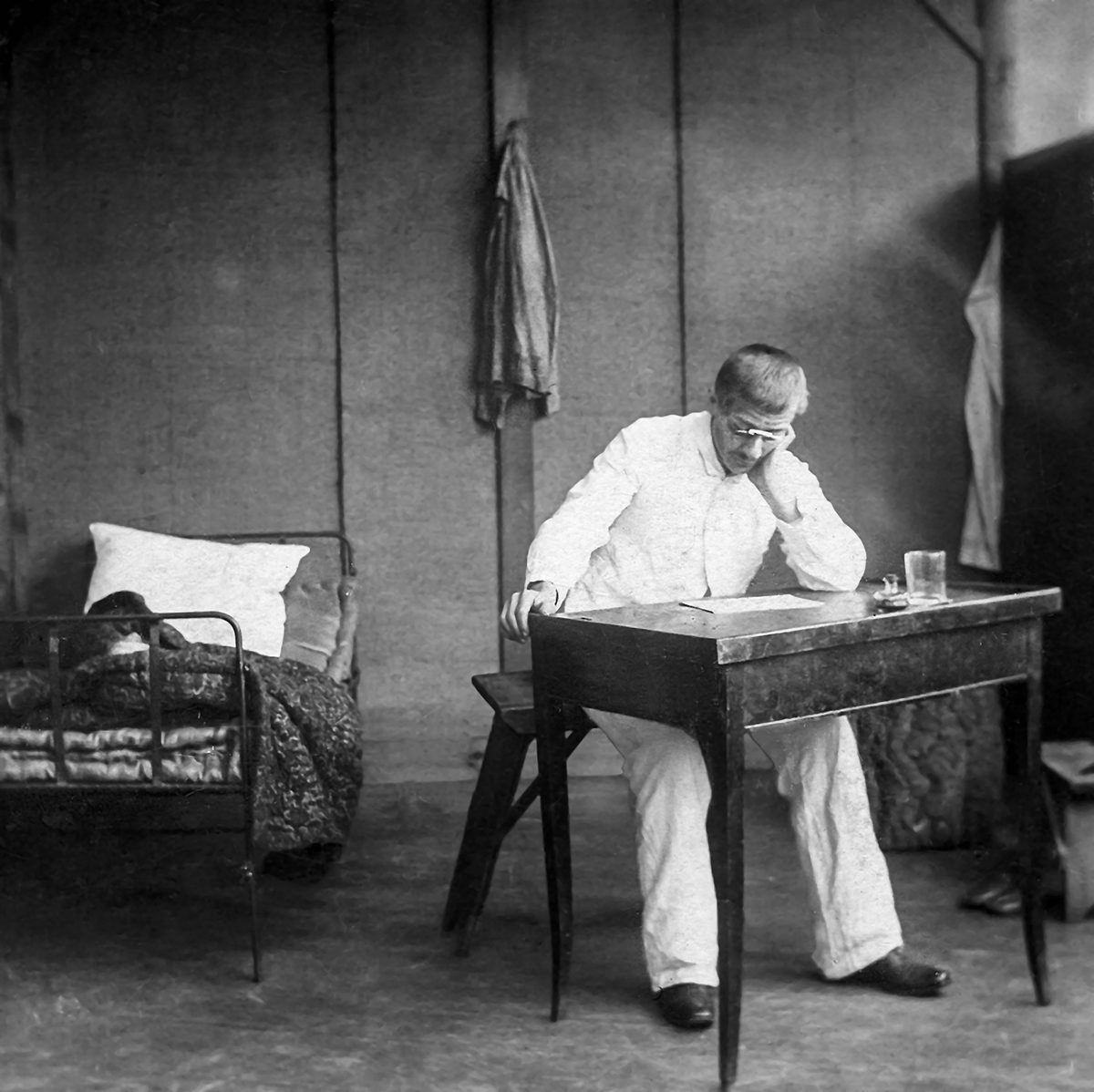
He was then transported to Devil's Island, a small rocky outpost off the coast of French Guiana, where he was held in a stone hut, forbidden from speaking freely with guards, and eventually fitted with iron leg shackles at night following a false escape rumor. His letters to his wife Lucie were censored and sometimes not delivered at all. French law permitted the government to hold him there indefinitely.[2][3]
For the next two years, the case was officially closed. The Army believed it had excised a traitor. The press, especially the antisemitic dailies, treated the conviction as confirmation of a broader anxiety about Jews in the officer corps. Dreyfus's family, led by his brother Mathieu, continued to investigate privately while presenting the appearance of accepting the verdict in hopes of eventually forcing a review through legal channels.[1][2]
Picquart's discovery and the Army's choice, 1896
The mechanism that ultimately unraveled the conviction was not a legal appeal. It was an internal Army investigation headed by a man who was not initially a Dreyfus sympathizer.
In the spring of 1896, Lieutenant Colonel Georges Picquart was appointed chief of the Statistical Section, the Army's intelligence unit. In the course of reviewing intercepted correspondence, he discovered a torn message — the petit bleu, a pneumatic-mail letter that had been reconstructed from fragments — addressed to a French infantry major named Ferdinand Walsin Esterhazy. The content strongly suggested that Esterhazy was passing information to the German military attaché.[1][2][3]
Picquart then compared Esterhazy's handwriting with the bordereau. The match was far stronger than the match with Dreyfus's handwriting. He brought this finding to his superiors. The response was not an investigation of Esterhazy. It was an order to Picquart to drop the matter and, shortly afterward, a reassignment that sent him to Tunisia.[1][2]
The Army now faced a choice that would define the affair's second phase. If Esterhazy was the real author of the bordereau, then Dreyfus had been convicted on fabricated evidence and misidentified handwriting. Acknowledging this would require admitting that the Army had imprisoned an innocent man, conducted a secret and illegal trial, and was now protecting the actual spy. The generals chose to protect the institutional verdict.[1][2]
The forgeries deepen: Henry and the manufactured proof, 1896–1898
To insulate the conviction from growing outside scrutiny, the chief of the Statistical Section, Lieutenant Colonel Hubert-Joseph Henry, fabricated additional documents implicating Dreyfus. The most significant forgery — later called the faux Henry — was a letter in what appeared to be the handwriting of the Italian military attaché, apparently confirming that the German attaché had received intelligence from a French officer named "D." Henry knew this letter did not exist in the original files. He created it.[1][2][4]
Meanwhile, Esterhazy, rather than being quietly retired, was allowed to demand a court-martial to clear his name after evidence of his guilt began leaking to the press through Mathieu Dreyfus and journalists sympathetic to the case. In January 1898, a military court acquitted Esterhazy in under three minutes. The acquittal was a demonstration of institutional closure: the Army was signaling that no external pressure, journalistic or familial, would induce it to revisit the original verdict.[1][2]
Zola's J'Accuse, January 13, 1898
The next day, the writer Émile Zola published a letter addressed to the President of the Republic on the front page of the newspaper L'Aurore. The editor, Georges Clemenceau, gave it its title: J'Accuse…! — I Accuse.
The letter was 4,000 words long. It accused, by name and role, every senior officer and official Zola held responsible for the original conviction, the forged evidence, the illegal dossier secret, and the acquittal of Esterhazy. It also accused the Army of a press of concealment, step by step, each step named and described.[1][2][4]
Zola understood what he was doing. The letter was written to force a prosecution. Under French law, accusing named individuals of crimes without proof was a criminal libel offense. Zola expected to be charged and tried. He wanted a public trial, with witnesses, where the evidence underlying the original conviction would be forced into the open. The strategy worked partly. Zola was tried, convicted, and sentenced to a year in prison and a fine. He appealed and eventually went into voluntary exile in England to avoid prison while the appeal ran.[2][4]
But the trial did produce testimony. Witnesses, including former intelligence officers, said things on the record that the Army would have preferred to suppress. The public had now heard, in a courtroom, that the evidence against Dreyfus was contested and that at least one officer had identified a different suspect.[1][2]
Henry's confession and suicide, August 1898
In the summer of 1898, a new War Minister, Godefroy Cavaignac, announced to the Chamber of Deputies that the faux Henry was genuine proof of Dreyfus's guilt. He had it posted publicly throughout France. This turned out to be the point of maximum overconfidence. An aide to Cavaignac, reviewing the documents more carefully, noticed inconsistencies in the paper and ink of the forgery.[2][3]
Henry was confronted on August 30, 1898. He confessed to having forged the document to "reinforce" evidence he believed to be true. He was arrested and taken to a military prison at Mont-Valérien. The next morning, August 31, he was found dead in his cell, his throat cut with a razor. The official finding was suicide.[2][3]
Henry's confession destroyed the last official bulwark of the 1894 verdict. The Army could no longer claim its secret evidence file was intact. Esterhazy fled to England, where he later gave interviews admitting he had written the bordereau.[2] A formal demand for a revision of Dreyfus's sentence reached the Court of Cassation in September 1898.
The Rennes retrial and the pardon, 1899
The Court of Cassation ordered a new court-martial. It was held at Rennes in August and September 1899. Dreyfus returned from Devil's Island to stand trial again. He was visibly diminished: four years of tropical imprisonment had aged him sharply. The trial lasted several weeks. The verdict was again guilty — this time with "extenuating circumstances," a phrase that made no legal sense applied to treason but reflected the court's attempt to find an exit that preserved some institutional face.[1][2][3]
The new verdict drew international condemnation. The French government, led by Prime Minister René Waldeck-Rousseau, issued a pardon ten days later. Dreyfus accepted the pardon under protest, explicitly stating that accepting it should not be interpreted as accepting the verdict. He was a free man but formally a convicted traitor.[2][3]
Full exoneration, 1906
Legal efforts continued through the early 1900s. The Court of Cassation, France's highest court, undertook a full review that lasted three years. In July 1906, the Court of Cassation quashed the Rennes verdict without remand — meaning it did not order a third court-martial. It declared Dreyfus innocent in its own judgment. The conviction was annulled.[2][3][4]
Dreyfus was reinstated in the Army, promoted to Major, and decorated with the Legion of Honor in a ceremony at the École Militaire — the same courtyard where he had been publicly stripped of his rank eleven years before.[2][4] He served in the First World War, retiring eventually as a Lieutenant Colonel. He died in 1935.
Why the twelve-year sequence matters
The standard summary treats the Dreyfus Affair as proof that antisemitism existed inside the French military establishment. That is accurate but undersells the structural point. The affair lasted as long as it did because the conviction was not merely wrong; it was bureaucratically protected at each stage. The secret dossier, Henry's forgeries, the Esterhazy acquittal, and the Rennes guilty verdict were each a separate decision by people in institutional positions to maintain the conviction against contrary evidence.[1][2][3]
What broke the chain was not evidence alone. Picquart found the evidence in 1896 and was reassigned. Evidence became effective only when it reached an institutional venue — a criminal court, a parliamentary forum, eventually the Court of Cassation — where the question being decided required the evidence to be tested against the original documents rather than deferred to military authority.[1][2][4]
Zola's letter mattered not primarily as literature but as a mechanism for forcing a prosecution. The faux Henry mattered not when it was created but when an official posted it publicly, which created accountability that made the forgery's exposure fatal to the cover-up's coherence. The Court of Cassation's 1906 ruling mattered because it was final in French law and came from an institution that the Army could not simply reassign or acquit.[2][3]
The Dreyfus Affair entered the comparative vocabulary of democratic governance because it demonstrated a version of what institutional failure looks like when checked: slowly, expensively, through specific procedural chokepoints rather than through a single revelation. The lesson is not that republics are virtuous. It is that they can be made to reckon with their errors if the procedural machinery remains functional long enough and adversarial enough to reach the original act.[1][2][3][4]
Sources
- Jewish Virtual Library, "The Dreyfus Affair" — overview of the affair's phases, antisemitic context, and legacy.
- Encyclopaedia Britannica, "Dreyfus affair" — factual chronology and historiographical context.
- Ruth Harris, Dreyfus: Politics, Emotion, and the Scandal of the Century (Metropolitan Books, 2010) — archival study of the affair's social and emotional dimensions.
- Émile Zola, "J'Accuse…!" (L'Aurore, January 13, 1898) — full text of the open letter, as reproduced on Wikisource.