The most famous sentence about the Great Chicago Fire is not a date, a weather report, or a building code. It is a tiny scene: October 8, 1871, a cow kicks a lantern in Catherine O'Leary's barn, and Chicago burns. The story is memorable because it feels proportionate to memory rather than to evidence. One animal, one lamp, one careless gesture, one city in flames.
The historical record is narrower and less satisfying. The fire did begin in the vicinity of the O'Leary barn on DeKoven Street, but the exact cause was never securely proved.[1][2][3] The official inquiry did not establish Catherine O'Leary's guilt, and later retellings kept changing the culprit even while preserving the same moral structure: the city was destroyed because one humble, foolish act set it off.[1][4]
That is why the sharper question is not simply whether the cow did it. The more useful historical question is why Chicago wanted the cow story so badly. Once the sources are lined up, the strongest conclusion is that the legend endured because it turned a complex urban systems failure into a single blameable image, and because Catherine O'Leary, a poor Irish Catholic woman, was an unusually convenient vessel for that blame.[1][2][3]
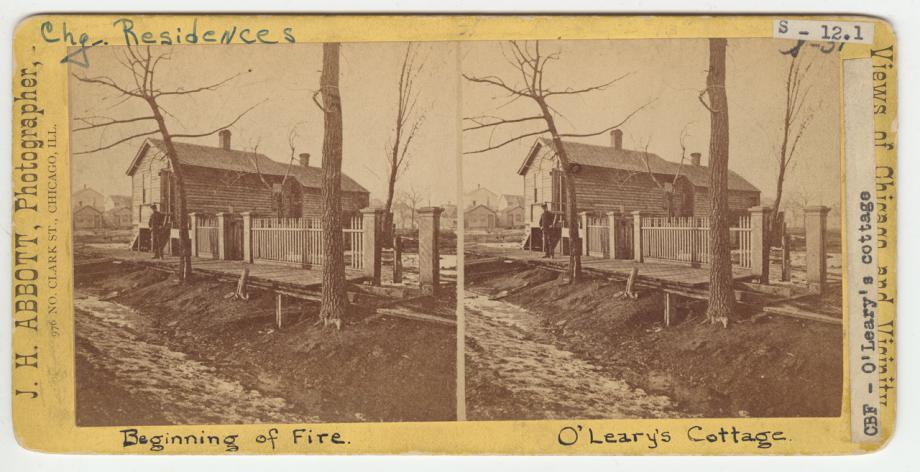
Image context: the surviving O'Leary cottage matters because it shows how the property itself became part of the legend's afterlife. The site was not only where a fire began. It became where Chicago kept returning to narrate causation as a household fable.[6]
Timeline anchors
- October 8, 1871: a fire began near the O'Leary property on DeKoven Street.[1][2][3]
- October 10, 1871: rain and exhaustion finally stopped the main blaze after it had crossed the river and devastated large sections of the city.[2][3]
- October 11, 1871: newspapers were already circulating the story that Catherine O'Leary's cow had caused the fire.[3]
- October 19, 1871: a writer for the Nashville Union was already challenging the O'Leary story after interviewing Catherine O'Leary.[3]
- 1911: the fortieth-anniversary moment gave the legend a fresh commemorative life, including staged public representations of Mrs. O'Leary and her cow.[1]
- October 28, 1997: Chicago's city council formally exonerated Catherine O'Leary and the cow.[4][5]
These dates matter because they separate three layers that popular memory often crushes together: the fire itself in 1871, the rapid newspaper circulation of the cow story in the days immediately afterward, and the much longer commemorative afterlife that kept turning uncertain cause into durable folklore.[1][3][5]
What the sources can actually support
The firmest claim in the record is about location, not mechanism. The Chicago History Museum's "Web of Memory" essay says the conflagration almost surely began in the vicinity of the crowded O'Leary barn, where the family kept cows, a horse, hay, coal, and wood shavings.[1] That already tells us something important. Even before anyone asks who or what lit the first spark, the setting was one of combustible storage in an unusually vulnerable city.
The National Archives summary makes the larger conditions explicit. The fire's exact origin remains unknown; what is known is that once it started, ferocious winds, extreme dryness, and abundant fuel let it race out of control.[2] Chicago in the mid-nineteenth century was built largely of wood, with wooden docks, vessels, sheds, and dense building stock that made embers harder to contain once the blaze crossed key corridors.[2] The article's inference from these sources is straightforward: the city's devastation requires more than a lantern story. It requires an urban environment ready to amplify flame into catastrophe.
This distinction matters because popular memory often treats ignition and destruction as though they were the same kind of cause. They are not. Even if one lantern, one smoker, or one partygoer triggered the first blaze, Chicago still burned at the scale it did because wind, materials, crowding, firefighting strain, and confusion allowed a local fire to become a metropolitan one.[2][3][4] The legend compresses all of that into a single domestic gesture.
Why the cow story is weaker than people remember
The case against Catherine O'Leary was never as strong as the folklore suggests. The Chicago History Museum essay states that O'Leary offered sworn testimony that she was in bed when the fire started and that the official inquiry found no proof of her guilt.[1] That does not prove some other exact theory. It does, however, set a hard evidentiary boundary: the story most schoolchildren know was not the same thing as an established investigative conclusion.
The Library of Congress guide to Chronicling America is useful here because it shows how fast the myth outran the evidence. Its timeline notes that by October 11, 1871, the cow story was already circulating in the New-York Tribune.[3] By October 19, another newspaper account was already undermining that version after speaking with O'Leary herself.[3] In other words, the legend and the doubt appeared almost side by side. The memory of certainty came later.
The later archive makes the story murkier rather than cleaner. The Chicago History Museum page notes that on the fire's fortieth anniversary, reporter Michael Ahern claimed that he and colleagues had invented the whole tale.[1] That confession is not a perfect solution either. It does not tell us the exact origin of the blaze, and later accounts even disputed Ahern's own role in writing the early story.[1] But it does show that the cow legend was not a stable eyewitness tradition moving intact from the scene into history. It was a changing media artifact.
The Library of Congress law blog records the same underlying point in institutional language: the investigating board was unable to determine the primary cause, yet the O'Learys remained attached to local legend anyway.[4] When Chicago's city council formally exonerated Catherine O'Leary and the cow in 1997, it was correcting a memory problem more than closing a forensic case.[4][5] The city could lift the official blame, but it could not easily erase a story that had already become one of the city's favorite explanatory miniatures.
Why Chicago kept the myth
The endurance of the story makes more sense once blame is treated as a social need rather than as a neutral readout of evidence. The Chicago History Museum essay is unusually blunt on this point. It argues that Mrs. O'Leary functioned as a better scapegoat than more abstract explanations because she could stand in for careless building, sloppy conduct, and an immigrant underclass already familiar to local prejudice.[1] The essay directly names anti-Catholic, anti-immigrant, and possibly anti-female sentiment as part of the legend's appeal.[1]
That argument has real explanatory force. A fire driven by weeks of dryness, combustible urban design, and institutional weakness is historically plausible but narratively awkward.[2][3][4] A cow kicking a lantern is narratively perfect. It supplies intention without conspiracy, accident without structure, and a single household image that children can remember. It also makes catastrophe feel morally containable. If one immigrant woman's barn did it, then the city did not have to confront the full embarrassment of having built such a flammable environment in the first place.
The sources also suggest a second reason the story lasted: it offered emotional scale. The bigger the disaster, the more readers seem to want a humble beginning. The Chicago History Museum essay remarks that there was something imaginatively satisfying in the idea that an epic fire could start from such a small domestic scene.[1] That is more than folklore psychology. It explains why later commemorations kept returning to Mrs. O'Leary and the cow long after the investigative uncertainty was obvious.[1][5]
The image record reinforces that point. The O'Leary site itself became a durable object of looking, collecting, retelling, and public performance.[1][6] The surviving cottage, the lost barn, anniversary parades, cartoons, and souvenir culture all helped convert a disputed cause into a stable memory form. What persisted was not proof. It was replay value.
Two interpretations still compete
Interpretation one: the legend preserves a core truth about a lantern accident
This interpretation starts from the fact that the fire did begin near the O'Leary barn and that several early rumors placed either Catherine O'Leary, her cow, or other human activity in or around that structure.[1][3] On this reading, the later embroidery may be unreliable, but the basic intuition that an ordinary barn accident caused the fire could still be right.
That interpretation is possible. The sources do not exclude accident at the site. What they exclude is confidence in the most famous version.
Interpretation two: the legend mattered because it turned structural vulnerability into personal blame
This interpretation begins with a different emphasis. It accepts the barn vicinity as the likely point of origin, but it treats the famous cow story less as a successful forensic memory than as a successful scapegoat narrative.[1][2][3] The unknown exact cause, the rapid newspaper circulation, the absence of proof against Catherine O'Leary, and the documented appeal of ethnic and gendered blame all point in the same direction.[1][3][4]
This second interpretation is stronger because it explains both halves of the record at once: why the story spread so quickly and why it survived despite weak proof. A legend built only on factual confidence should have died under contradictory testimony and investigative uncertainty. The O'Leary story endured because it answered a cultural need that evidence alone could not unsettle.[1][5]
Why the second reading is the better one
The most defensible conclusion is therefore not that the cow story is absurd in every detail, nor that historians now know the true culprit with confidence. The better conclusion is narrower and more historically useful. The fire began near the O'Leary property, but the famous image of Catherine O'Leary's cow kicking a lantern became durable because it solved Chicago's memory problem better than the record solved its causation problem.[1][2][3]
That distinction keeps the claim properly bounded. The sources state that the exact cause remained undetermined, that the city was dangerously flammable, that the myth circulated almost immediately, and that anti-immigrant blame helped sustain it.[1][2][3][4] The essay's interpretation is that these facts belong together. Chicago did not just inherit a false anecdote. It chose, repeated, and commemorated a culprit-shaped version of catastrophe because that version was easier to carry than a systems story about wood, wind, drought, and governance.
The legend survives for the same reason many historical myths survive: it is smaller than the event and therefore easier to remember. The archive is larger, rougher, and less consoling. That is usually where the history starts.
Sources
- The Great Chicago Fire & The Web of Memory, "The O'Leary Legend" - on O'Leary's testimony, the inquiry's failure to prove guilt, Michael Ahern's later claim, and the politics of scapegoating.
- National Archives Museum, "150 Years Ago: The Great Chicago Fire" - on the unknown exact origin, dry and windy conditions, wooden construction, and the scale of destruction and rebuilding.
- Library of Congress, "Great Chicago Fire of 1871: Topics in Chronicling America" - on the fire's timeline and the rapid newspaper spread of the O'Leary-cow story and its early rebuttal.
- Library of Congress Law Library blog, "The Great Chicago Fire" - on the investigating board's inability to determine the primary cause, the 1997 exoneration, and post-fire fire-safety reforms.
- Chicago City Council Journal, October 28, 1997 - record of the resolution exonerating Catherine O'Leary and her cow.
- The Great Chicago Fire & The Web of Memory, "The Cottage of Patrick and Catherine O'Leary; J. H. Abbott, Stereograph, 1871 (ichi-02741)" - source page for the archival photograph used here.