The usual shorthand for Dred Scott v. Sandford is that it was a racist Supreme Court opinion that helped push the United States toward civil war. That is true, but it is still too blunt to explain why the decision landed with such force in 1857. The opinion did not merely reject one freedom suit. It tried to reorganize the constitutional field around slavery.[1][5]
That is easiest to see when the ruling is read as a sequence rather than as a slogan. Roger B. Taney's majority opinion begins with citizenship and jurisdiction, then moves into the status of federal territories, and then turns slaveholding into a form of constitutionally protected property.[1] By the end of that chain, the Court has built a much larger claim than "Dred Scott loses." It has argued that Black people cannot claim federal citizenship, that Congress cannot exclude slavery from the territories, and that the Constitution itself protects the master's claim while moving west.[1][5]
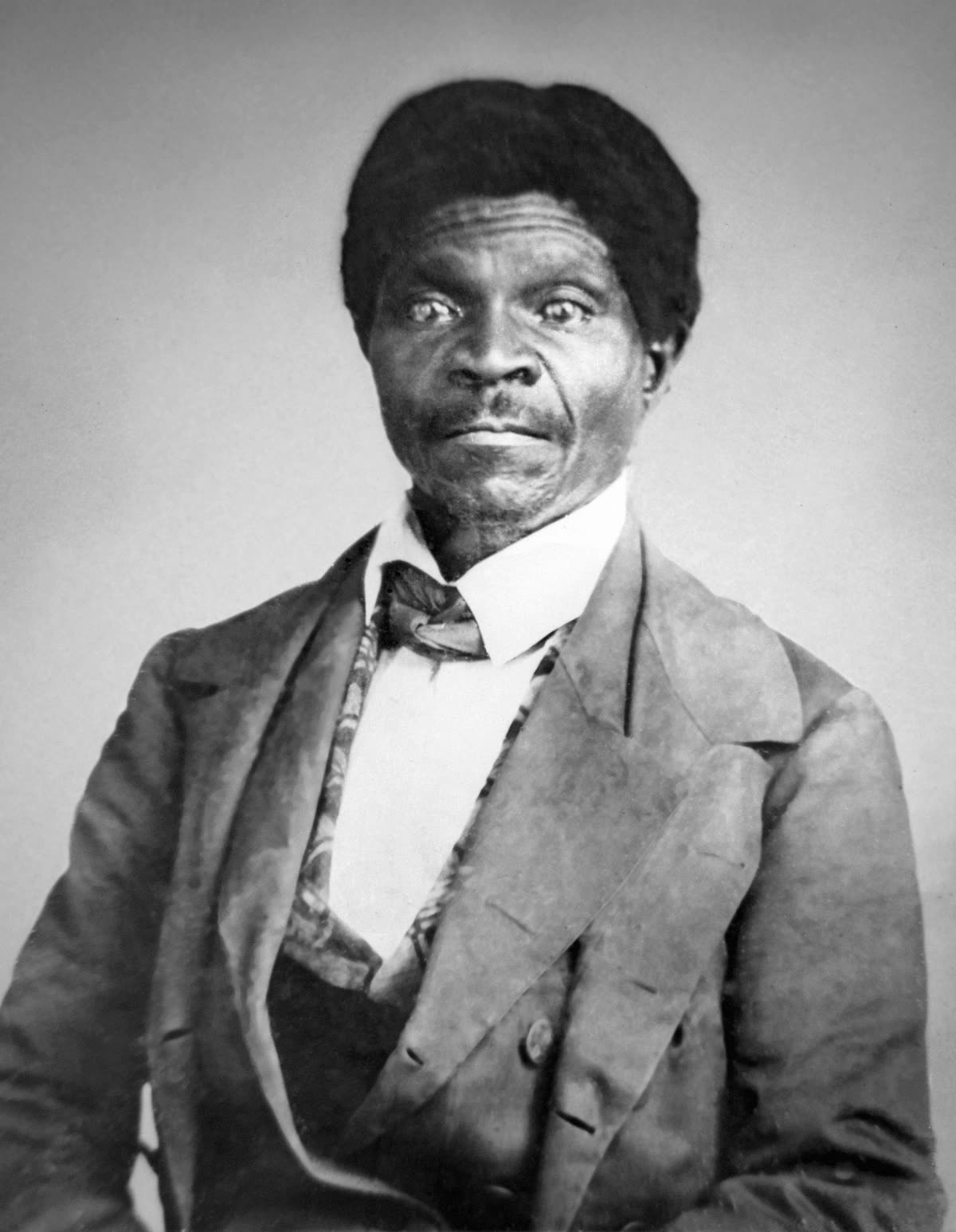
The lead image is the surviving circa-1857 photograph of Dred Scott.[6] It matters because this article is about a judicial opinion that speaks in sweeping abstractions while resting on one family's movement through Illinois, Fort Snelling, Missouri, and the courts.[1][2][3] Reading the photograph beside the opinion restores the asymmetry at the center of the case: one side was trying to live as free people, while the Court was trying to settle the constitutional status of slavery for the whole republic.
Timeline anchors
- 1834: John Emerson took Dred Scott from Missouri to Rock Island, Illinois, a free state.[1][2]
- 1836-1838: Emerson then held Scott and Harriet Scott at Fort Snelling in present-day Minnesota, then in free Wisconsin Territory under the Missouri Compromise line.[1][2][3]
- April 6, 1846: Dred and Harriet Scott filed freedom suits in St. Louis.[2][3][4]
- 1850: a St. Louis jury found for the Scotts.[2][3]
- 1852: the Missouri Supreme Court reversed that victory and abandoned the path that had often freed enslaved people after residence on free soil.[2][3][4]
- March 6, 1857: the U.S. Supreme Court issued Taney's opinion in Dred Scott v. Sandford.[1][2][5]
These dates matter because the case did not begin in Washington as a giant constitutional test. It began inside a familiar Missouri freedom-suit framework. The Scotts' claim drew strength from an older state-level pattern often summarized as "once free, always free": if an enslaved person had been taken by an owner to reside in a jurisdiction where slavery was barred, Missouri courts had often treated that residence as breaking the bond of slavery.[3][4] Dred and Harriet Scott used that rule because their lived history fit it unusually well. Emerson had taken them first into Illinois and then into free federal territory at Fort Snelling.[1][2][3]
The case arrived with a workable freedom rule already in view
The National Park Service chronology makes the path plain. The Scotts filed in 1846, lost the first round on a technicality in 1847, won a new trial, and then secured a jury verdict for freedom in 1850.[2] Missouri Digital Heritage places the decisive shift in 1852, when the Missouri Supreme Court reversed course and declined to follow the state's earlier freedom-suit logic.[3] That reversal is the bridge between the local case and the national one.
This part of the story matters because it shows what the Supreme Court did and did not inherit. Taney did not receive a blank slate. He received a dispute already shaped by state doctrine, by travel into free jurisdictions, and by a record that had been compressed in federal court into an "Agreed-Upon Statement of Facts" summarizing Dred Scott's movements and family life.[1][3] The opinion that followed did not simply weigh evidence about residence. It used that agreed record as a platform for a broader constitutional intervention.[1][3][5]
The NPS lesson on the Old Courthouse adds another useful boundary. Dred and Harriet Scott were not anomalies wandering outside law; they were using one of the limited legal routes available to enslaved people in Missouri.[4] That point keeps the case from being misremembered as a purely federal creation. The Supreme Court took a claim that had once been legible within Missouri practice and rewrote the level at which the argument had to be decided.[3][4]
Taney starts with citizenship and tries to freeze constitutional meaning
Taney's first major move was jurisdictional. The National Archives transcript summarizes the opinion's core holding in one sentence: persons of African descent whose ancestors had been brought to the United States as slaves were not "citizens" within the meaning of the federal Constitution and therefore could not sue in federal court in that character.[1] In the transcript's numbered propositions, this appears early and repeatedly. The opinion insists not only that Scott cannot sue as a citizen, but that later changes in public feeling cannot alter what the Constitution originally meant on that point.[1]
This is where the opinion often gets summarized, and understandably so. It is the part that most openly denies Black belonging at the federal level. Yet even here, the wording is doing more than a narrow technical job. Taney is not saying only that Scott personally failed to meet some procedural threshold. He is trying to define an entire class of people outside the constitutional community the Court is willing to recognize.[1][5]
That ambition becomes clearer because the opinion speaks historically. It claims to recover what the Constitution meant when adopted and treats that asserted original meaning as binding in 1857, despite free Black citizenship practices that had existed in some states.[1] The article's inference from the text is straightforward: Taney is using jurisdiction as the front door for a much larger argument about who the Constitution was for.
The opinion does not stop at standing; it moves to territory and property
If the Court had truly wanted to decide the smallest possible question, it could have stopped after holding that Scott lacked standing in federal court. Instead, the opinion keeps going. The National Archives transcript shows Taney moving next to Congress's power over the territories and then to the status of enslaved people as property protected by the Constitution.[1]
This second movement is the most historically consequential part of the opinion. Taney argues that the territories are held for the "common and equal benefit" of citizens, that Congress cannot exclude one class of citizens while admitting another, and that every citizen has the right to take into a territory any species of property recognized by the Constitution.[1] The opinion then makes the crucial leap: it says slaves are constitutionally recognized as property and that Congress therefore cannot bar slaveholders from carrying them into federal territory.[1]
That is the point at which the ruling stops looking like a harsh jurisdictional opinion and starts looking like an effort to nationalize slavery's protection. The Missouri Compromise line, which had barred slavery north of 36°30', becomes unconstitutional under this reading.[1][3] A case that began with one family's residence in free jurisdictions is converted into an argument that the federal government lacks authority to keep slavery out of the territories at all.[1][5]
The Library of Congress entry for the official U.S. Reports version matters here because it reminds us that this was not a rumor, pamphlet summary, or later schoolbook paraphrase. The reasoning appears in the published Supreme Court report itself.[5] Reading it in that form makes the structure harder to evade. Jurisdiction is only the opening gate. Territorial power and property protection are where the opinion reveals its larger purpose.
Why the territorial move matters even more than the citizenship holding
The citizenship holding was brutal and historically notorious, but the territorial holding is what gave the decision national strategic weight in 1857. A ruling confined to Scott's inability to sue would still have been ugly. A ruling that also invalidated Congress's territorial slavery restriction was explosive.[1][3]
That difference matters because U.S. politics in the 1850s was already turning on whether slavery would be contained or allowed to expand westward. Missouri Digital Heritage describes the case as a "lightning rod" for sectional bitterness because it took a freedom suit and turned it into a national decision on slavery's place in the territories.[3] The opinion's structure explains why. Taney was not content to say that Scott remained enslaved under Missouri law. He wrote as if the Constitution itself carried slave property rights across the map.[1][3][5]
The result is an opinion with two time scales at once. On one scale, it determines the Scotts' federal case. On the other, it tries to settle the constitutional rules for the entire territorial future of the Union. That second scale is what makes the decision read less like adjudication and more like constitutional statecraft on behalf of slavery.
Two readings still compete
Reading one: the case is mainly about the denial of Black citizenship
This reading emphasizes the opinion's most infamous declarations. It treats the case above all as a ruling that Black people could not claim U.S. citizenship or federal judicial protection.[1] That reading is fully grounded in the text, and it captures why the opinion remains morally shocking.
Reading two: the case is a proslavery constitutional program
This reading accepts the citizenship holding, then insists that the opinion's real reach lies in the way Taney links citizenship, territorial access, and slave property into one system.[1][3][5] On this reading, Dred Scott matters not only because it excludes Black people, but because it tries to make slavery's expansion constitutionally secure.
The second reading is stronger because it explains why the opinion kept talking after jurisdiction. A Court interested only in exclusion could have dismissed the case more narrowly. Taney instead used the occasion to write a territorial and property theory that reached far beyond Scott himself.[1][5]
Why the second reading is the better one
The most useful way to read Dred Scott, then, is as a constitutional sequence. First, the opinion narrows the category of federal citizenship. Second, it narrows Congress's power over the territories. Third, it widens constitutional protection for slave property.[1] That chain is what turned one freedom suit into a national proslavery intervention.
The later constitutional response confirms the scale of what the Court had tried to do. The National Archives summary notes that the 13th Amendment abolished slavery and the 14th Amendment established birthright citizenship, undoing the core architecture of the ruling.[1] Those amendments did not simply correct a mistaken procedural judgment. They had to remake the constitutional order the opinion had tried to define.
That is why the photograph of Dred Scott belongs at the top of the piece.[6] The opinion worked by abstraction: citizen, territory, property, jurisdiction. The photograph brings back the litigant whose life had to pass through those categories. Once the decision is read closely, its force lies in the way it uses one man's case to write a larger proslavery Constitution, and in the way the postwar amendments had to answer it at the same scale.
Sources
- National Archives, "Dred Scott v. Sandford (1857)" - milestone document summary and transcript of the Supreme Court ruling.
- National Park Service, "Dred Scott Chronology" - timeline of the Scotts' movements, trials, state appeal, and Supreme Court decision.
- Missouri Digital Heritage, "Missouri's Dred Scott Case, 1846-1857" - state-archive reconstruction of the freedom suits, Missouri reversal, and agreed statement of facts.
- National Park Service, "(H)our History Lesson: Suing for Freedom, Dred and Harriet Scott's Case at the Old Courthouse" - context on Missouri freedom suits and the legal path from St. Louis to the Supreme Court.
- Library of Congress, "U.S. Reports: Dred Scott v. Sandford, 60 U.S. (19 How.) 393 (1856)" - official published Supreme Court report entry.
- Wikimedia Commons, "File:Dred Scott photograph (circa 1857).jpg" - source page for the archival photograph used as the article image.