Codex Sinaiticus is often introduced with superlatives: one of the world's most important books, a fourth-century Greek Bible, and the oldest substantial book to survive from Antiquity.[1][2] Those claims are true enough, but they can make the manuscript feel settled, as if its significance were simply stored inside ancient parchment. The more difficult history is a custody story. Codex Sinaiticus matters now because its pages passed through preservation, removal, scholarly publication, imperial diplomacy, Soviet sale, monastic protest, fragment discovery, conservation work, and digital reunion without ever becoming a single uncomplicated possession.
The manuscript's modern memory begins at Saint Catherine's Monastery, where the Codex Sinaiticus Project says it was preserved for many centuries.[2] That monastic setting matters because it gives the story a place before it becomes a European library story. The codex was not waiting in an empty desert for discovery. It belonged to a living monastery with manuscripts, liturgy, buildings, risk, earthquake damage, conservation needs, and its own historical memory. When the fourth-century book later became a global research object, that older custody did not disappear. It became the point around which every later claim had to turn.
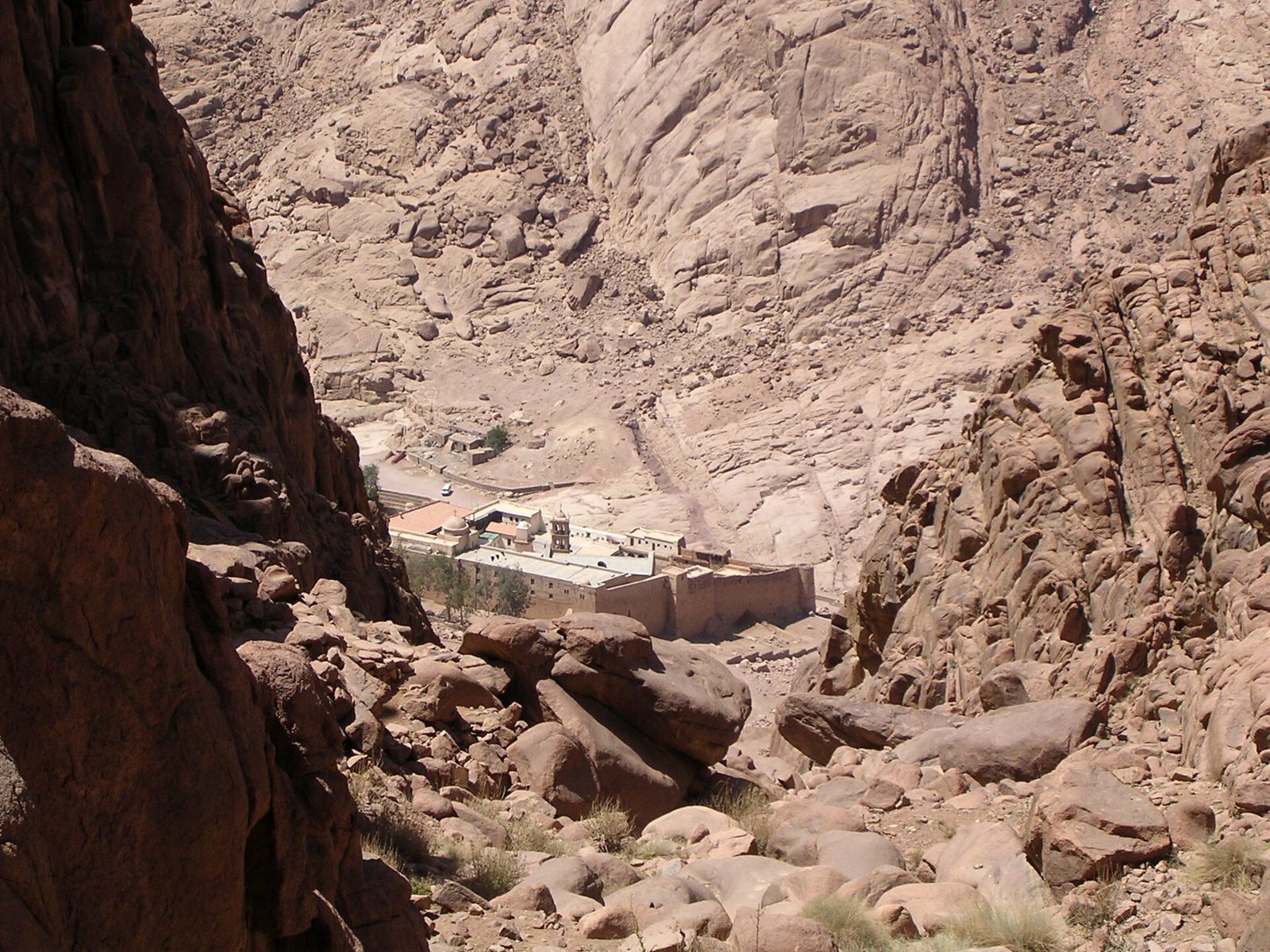
The monastery image above belongs here for that reason. It keeps the story anchored before the manuscript becomes a library object, a diplomatic file, or a digital interface: stone walls in a desert mountain landscape, a living institution around which later claims of preservation, removal, return, and access still turn.[7] The modern question is not only what the manuscript says. It is how a book becomes readable when its leaves are held in different cities by institutions with different claims, languages, catalogues, and memories.
The monastery before the discovery story
The first possible written notice of the codex appears not in a modern catalogue but in the journal of Vitaliano Donati, an Italian visitor to Saint Catherine's in 1761. The official project history says Donati reported seeing a Bible of large, delicate parchment leaves written in a round script.[1] That identification is cautious, but the caution is useful. It reminds us that the codex did not enter history fully formed as a named treasure. It was first an observed manuscript inside a monastery's broader collection.
The familiar nineteenth-century narrative starts in 1844, when Constantine Tischendorf visited Saint Catherine's. According to the project's history, sometime between May 24 and June 1, 1844, monks brought 129 Old Testament leaves to his attention, and Tischendorf obtained 43 of them.[1] In 1845 he returned to Leipzig, and in 1846 he published those leaves under the title Codex Friderico-Augustanus, honoring Frederick Augustus II of Saxony rather than naming Sinai as the source.[1] Even that title performs a custody shift. The leaves had come from a monastery, but the published name placed them inside Saxon patronage and European scholarship.
This is where commemoration becomes unstable. One memory casts Tischendorf as the scholar who rescued a biblical treasure for the world. Another casts the episode as the beginning of an unequal removal from a monastery whose consent, record keeping, and political leverage were not those of Leipzig, Saint Petersburg, or London. The official Codex Sinaiticus history is careful about this boundary. It records what Tischendorf said, notes where no other record has been identified, and follows the later paperwork rather than turning the story into either pure theft or pure salvation.[1]
Loan, donation, and a promise to return
The custody problem sharpened during Tischendorf's third visit in 1859, this time under the patronage of Tsar Alexander II. The project history says he first saw the 347 leaves on February 4, 1859, then requested that they be transferred to the monastery's metochion in Cairo so he could examine and transcribe them more effectively.[1] On February 24, the codex was brought to Cairo, and from March to May he examined it one gathering at a time.[1]
The crucial document came later. On September 16/28, 1859, Tischendorf signed a receipt for the loan of the 347 leaves. The official narrative says that receipt stated he was taking the manuscript to Saint Petersburg to compare his transcription with the original for publication, promised to return it intact when requested, and referred to conditions in an earlier letter from the Russian ambassador.[1] That ambassador's letter said ownership remained with the Holy Monastery unless a donation were realized.[1]
Those details matter because they resist a clean story. If the codex had simply been transferred as an uncontested gift, the receipt and ownership reservation would not carry such weight. If it had simply been stolen in one moment, the later diplomatic and ecclesiastical paperwork would be irrelevant. Instead, the record shows a chain of loan language, asserted future donation, imperial patronage, and institutional asymmetry. Historical memory has to sit with that mess.
The donation question did not end in 1859. The official project history follows the manuscript through later negotiations and a formal deed of gift associated with 1869.[1] But the fact that later paperwork existed did not erase the monastery's later claim. In January 1934, soon after the codex arrived in London, Archbishop Porphyrios of Sinai asserted that the monastery was the sole rightful owner. The British Museum replied by referring the monastery to the Soviet government, while its director began re-examining the events from 1859 to 1869.[1] The afterlife of the codex was therefore not only textual. It was archival argument.
London did not end the custody question
The most visible twentieth-century transfer came in 1933, when the principal surviving portion of the codex, 347 leaves, was purchased from the Soviet government and came to the British Museum, now the British Library.[2] The purchase gave London the largest portion, but it did not reunite the manuscript physically. Leipzig still held 43 leaves. Saint Petersburg held fragments. Saint Catherine's retained leaves and fragments, including material discovered later.[3][4]
Leipzig University Library's project page gives the current distribution in compact form: about 407 surviving leaves, with 43 in Leipzig since 1844, 347 in the British Library since 1933, 5 fragments in the Russian National Library, and 12 fragmentary leaves plus 14 smaller fragments at Saint Catherine's Monastery.[3] That distribution is the modern shape of the codex. It is not a single book on one shelf. It is a dispersed artifact whose memory depends on all four custodial sites.
The British Library catalogue record adds another kind of precision: shelfmark and folio-level custody. Its Archives and Manuscripts catalogue identifies Add MS 43725 as Codex Sinaiticus and links digitised folio groups such as ff 217v-228r to online manuscript viewing.[5] That bureaucratic detail is not dry housekeeping. It is how a dispersed ancient book becomes findable in the present. Shelfmarks, folio ranges, IIIF manifests, and institutional records now stand beside parchment as part of the manuscript's public life.
The monastery's memory remained active too. The Saint Catherine Foundation records that after renovation works following an earthquake, 1975 brought the discovery of 12 complete leaves and more than 20 fragments of Codex Sinaiticus.[4] That discovery complicates any story in which the codex simply left Sinai and became a European collection object. Sinai continued to contain material evidence. The monastery was not merely the starting point of a finished transfer; it remained a custodian of surviving fragments and a site where the manuscript's physical history could still change.
Digital reunion as commemoration, not repair
The Codex Sinaiticus Project describes itself as an international collaboration to reunite the entire manuscript in digital form and make it accessible to a global audience.[2] Its project history says the four member institutions agreed to research the codex's history, commission an objective historical narrative acceptable to all four, and publish relevant documents where permissions allowed.[2] That is a striking formulation. The digital project was not only a scanning job. It was also a negotiated act of memory among custodians who did not all inherit the manuscript in the same way.
Digital reunion can be tempting language. It suggests that a technological interface has solved the old problem by placing every page within one browser window. But digital access does not undo removal, sale, dispute, or physical division. It changes the terms of commemoration. Readers can now move across leaves whose physical custody remains divided, while the project itself acknowledges the institutions that hold them.[2][3] The codex becomes more available without becoming less contested.
That is why the best memory of Codex Sinaiticus is neither a simple rescue tale nor a simple dispossession tale. The manuscript's scholarly importance is real. D. C. Parker's book record at the University of Birmingham frames the codex through creation, ancient use, preservation at Saint Catherine's, later division and dispersal, and digital reassembly.[6] But the very breadth of that frame shows why the manuscript cannot be reduced to a single heroic verb. It was preserved. It was removed. It was published. It was claimed. It was sold. It was rediscovered in fragments. It was conserved. It was digitally reassembled.
Each verb attaches to a date and a place: Sinai in the centuries before modern scholarship, 1761 as a possible early notice, 1844 and 1859 as Tischendorf moments, 1933 as the Soviet sale to London, 1934 as renewed monastic protest, 1975 as fragment discovery, and 2009 as the fully developed digital website's public phase.[1][2][4] The timeline does not settle ownership as a moral question. It shows why commemoration has to hold multiple forms of custody together.
The physical page still matters because it refuses abstraction. The codex's authority does not come from being old in the abstract; it comes from surviving as a handled, corrected, divided, catalogued, photographed, and argued-over book. A reader looking at one scanned page is also looking at the traces of four institutions, a monastery's long preservation, nineteenth-century scholarship under imperial cover, twentieth-century state sale, and twenty-first-century digital repair that is powerful precisely because it is incomplete.
Codex Sinaiticus is therefore best remembered as a custody problem that became a public resource. Its digital presence gives readers a new kind of access, but the manuscript's history keeps asking what access means when preservation and possession have never been the same thing.
Sources
- Codex Sinaiticus Project, "Codex Sinaiticus - History" - official narrative of the manuscript's notices, Tischendorf visits, 1859 loan language, later deed, 1933 sale, and 1934 monastery claim.
- Codex Sinaiticus Project, "Project History" - consortium history, importance of the codex, 347-leaf London portion, and digital-reunion research objectives.
- Leipzig University Library, "Das Codex Sinaiticus-Projekt" - holdings breakdown across Leipzig, London, Saint Petersburg, and Saint Catherine's Monastery.
- The Saint Catherine Foundation, "Codex Sinaiticus Project" - note on the 1975 discovery of leaves and fragments and later conservation work at the monastery.
- British Library Archives and Manuscripts Catalogue, "Add MS 43725, ff 217v-228r" - catalogue record for a folio group within Codex Sinaiticus and its digitised content link.
- University of Birmingham, D. C. Parker, Codex Sinaiticus: The Story of the World's Oldest Bible - publication record for the major modern monograph on the manuscript.
- Wikimedia Commons, "File:St Catherines From Sinai.JPG" - real photograph of Saint Catherine's Monastery seen from Mount Sinai, used here to ground the custody story in the monastery landscape.
Editor’s Pick Review
This piece earns the add-on editor-pick slot because it finds a disciplined historical argument inside a familiar “great manuscript” subject. Instead of treating Codex Sinaiticus as a rescued treasure or a simple dispossession case, the article follows custody as a sequence of places, documents, claims, sales, fragments, and digital mediation. The result is richer than a timeline: each date matters because it changes who can read, hold, catalogue, contest, or commemorate the book.
The image choice now passes the stricter post-publish policy cleanly: the former manuscript scan has been replaced by an immersive, topic-grounded photograph of Saint Catherine’s Monastery, so the article’s custody argument begins from place rather than a document reproduction or explanatory visual. The Chinese translation carries the custody vocabulary with unusual steadiness, preserving the article’s careful refusal of easy moral compression while keeping the manuscript’s institutional and physical life visible in the sentence rhythm.