Gemini 8 is often remembered in two separate pieces: a triumph for spaceflight history and a near-fatal scare for Neil Armstrong and David Scott.[1][2] The stronger way to read it is as one continuous event. On March 16, 1966, the mission completed the first docking in space, the operation NASA needed to make lunar-orbit rendezvous more than a paper plan.[1][2] Then, within minutes, the same mission became a violent control emergency that forced the crew to abandon the rest of the flight and come home early.[2][3]
That compressed sequence is what makes Gemini 8 historically valuable. Earlier Gemini flights had already proved that astronauts could survive for days, maneuver in orbit, and approach another spacecraft.[2] Gemini 8 was supposed to push the program into a more operational stage: repeated dockings with an Agena target vehicle, a long David Scott spacewalk, and a three-day mission built around the idea that rendezvous and docking could become routine technique rather than experimental theater.[1][2] Instead, the flight demonstrated a harsher lesson. Docking worked, but once a spacecraft began to misbehave, the crew needed a way to isolate the fault faster than the fault could consume control authority.
That is the central claim of this event reconstruction: Gemini 8 mattered because it fused two thresholds into one day. It proved that two spacecraft could link up in orbit, and it proved that the line between precision and disaster in orbital operations could be only a few switches wide.[1][2][3]
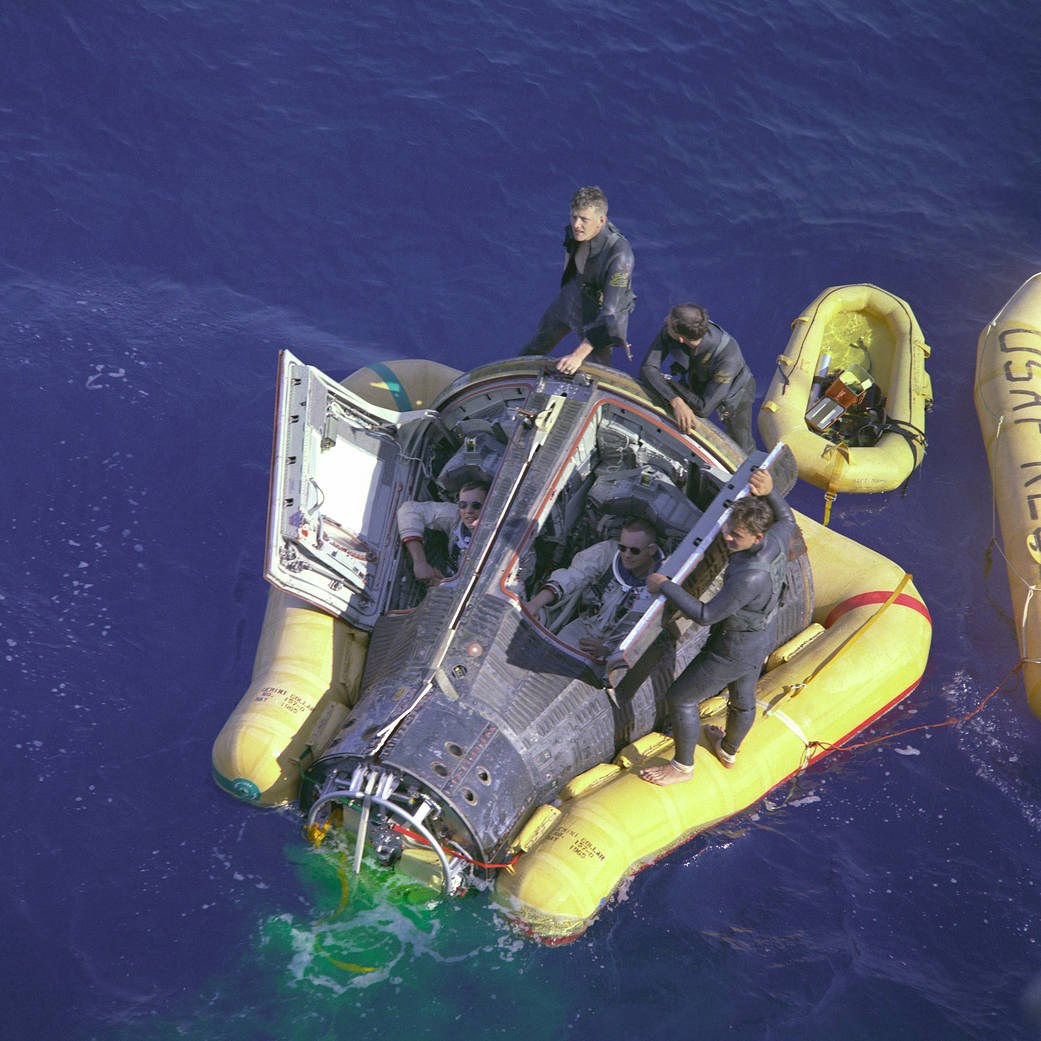
Image context: the cover uses NASA's recovery photograph of Gemini VIII floating in the western Pacific after its emergency splashdown.[3] It fits this article because the mission's historical meaning lies at the intersection of achievement and abort. The image does not show the docking itself; it shows the procedural afterlife of the emergency, when the first docking in space had already succeeded and the question had narrowed to whether the crew could be brought home alive.
Timeline anchors
- March 16, 1966, 11:41:02 a.m. EST / 16:41:02 UT: Gemini VIII launches from Complex 19 at Cape Canaveral with Neil Armstrong and David Scott aboard.[1]
- Less than seven hours after liftoff: Armstrong guides Gemini VIII into the first successful docking in space with the Agena target vehicle.[2]
- Minutes after docking: the docked spacecraft begins an unexpected roll during post-docking maneuvers; after undocking, the Gemini's spin accelerates toward one revolution per second.[2][3]
- Same day, after the crew activates the re-entry control system: mission rules require immediate termination of the planned three-day mission and diversion to a western Pacific contingency landing area.[3]
- March 16, 1966, 10:22:28 p.m. EST / March 17, 03:22:28 UT: Gemini VIII splashes down in the western Pacific after a flight lasting 10 hours, 41 minutes, 26 seconds.[1][3]
The mission began as a Moon-program rehearsal
NASA's own Gemini retrospective makes the purpose plain. Project Gemini existed to prove the techniques Apollo would need, and rendezvous and docking sat near the center of that list because lunar-orbit rendezvous required spacecraft to separate and reunite reliably in space.[2] By early 1966, five Gemini missions had already established that the spacecraft could stay aloft, change orbit, and support spacewalking.[2] Gemini VIII was supposed to move from demonstration toward repeatability.
The plan reflected that ambition.[1][2] Gemini VIII would launch after the Agena target vehicle had reached the correct orbit, chase it down, dock, run electrical connections, and then treat the docked pair as a working system rather than a stunt. Scott's scheduled spacewalk and later redocking tests were part of the same logic. NASA was no longer asking whether astronauts could merely survive in orbit. It was asking whether the pieces of a lunar mission could be executed in disciplined sequence.[1][2]
That is why the first docking mattered so much before the emergency even began.[1][2] If Armstrong could close the final distance and lock the spacecraft together at controlled relative speed, he would prove that orbital rendezvous had crossed from theory into practiced craft. NASA's 2026 mission page still frames the result in those terms: the docking was a crucial technology milestone for later Moon landings.[1]
The docking succeeded, then the mission changed character almost immediately
The docking itself went well.[2] In the 55 Years Ago NASA reconstruction, Armstrong received the call to proceed, closed at about one foot per second, and reported the vehicles docked.[2] Scott then commanded the Agena's thrusters to roll the combined stack 90 degrees as part of the post-docking work.[2] For a brief interval, Gemini VIII looked exactly like the mission NASA had prepared.
Then the combined spacecraft began to roll unexpectedly out of communications range over the Indian Ocean.[2] This is the hinge in the story. The operational success of docking had altered the system the crew was flying. Gemini was no longer a single free spacecraft moving on its own. It was coupled to another vehicle, and an attitude-control problem inside that new arrangement immediately became harder to diagnose because the astronauts first had to decide which craft was actually at fault.[2][3]
That uncertainty matters. Historical memory can make Armstrong's later response look instantaneous, as if the crew recognized the malfunction immediately and solved it with one cool-headed move. The sources point to a more dangerous sequence.[2][3] The first crew reaction was to suspect the Agena, because the roll began while the two craft were docked.[3] Scott therefore pushed the undock button, and Armstrong backed Gemini away.[3]
The motion did not stop. It got worse.[2][3] Once free of the Agena's added mass, the Gemini spacecraft spun faster, not slower, and the crew now knew the problem belonged to their own vehicle.[2][3] What had looked like an irritating post-docking anomaly had become a life-threatening control loss.
Undocking exposed the real failure: a stuck thruster and a shrinking margin
NASA's detailed retellings preserve the drama in practical rather than cinematic terms.[2][3] Scott radioed that they had serious problems and were tumbling end over end; Armstrong added that the spacecraft was rolling up and they could not turn anything off.[3] As the spin approached one revolution per second, their vision blurred.[3] At that rate, the emergency threatened far more than mission success. It threatened crew consciousness and the possibility of recovering any deliberate attitude control at all.[3][4]
The key decision came when Armstrong shut down the Orbit Attitude and Maneuvering System and switched to the re-entry control system thrusters mounted on the nose of the spacecraft.[3][4] That move stopped the spin, but it also changed the mission's remaining logic. The re-entry control system was not a casual backup for normal orbital work. It was the control authority needed for coming home.[3] Once Armstrong had drawn on it heavily to save the spacecraft, the planned Gemini VIII mission was over whether the crew wanted to continue or not.
The Smithsonian summary of the spacecraft captures that boundary cleanly: the roll was arrested with the re-entry control system, and mission rules then forced an emergency Pacific landing less than twelve hours into what was supposed to be a three-day flight.[4] NASA's own account adds the scale of the consumption. Flight director John Hodge knew Armstrong had used almost 75 percent of the re-entry maneuvering propellant to stop the spin.[3] In other words, the system that saved the crew also closed off the rest of the mission.
This is why Gemini VIII belongs in event reconstruction rather than simple commemoration. The important fact is not only that Armstrong stayed calm. The important fact is that the crew crossed from triumph to abort through a sequence in which each correct move also narrowed the next set of options.[2][3][4]
The forced abort made recovery a logistics problem rather than a heroic epilogue
Once the re-entry system had been activated, mission rules required landing at the next available opportunity.[3] The planned western Atlantic recovery by the USS Boxer vanished from the schedule; Gemini VIII now targeted a preplanned contingency area in the western Pacific, and the USS Leonard F. Mason was ordered toward the new splashdown point.[2][3] This shift is worth noticing because it shows how much of successful crisis handling depended on infrastructure already being in place. The emergency response was not improvised from nothing. It was executed through mission rules, backup recovery zones, and naval assets assigned in advance.[2][3]
That administrative preparation kept the story from ending in orbit. Gemini VIII splashed down only about 1.6 to 2 miles from its aim point after 10 hours, 41 minutes, 26 seconds of flight.[1][2][3] Recovery aircraft raced out from bases in Japan, pararescuers reached the spacecraft in the water, and the two astronauts waited in the floating capsule for pickup.[3] The recovery photo used here belongs to that phase of the story because it shows the mission's final truth. Gemini VIII had already changed space history by docking. It had to rely on contingency procedure to survive what happened next.
Postflight lessons: docking was not enough without fast fault isolation
NASA's post-mission analysis traced the wild gyrations to an electrical short circuit that caused thruster number 8 to stick open.[2] The later Wild Ride account is slightly more cautious in phrasing, describing an erratic yaw OAMS thruster later believed to have been triggered by a short in the wiring.[3] The difference in wording does not change the underlying lesson. A spacecraft capable of rendezvous and docking still carried a dangerous vulnerability if the crew could not isolate a single runaway control element quickly enough.[2][3]
That lesson produced a concrete change. NASA added a master switch so astronauts on later Gemini flights could turn off individual malfunctioning elements more selectively.[3] This matters historically because Gemini VIII did more than prove astronaut bravery. It changed spacecraft operating logic. The mission demonstrated that orbital assembly tasks for Apollo required not only precision approach and docking technique, but also fault-management architecture that could keep one bad thruster from turning a success into catastrophe.[1][2][3]
Seen this way, Gemini VIII was a bridge mission in the fullest sense.[1][2] It connected Gemini's earlier rendezvous work to Apollo's lunar ambitions, and it connected a headline achievement to a systems lesson NASA needed before sending crews farther from Earth. The first docking in space did happen on Gemini VIII. The equally important historical fact is that the mission taught NASA never to treat docking as the whole problem.
Sources
- NASA, "Gemini VIII" mission page - mission duration, launch and landing times, objectives, and the mission's place as the first docking in space.
- NASA, "55 Years Ago: Gemini VIII, the First Docking in Space" - mission plan, docking sequence, post-docking roll, thruster number 8 finding, and contingency splashdown details.
- NASA, "Gemini's First Docking Turns to Wild Ride in Orbit" - the undocking decision, one-revolution-per-second spin, re-entry control system use, propellant loss, recovery sequence, and postflight modification.
- Smithsonian Institution, "Hardware, Capsule, Gemini VIII" - museum summary of the first docking, runaway thruster, re-entry control system response, and forced emergency landing.
- NASA, Gemini Program Mission Report: Gemini VIII - formal mission record for flight objectives, system performance, and the technical context of the mission.