Freedom Summer is often remembered through its danger: burned churches, beatings, arrests, and the murders of James Chaney, Andrew Goodman, and Michael Schwerner.[1][2][3] That memory is justified, but by itself it can make the project look like a morally charged but strategically improvised burst of activism. The stronger historical reading is more exact. Freedom Summer worked because it turned a local system of disfranchisement into a national democratic test without abandoning the local ground on which the struggle had already been built.[1][2][3][4]
That mechanism had several moving parts. Organizers in Mississippi had already spent years building relationships, testing registration drives, and learning how county officials, registrars, sheriffs, employers, and white supremacist violence reinforced one another.[2][3] In 1964, COFO and SNCC did not replace that local work with a northern volunteer spectacle. They attached outside witness to inside organizing. The result was a campaign in which voter registration, Freedom Schools, community centers, and the Mississippi Freedom Democratic Party all pushed the same point from different angles: Mississippi's exclusion of Black citizens was not a local custom with local consequences. It was a constitutional failure visible to the whole country.[1][2][3][4][5]
That is why the project's afterlife matters. Freedom Summer did not suddenly open registrars' offices across Mississippi; the registration numbers remained brutally constrained.[3] The immediate legislative breakthrough would come later, in the Voting Rights Act of 1965.[1][3][5] But the summer changed the scale on which Mississippi could be discussed. County intimidation, courthouse obstruction, school inequality, and party exclusion ceased to look like separate local grievances. They became one connected argument about who counted as part of American democracy.
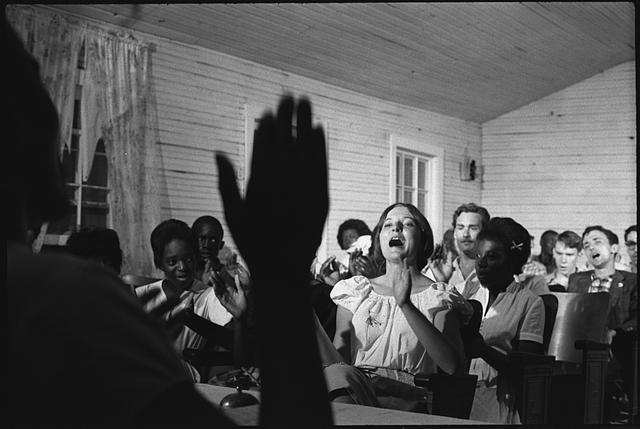
Image context: the lead image is a June 22, 1964 Library of Congress photograph showing Black and white volunteers meeting at a Black church in Ruleville, Mississippi during Freedom Summer.[6] It belongs here because the article's claim is structural before it is sentimental. Freedom Summer did not become consequential only in national television moments. It became consequential because rooms like this one tied local institutions, interracial witness, and political planning into the same frame.
Timeline anchors
- 1961: SNCC begins sustained voter-registration work in rural Mississippi under conditions of intimidation and violence.[3]
- 1962: Robert Moses becomes director of COFO, which coordinates civil-rights organizing across Mississippi.[3]
- 1963: the Freedom Vote demonstrates how outside volunteers can amplify a local Black political campaign.[3]
- June 14, 1964: the first Freedom Summer volunteers begin training in Oxford, Ohio.[3]
- June 21, 1964: Chaney, Goodman, and Schwerner disappear in Neshoba County while investigating the burning of a church linked to civil-rights organizing.[3]
- August 1964: the Mississippi Freedom Democratic Party challenges the all-white Mississippi delegation at the Democratic National Convention in Atlantic City.[1][4][5]
- 1965: Congress passes the Voting Rights Act after the voting-rights crisis in Mississippi and elsewhere has become nationally unavoidable.[1][3][5]
Those dates matter because they show Freedom Summer as a relay rather than a spontaneous episode. Local work comes first, volunteer mobilization follows, national attention spikes under violence, and the MFDP carries the struggle from courthouse doors into party procedure.
1) Local organizing came first, so the summer had somewhere real to land
One of the easiest mistakes is to imagine Freedom Summer as the arrival of outside idealists into a political vacuum. The King Institute's overview makes clear that SNCC had already been laboring in rural Mississippi since 1961, and that this work had taught organizers a hard lesson: the direct-action forms that had worked in places such as Montgomery and Birmingham could not simply be copied into Mississippi's county system.[3] There, segregation was enforced through courthouse procedure, economic retaliation, police harassment, and white violence so deeply woven into local life that a march by itself could not break the structure.
That is why COFO mattered. By the time Freedom Summer opened in 1964, Robert Moses and allied organizers were not inventing a movement from scratch. They were coordinating one.[1][3] The National Archives summary and the SNCC Digital Gateway both frame the project as a coalition effort grounded in Mississippi branches of SNCC, CORE, the NAACP, and SCLC.[1][2] In mechanism terms, that meant the summer project could plug volunteers into existing relationships with Black churches, local leaders, and communities that had already been bearing the risk.
This point is not merely organizational trivia. It explains why Freedom Summer produced more than spectacle. Because local people had already mapped the registrars, the hostile counties, the safe houses, the churches, and the probable lines of retaliation, the summer campaign could scale quickly without becoming purely symbolic.[2][3] The church meeting in Ruleville photographed by Thomas R. Koeniges captures that infrastructure in miniature.[6] Freedom Summer's national meaning was assembled in local rooms first.
2) Outside volunteers changed the visibility of violence, not the existence of violence
The second part of the mechanism was witness. SNCC's own retrospective is unusually direct on this point: COFO decided to bring "the nation's children" to Mississippi because the federal government had remained reluctant to intervene and much of the country was still unaware of the terror shaping Black political life in the state.[2] The project therefore did not assume that outside volunteers were morally superior or politically central by themselves. It assumed that white northern presence would alter what the nation was forced to see.
The sequence validated that grim logic almost immediately. The first group of volunteers began training on June 14, 1964.[3] One week later, Chaney, Goodman, and Schwerner disappeared while investigating the burning of a church in Philadelphia, Mississippi.[3] The murders did not create Mississippi's violence; they changed its audience. What had long happened to local Black citizens and organizers could no longer be dismissed as a rumor from a distant county. Violence against an interracial, partly northern volunteer force became legible to national media, liberal institutions, and federal officials in a way Mississippi's Black residents had been denied for years.[1][2][3]
The broader numbers confirm that the violence was systemic rather than episodic. The National Archives page records 1,062 arrests, 80 workers beaten, 37 churches bombed or burned, 30 Black homes or businesses bombed or burned, and multiple murders connected to the movement.[1] SNCC's page gives a similarly grim end-of-summer ledger: more than 1,000 arrests, at least 80 beatings, 35 known shootings, and 6 known murders.[2] The precise counts vary by source, but the mechanism does not. Repression had always been there. Freedom Summer made it impossible to keep repression politically local.
3) Freedom Schools and the MFDP widened the argument beyond a registrar's desk
If the story stopped with witness, Freedom Summer would still matter, but it would look too reactive. Its deeper strength was that it translated visibility into alternative institutions. The King Institute notes that the volunteers were trained not only to register voters, but also to teach literacy and civics in Freedom Schools and to promote the Mississippi Freedom Democratic Party's challenge in Atlantic City.[3] SNCC's account adds scale and texture: more than 44 projects spread across congressional districts, and all but three summer projects included Freedom Schools.[2]
That mattered because the movement was broadening the definition of citizenship. Registration drives tested the state's willingness to allow Black voting. Freedom Schools taught students Black history, civics, and leadership under conditions where segregated public education had denied them those tools.[2][3] Community centers and libraries created public space in places where ordinary civic participation could itself be dangerous.[1][2] The point was no longer only, "Let this person fill out a form at the courthouse." It was, "Build the capacities and public legitimacy of a political community the state has refused to recognize."
The MFDP pushed that logic into national party procedure. The King Institute's MFDP entry explains that Black Mississippians, excluded from the state's Democratic Party, created a parallel party, held open precinct and district caucuses, and selected delegates for the August 6, 1964 state convention in Jackson before challenging the regular all-white delegation in Atlantic City.[4] This move was strategically brilliant because it shifted the burden of explanation. Mississippi officials no longer had to justify only county registrars and local sheriffs. The national Democratic Party had to explain whether it would seat a segregationist delegation instead of a biracial one that had followed democratic procedure.[4][5]
Fannie Lou Hamer's testimony gave that challenge its unforgettable public edge, but the mechanism was already in place.[4][5] Freedom Summer had built a bridge from local disfranchisement to national embarrassment. Once the MFDP appeared before the credentials committee, Mississippi's voting crisis ceased to be only a Southern-state story. It became a test of whether a national party would ratify exclusion in full view of the country.
4) The summer succeeded by changing scale, even where it failed on the immediate count
Freedom Summer therefore has to be judged with some care. If the standard is immediate registration success, the numbers look brutal. The King Institute reports that around 17,000 Black Mississippians attempted to register during the summer, but only about 1,600 applications were accepted by local registrars.[3] If the standard is whether the MFDP was fully seated in Atlantic City, the answer is also no. The credentials committee offered a compromise, and Hamer's famous rejection of "two seats" captured the bitterness of that limit.[4]
Yet those failures are exactly why the project should be read mechanistically rather than romantically. Freedom Summer was designed less to win immediate permission from Mississippi's gatekeepers than to expose the gatekeeping system so thoroughly that national institutions would have to respond.[1][2][3][4] The Library of Congress exhibition on the immediate impact of the Civil Rights Act states the effect plainly: the project focused national attention on the plight of Mississippi's Black citizens and helped lead toward the Voting Rights Act of 1965.[5] That claim does not mean Freedom Summer by itself caused the act. It means the summer altered what federal delay and party evasiveness now cost politically.
This is also why the project marks a turning point inside the movement. It joined long local Black organizing to a national field of visibility without reducing local people to background figures.[2][3] The most durable product of the summer was not one march, one speech, or one news cycle. It was a new scale of democratic argument. Mississippi's courthouse exclusions, school inequities, and party barriers were forced into the same national frame.
What Freedom Summer actually proved
The best way to understand Freedom Summer is as a transfer mechanism. Years of local organizing supplied knowledge and trust.[2][3] Outside volunteers changed who had to watch.[2][3] Violence supplied evidence that segregation could not be discussed as ordinary local administration.[1][2][3] Freedom Schools and community institutions widened the meaning of political participation.[2][3] The MFDP then pushed the whole case into the formal machinery of national party democracy.[4][5]
That is why the project still matters in 2026. Freedom Summer did not discover Mississippi's injustice, and it did not solve it in one season. It made a different achievement. It arranged local courage, interracial witness, educational institution-building, and party challenge so that the state could no longer keep Black disfranchisement at county scale. Once that happened, Mississippi became not just a place of repression, but a problem the nation had to answer.
Sources
- National Archives, "Freedom Summer" - overview of COFO's 1964 project, the violence directed at workers and Black Mississippians, and the later connection to the Voting Rights Act.
- SNCC Digital Gateway, "Freedom Summer" - movement-centered account of why outside volunteers were brought into Mississippi, how the projects were organized, and how the summer shifted toward the MFDP challenge.
- The Martin Luther King, Jr. Research and Education Institute, "Freedom Summer" - chronology and analysis of SNCC, COFO, volunteer training, voter-registration results, Freedom Schools, and the political momentum toward the Voting Rights Act.
- The Martin Luther King, Jr. Research and Education Institute, "Mississippi Freedom Democratic Party (MFDP)" - on the parallel caucuses, Atlantic City challenge, Fannie Lou Hamer's testimony, and the convention compromise.
- Library of Congress, "Immediate Impact of the Civil Rights Act" - exhibition page connecting Mississippi Freedom Summer and the MFDP to national attention and the road toward the Voting Rights Act.
- Library of Congress, "Image from LOOK - Job 64-1904 titled Freedom summer -- students in Mississippi (white students working for Negro vote)" - June 22, 1964 photograph of volunteers meeting at a Black church in Ruleville, Mississippi, used here as the article image.
Editor’s Pick Review
This piece takes the add-on editor-pick slot because it turns a familiar civil-rights episode into a precise causal mechanism without flattening the local actors into background. The article keeps its analytical spine visible from start to finish: local organizing supplied trust and maps of power, outside volunteers changed national visibility, Freedom Schools widened citizenship, and the MFDP pushed the argument into party procedure. The result is historically grounded, structurally clear, and more durable than a danger-centered retelling alone.
The visual choice is also compliant with the stricter policy. The Library of Congress church-meeting photograph is immersive and directly tied to the article’s thesis about local rooms becoming national democratic evidence; there are no analytical graphics or symbolic filler images. The Chinese translation is especially strong among the candidate pool, with low translationese density, stable terminology, and a readable argumentative rhythm.