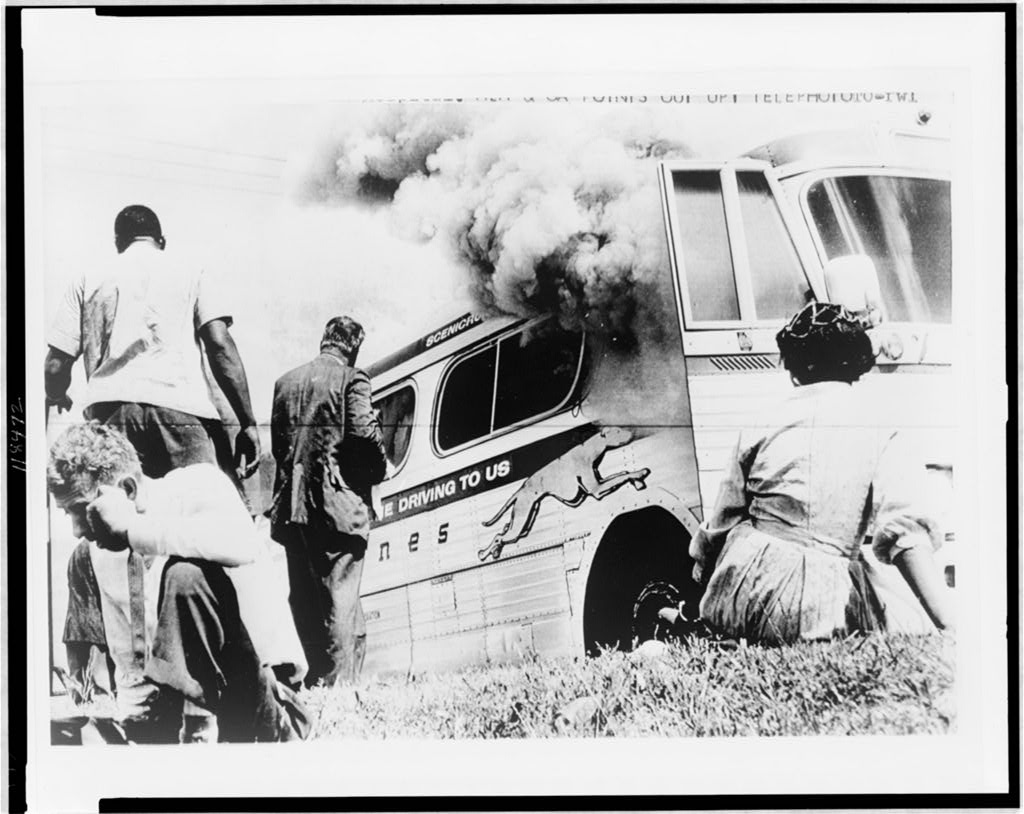
The Freedom Rides are often remembered through one unforgettable image: a Greyhound bus outside Anniston, Alabama, burning after a white mob attacked it on May 14, 1961.[1][4][5] That image matters, but it can also compress the story in the wrong way. It makes the campaign look like a pure martyrdom episode, as if its main historical meaning were that brave people endured spectacular violence in the Deep South. They did. But the rides changed federal policy for a more structural reason. After Alabama violence appeared to break the first CORE ride, student organizers in Nashville refused to let terror define the end of the sequence. They restarted the route, accepted repeated arrests, and kept pushing the federal government from sympathy toward enforceable administrative action.[1][2][3]
That is why the crucial historical question is not only why mobs attacked the riders. It is why the campaign still worked after Anniston and Birmingham seemed to prove that the attackers had won.[1][2][5] The answer sits in the transition from roadside beatings to organized repetition: more riders, more buses, more arrests, more press, more pressure on Washington to decide whether Boynton v. Virginia would remain a Supreme Court principle on paper or become a rule that bus companies and terminals actually had to obey.[1][3][6]
The archival photograph used here shows riders gathered outside the burned bus rather than inside a courtroom or federal office.[4] That is the right visual key because the campaign's administrative ending only came after organizers proved that terror had failed in its first purpose. The bus was destroyed. The ride was not.
Time anchors: the sequence that mattered
- May 4, 1961: CORE riders leave Washington, D.C., for New Orleans to test whether interstate buses and terminal facilities would obey existing law.[1][3][6]
- May 14, 1961: one bus is firebombed near Anniston; riders are beaten in Birmingham after local protection fails.[1][2][4][5]
- May 17, 1961: Diane Nash and Nashville students send a new group back toward Birmingham rather than let the campaign die.[1][2]
- May 20-21, 1961: the resumed ride reaches Montgomery under escort, then meets another mob assault; federal marshals are later deployed during the siege at First Baptist Church.[1][2]
- May 24-29, 1961: Jackson arrests begin to multiply, and the Kennedy administration asks the Interstate Commerce Commission to ban segregation throughout the facilities under its jurisdiction.[1][3]
- November 1, 1961: the ICC order takes effect, giving the campaign the federal enforcement lever it had been trying to force into existence.[1]
Those dates show why this should be read as an event reconstruction, not just a gallery of heroic scenes. The Freedom Rides succeeded because organizers kept the sequence moving long enough for the venue of decision to change.
1) The rides were designed to test enforcement, not just law on paper
By the time the first riders boarded on May 4, the basic constitutional argument had already been won in principle. Morgan v. Virginia had struck at segregation in interstate bus travel, and Boynton v. Virginia extended that logic to terminal restaurants and waiting rooms used by interstate passengers.[1][6] The unresolved problem was enforcement. A legal rule existed at the top of the system, but southern carriers, terminal managers, local police, and state officials still operated as if custom outranked law.[1][6]
CORE's wager, then, was not merely symbolic integration. It was a test of whether a right became real when ordinary travelers tried to use it.[1][3] That is why the route mattered. The riders did not stay in Washington and argue about precedent. They traveled into Virginia, the Carolinas, Georgia, Alabama, Mississippi, and Louisiana because each stop forced a practical answer: would a Black passenger be served, seated, admitted, and protected, or would local power simply reimpose Jim Crow at the point of contact?[1][3]
This distinction is central to understanding what followed. If the campaign had been only a protest ride, Alabama mobs could have ended it by making the cost unbearable. If it was an enforcement test, however, every refusal and every beating generated new evidence that the federal government was failing to govern a domain already under federal law.[1][3][6]
2) Anniston and Birmingham looked like the end because they were meant to be
The Alabama attacks were not random eruptions. They were designed to close the route by proving that the Deep South still controlled the street.[1][2][5] The King Institute summarizes the moment starkly: when the riders reached Anniston on May 14, a violent mob met them, one bus was firebombed, and fleeing passengers were driven into an angry crowd.[1] SNCC's account sharpens the physical picture: Klansmen slashed the tires, trapped the riders against the doors, and only the opening of a rear exit prevented the burning bus from becoming a mass killing.[2][4]
Birmingham completed the message. There, the riders encountered another mob while Bull Connor's police offered no effective protection.[1][2][5] The point was larger than bodily injury. Alabama segregationists were trying to establish that no federal ruling could survive first contact with local collusion between police inaction and white mob force. Under those conditions, James Farmer's initial decision to end the first ride was understandable. The original route had been physically broken.[1][3]
That is why the Anniston photograph matters as more than iconography.[4] It captures a campaign that appears, at that instant, to have been defeated in material terms. The bus is unusable. The riders are exposed. The state is absent except as permission. If the sequence had ended there, the lesson of the Freedom Rides would have been grimly simple: federal law stopped at the Alabama line.
3) Diane Nash's restart changed the meaning of the whole campaign
The decisive turn came not from Washington but from Nashville. Student activists there concluded that stopping after Anniston and Birmingham would hand strategic victory to violence.[1][2] The King Institute preserves Diane Nash's reasoning in its blunt form: "We can't let them stop us with violence."[1] That line is brief, but historically it did enormous work. It reframed the issue from whether the first ride had been smashed to whether the movement would accept a rule that terror could veto enforcement.
On May 17, Nash and a new group of riders returned toward Birmingham.[1][2] They were arrested, stranded, pushed back toward Tennessee, and forced to solve practical problems that older heroic summaries sometimes glide past: finding drivers, getting funds, arranging support, and keeping people moving under conditions where any ride south looked like a possible death trip.[1][2] This logistical dimension matters because it shows the Freedom Rides were not sustained by courage alone. They were sustained by organizers who kept converting shock into another departure.
That restart also altered the federal problem. Before Nash's decision, the Kennedy administration could imagine the violence as a terrible but self-limiting crisis around a single ride. After Nashville reentered the route, the administration faced something harder: a renewable campaign that would keep producing national headlines until someone either crushed it openly or enforced the law.[1][2]
4) Montgomery exposed the thin edge of federal intervention
The resumed ride reached Montgomery on May 20 under a police escort arranged under pressure from Washington.[1][2] That detail is easy to read as a sign that the federal government had finally taken control. The sequence shows something narrower. Protection existed up to the city line, then vanished. Once the bus entered Montgomery, local police failed to appear as expected and another mob attack followed.[1][2]
This is the point where the story stops looking like a simple arc from violence to rescue. The federal government was now involved, but unevenly and reluctantly. The escort to Montgomery showed that Washington could lean on state officials. The collapse at the terminal showed that such leverage was still thin, contingent, and vulnerable to local sabotage.[1][2] A campaign built only on the hope of occasional escorts would have remained hostage to every county line and every sheriff's timetable.
The next night, during the crisis around First Baptist Church in Montgomery, federal marshals were deployed after Martin Luther King Jr. called Attorney General Robert Kennedy from inside the church while a threatening mob gathered outside.[1] This was an important escalation, but it still did not solve the underlying enforcement problem. Marshals could defend one church on one night. They could not ride every bus, police every terminal, or make carriers desegregate by administrative habit. The campaign still needed a broader lever.
5) Jackson moved the struggle from spectacular violence to repeatable arrests
That broader lever emerged when the rides kept moving into Mississippi. The shift to Jackson changed the mechanics of the campaign.[1][2][3] Instead of relying on Alabama-style mob theater, Mississippi authorities increasingly used arrest, processing, and jail to contain the riders. On the surface, that seemed less chaotic than firebombing and beatings. Strategically, it was a trap for the segregationist side. A jail system could absorb individuals. It had much more trouble absorbing a national stream of volunteers determined to keep arriving.[1][2]
The CORE pamphlet from May 1961 already catches the campaign in this transitional phase. It reports James Farmer's arrest on May 24 for trying to eat in the Jackson terminal and describes new rides already underway as the organization tried to scale the action rather than mourn the first bus.[3] The King Institute and SNCC both emphasize what happened next: students from across the country began purchasing tickets south, and Jackson jails filled with riders whose arrests kept the story in public view.[1][2]
This was the crucial strategic conversion. In Alabama, segregationists had tried to make the rides impossible through uncontrolled violence. In Mississippi, authorities made them administratively repetitive, which meant the movement could answer by becoming administratively repetitive too: more tickets, more arrests, more names, more coverage.[1][2][3][5] That did not reduce the riders' personal risk. It did change the political arithmetic. Each arrest was now one more proof that the federal government had allowed a supposedly settled legal question to become a continuing governance embarrassment.
6) The campaign succeeded when moral emergency became federal procedure
The Kennedy administration finally moved on May 29, 1961, when it directed the Interstate Commerce Commission to ban segregation in all facilities under its jurisdiction.[1] That order did not take effect immediately; the rule became operative on November 1, 1961.[1] The delay matters. It shows that the Freedom Rides did not produce instant redemption. What they produced was a forced administrative path from constitutional principle to enforceable regulation.
That is the best way to understand what the riders actually won. They did not merely secure sympathy, and they did not simply dramatize injustice for television. They created a situation in which the federal government had to choose between endless crisis management and a rule that would bind carriers and terminals across the interstate system.[1][2][6] The ICC order mattered because it reached the precise layer where southern practice had been resisting change: the everyday facilities of travel, not just abstract doctrine.[1][6]
In that sense, Jackson was as important as Anniston. Anniston revealed the brutality of the old order. Jackson helped make continuation thinkable. The rides became harder to erase once the campaign had shifted from a single broken bus to a repeatable machine of arrival, arrest, publicity, and renewed arrival.[1][2][3]
Why the sequence still matters
The Freedom Rides are sometimes told as a morality tale in which federal power eventually awakens to defend virtuous citizens. The sequence reconstructed here is harder and more useful. Federal power moved late, partially, and under pressure.[1][2] The campaign succeeded because organizers refused to let the first defeat stand as final, kept creating new incidents under the same unresolved legal regime, and forced Washington to convert outrage into administrative enforcement.
That is why the Anniston bus should not be treated as the whole story.[4][5] It is the hinge. The bus burned, but the movement's answer was to produce another departure, then another arrest, then another wave of riders, until the cost of non-enforcement exceeded the political cost of issuing a federal order. The Freedom Rides changed history not only because people were brave enough to board. They changed it because, after terror had made continuation look irrational, other people were organized enough to board again.[1][2][3][5]
Sources
- The Martin Luther King, Jr. Research and Education Institute, "Freedom Rides" — campaign overview from the May 4 departure through the May 29 ICC request and the November 1 rule change.
- SNCC Digital Gateway, "Freedom Rides" — SNCC perspective on Anniston, Birmingham, Diane Nash's restart decision, Montgomery, and the expansion of student participation.
- Congress of Racial Equality, CORElator, "Special Freedom Ride Edition" (May 1961) — contemporary CORE pamphlet documenting the original ride, the Birmingham joiners, and the early Jackson arrests.
- Library of Congress, ""Freedom Riders," sponsored by the Congress of Racial Equality, gather outside burning bus in Anniston, Ala." — archival photograph and catalog record.
- Raymond Arsenault, Freedom riders : 1961 and the struggle for racial justice — book-length reconstruction of the campaign and its political consequences.
- Oyez, "Boynton v. Virginia" — case overview of the 1960 Supreme Court ruling on segregation in terminal facilities used by interstate passengers.