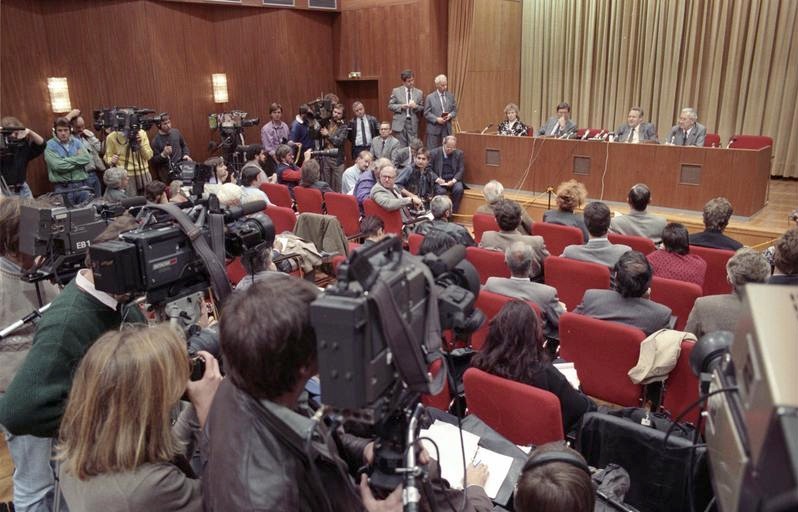

On the evening of 9 November 1989, the Berlin Wall did not first become historical at the concrete barrier itself. It first became historical in a press room.[1][2] The clip embedded below matters because it captures a state losing control over sequence. Günter Schabowski, a Politburo member speaking in East Berlin, was supposed to explain a new travel regulation as part of an attempt to stabilize a crumbling system. Instead, in a few halting minutes, he helped convert a managed bureaucratic concession into a public instruction heard as immediate.[1][4]
The shorthand version of the story usually jumps straight to the famous line and then to the jubilant images on the Wall. That sequence is emotionally satisfying, but it misses the real historical mechanism. Border regimes live on timing. A rule that begins after paperwork, offices, stamps, and the next morning belongs to one political world; a rule heard on live television as valid right now belongs to another.[1][4][5] This footage preserves the moment when East Germany's leadership lost its monopoly over that timing.
The video is in German, and that detail matters rather than inconveniences. The written analysis here does the explanatory work for readers who do not follow the audio, but the archival value of the clip lies partly in rhythm: Schabowski consulting papers, answering in a flat bureaucratic register, then letting an unfinished policy become a public event.[1][2] What survives on screen is not revolutionary rhetoric. It is administrative drift under live pressure.
Historical context: by November 1989 the regime was looking for release, not a ceremonial self-liquidation
The border crisis of 9 November 1989 only makes sense against the speed of the previous months. In May 1989, Hungary began dismantling its border fence with Austria; through the summer and early autumn, East Germans used openings through Hungary and exits via Czechoslovakia to flee the GDR in growing numbers.[3] At the same time, demonstrations widened inside East Germany, especially in Leipzig, and the regime's political authority thinned week by week.[3] When Erich Honecker fell from power on 18 October 1989, the new leadership inherited a legitimacy crisis, a migration crisis, and a public that no longer treated the Wall as an unquestioned fact.[3]
That is the setting in which the travel regulation appeared. The leadership wanted relief without surrender. The page for the former GDR press center notes that Schabowski came to the press conference with prompts including "Read out text travel regulation" and "step toward normality."[4] That wording is revealing. The regime imagined a calibrated easing measure, one more attempt to drain pressure while keeping the bureaucracy in command of procedure. The point was to regulate movement, not to stage an uncontrolled opening of the border that same evening.[4][5]
Image context: the cover uses a real Bundesarchiv press photograph of Schabowski at the 9 November 1989 press conference. It belongs here because the article's argument turns on one visible fact: the decisive hinge came before the checkpoint crowds, in a room full of notes, microphones, and incomplete briefing papers.[6]
Video provenance
The embedded clip comes from footage berlin - rbb media on YouTube and preserves the press conference itself.[1] UNESCO's multimedia archive identifies the underlying film as a Current Affairs Camera / GDR Television report from the German Broadcasting Archive, part of the documentary collection on the construction and fall of the Berlin Wall that Germany placed on UNESCO's Memory of the World Register in 2011.[2] That provenance matters. This is not a later anniversary montage that smooths the event into hindsight. It is the room, the cadence, and the uncertainty by which the news first entered circulation.
Close reading: the clip shows a border regime failing in the grammar of announcement
The first thing the footage establishes is ordinariness.[1] Schabowski is not framed like a world-historical prophet. He looks like a senior party functionary working through a briefing: papers in hand, microphones packed in front of him, journalists asking questions in sequence. That visual texture matters because it restores contingency. The Wall did not open after a solemn declaration that the state had carefully chosen and theatrically staged. It opened after a routine press encounter revealed how weak the state's internal command had become.
The second thing the clip shows is compression under pressure.[1][4] Schabowski is clearly handling material that has not been fully digested into a clean public script. The famous answer lands with force today precisely because it does not arrive with force in the room. He searches his papers, compresses a more mediated procedure into a simpler public rule, and lets the phrase "effective immediately" carry more practical meaning than the bureaucracy intended.[4] The footage therefore captures something deeper than a verbal mistake. It captures the collapse of administrative pacing. Once the timing device fails, the rest of the border system starts failing behind it.
That is why this video matters more than a still image or a retrospective quotation. On paper, the GDR leadership still believed it was managing a regulation. On screen, one can watch that regulation escape into mass interpretation.[1][4] The press room becomes the place where sovereignty over the clock is lost. A regime that depended on checkpoint procedure, stamped permissions, and controlled openings suddenly speaks in a register the public can hear only one way: go now.
The footage also clarifies that the Wall did not open because one room possessed magical causal power by itself. It opened because live media translated an ambiguous bureaucratic statement into public action.[1][3][5] The U.S. Office of the Historian notes that the world was taken by surprise when crowds began dismantling the Wall during the night of 9 November 1989.[3] Berlin.de's page on Bornholmer Straße fills in the mechanism on the ground: after West German television reported the travel-rule change Schabowski had just announced, crowds began collecting at the checkpoints; about two hours later the guards at Bornholmer "opened the floodgates," and over the next hour roughly 20,000 people crossed the Bösebrücke without checks.[5] The press conference is therefore the upstream artifact in a longer chain of transmission, interpretation, crowd pressure, and institutional surrender.
Why this archival moment still matters
The clip corrects a comforting myth. It is tempting to remember 9 November 1989 as though East Germany elegantly recognized history's verdict and opened the border with ceremonial clarity. The archival record points somewhere sharper. The leadership was trying to buy time, lower pressure, and keep initiative.[3][4] What made the night decisive was the interaction between a half-briefed spokesman, a live television audience, and border guards confronted with crowds before the machinery of permission had been reorganized to cope.[1][4][5]
Seen from that angle, the celebration on the Wall is the afterimage, not the first cause. This video preserves the hinge moment in which a socialist bureaucracy ceased being able to decide when its own rule would begin. That is why the footage belongs at the center of the story. It lets us watch the Berlin Wall opening not as a simple symbol of freedom descending from nowhere, but as a precise failure of state timing that millions of people were ready to exploit the instant they heard it.
Sources
- footage berlin - rbb media, "Schabowskis Versprecher führt zum Mauerfall – Pressekonferenz am 9. November 1989 | Ende der DDR," YouTube video.
- UNESCO Multimedia Archives, "Günter Schabowski Speaks to the International Press, East-Berlin, 9 November 1989" - provenance note linking the film to the German Broadcasting Archive and UNESCO's Memory of the World collection.
- Office of the Historian, U.S. Department of State, "The Fall of the Berlin Wall, 1989" - short official history of the 1989 border crisis and the surprise of the Wall's opening.
- Orte der Einheit / Stiftung Haus der Geschichte, "Press Center of the GDR" - site note on Schabowski's 9 November 1989 press conference, including his travel-regulation prompts.
- Berlin.de, "Former border crossing at Bornholmer Strasse" - official account of the checkpoint crowds, the guards opening the floodgates, and the first large-scale crossing.
- Wikimedia Commons, "File:Bundesarchiv Bild 183-1989-1109-030, Berlin, Schabowski auf Pressekonferenz.jpg" - file page for the archival photograph used as this article's image.