The Civilian Conservation Corps is often remembered as a New Deal success in one broad, flattering sentence: unemployed young men planted trees, built trails, and sent money home. That summary is true, but it leaves out the real historical question. The harder question is why the CCC moved so quickly in 1933 when so many other emergency programs took longer to define, staff, and legitimize. The best answer is not that conservation work was universally popular or that Franklin Roosevelt simply willed a corps into existence. The better answer is structural: the CCC was designed as a narrow operating system with a small number of moving parts, and each part solved a different political problem at the same time.[1][2][3][4]
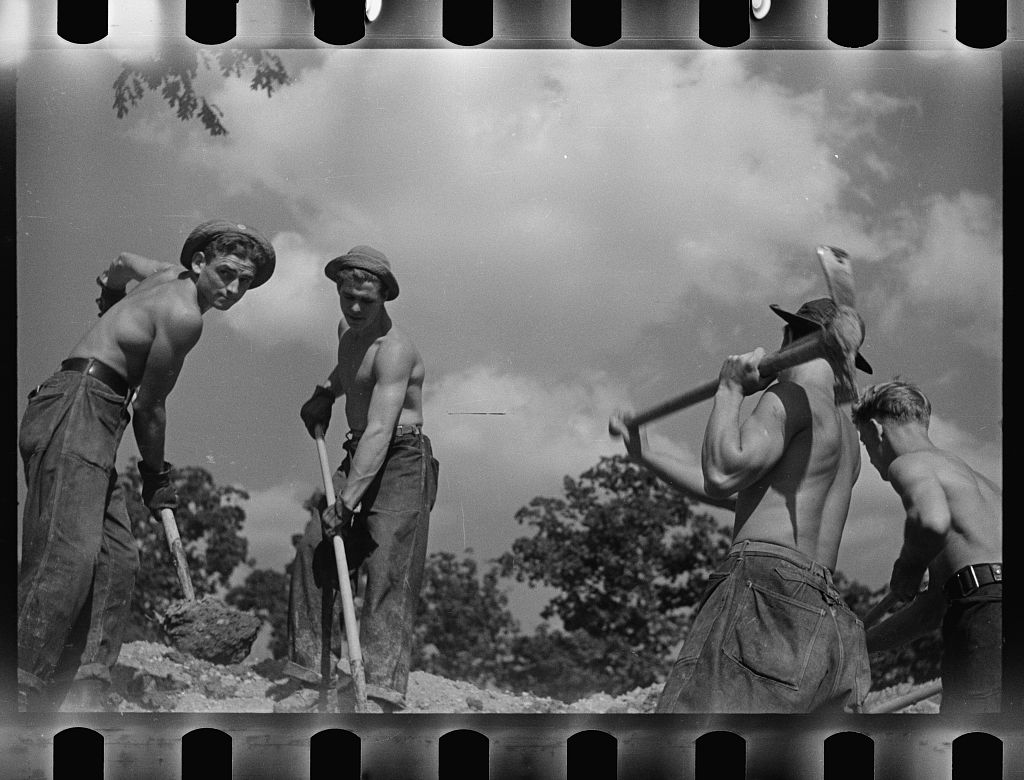
The cover photograph from August 1935, taken in Prince George's County, Maryland, shows that operating system at ground level: shirtless young men with shovels and pickaxes, working in a disciplined group on a physically obvious task.[6] The image matters because the CCC had to look like that if it was going to survive. It could not appear as abstract relief, and it could not become ordinary military service. Its durability came from sitting between those two forms.
Timeline anchors
- March 21, 1933: Roosevelt asks Congress for a program that would put unemployed men into forestry, flood control, and related outdoor labor while avoiding the stigma of a cash dole.[1]
- March 31, 1933: Congress passes the Emergency Conservation Work Act, creating the legal basis for the program that soon became popularly known as the CCC.[1][2]
- April 5, 1933: Executive Order 6101 establishes Emergency Conservation Work as an independent agency.[3]
- April 1933: the Labor Department begins selection, the Army begins camp mobilization, and Agriculture and Interior line up project work.[2][4]
- July 1, 1933: the startup wave has already pushed enrollment close to 300,000 men in more than a thousand camps.[4]
- June 30, 1942: the program ends after the wartime labor market and military mobilization absorb the young men it had originally targeted.[4]
These dates show that the CCC's central achievement was not only scale. It was speed under institutional fragmentation.
First mechanism: the program was narrow enough to organize quickly
Roosevelt's original pitch to Congress was deliberately limited. He asked for a measure that would move unemployed men into "simple work" related to the conservation and development of natural resources.[1] That narrowness was politically useful. It reduced the need for complicated means-testing, professional retraining, or industrial planning. The state was not promising to redesign the whole labor market. It was promising to recruit a specific population for a specific kind of outdoor work.[1][2]
The legislation kept that logic. The CCC Act focused on unemployed, unmarried young men, generally ages 18 to 25, serving six-month terms at a monthly wage of $30.[2] That is the first reason the program scaled. It was built around a standardized participant profile and a standardized term length. A six-month rotation made manpower predictable. The age restriction and unmarried status simplified selection. The work itself favored labor intensity over complex equipment. In administrative terms, the corps did not try to solve every unemployment problem; it defined one tractable slice of unemployment and attacked that slice hard.[1][2]
That choice also mattered rhetorically. During the first New Deal months, Congress and the White House needed emergency relief that could still be presented as discipline, work, and national repair. Conservation labor provided exactly that language. It let Roosevelt talk about reforestation, erosion control, flood prevention, and park improvement rather than about direct maintenance payments.[1][4]
Second mechanism: four agencies split the job into clean lanes
The CCC was not one agency doing everything. It was a tightly divided system. The National Archives' records guide traces the legal structure through Emergency Conservation Work and Executive Order 6101, while the National Archives' Prologue history describes the operational split more clearly: Labor selected enrollees, War managed the camps, and Agriculture plus Interior supervised most of the field projects.[3][5] That division is the second reason the program scaled.
Each department handled the work it already knew how to do. Labor could work through state relief channels to identify eligible young men. Agriculture and Interior already controlled large project landscapes through the Forest Service, National Park Service, and related bureaus. The Army knew how to move men, feed them, house them, and keep them on schedule.[4][5] Instead of building a new bureaucracy from scratch, the CCC assembled a temporary coalition of existing ones.
This is where the program's historical cleverness becomes visible. Emergency systems often fail because every agency claims the whole mission or because nobody owns the unglamorous logistics. The CCC did the opposite. It made logistics central from the start and placed them with the institution most capable of doing them quickly.[4][5]
Third mechanism: the Army camp solved the hardest practical problem
The Army's role is easy to understate because the CCC was supposed to remain civilian. Yet the Army camp was the machine that made the corps real. Prologue's account describes camps of roughly 200 men each, with the Army responsible for gathering enrollees, transporting them, housing them, and running camp life.[5] In the early months of 1933, that solved the problem that destroys many emergency labor programs: how to take thousands of inexperienced workers, move them onto remote public lands, and keep them fed, clothed, medically screened, and productive without administrative collapse.
This is also why the CCC expanded so fast in the first ninety days. The Army already possessed transport, mess, medical, and command routines. A civilian agency could have designed those systems eventually, but not at April 1933 speed. The Army made it possible to open camp after camp while Agriculture and Interior focused on the actual work projects.[4][5]
That arrangement was never frictionless. Prologue notes early tension between the Forest Service and the War Department over how much authority the Army should wield inside the camps.[5] But that friction itself reveals the program's logic. The CCC was not fast because everybody agreed; it was fast because the government chose an arrangement strong enough to function before the jurisdictional disputes were fully settled.
Fourth mechanism: the home-remittance rule made the wage politically legible
The CCC's most revealing design choice may have been the remittance rule. Enrollees earned $30 a month, but a large share, typically $22 to $25, had to be sent directly home to dependent family members.[2][5] This rule did several jobs at once.
First, it turned the corps into household relief rather than bachelor pocket money. The federal government could say the camp fed, clothed, and supervised the enrollee while the paycheck stabilized the family budget back home.[2][5] Second, it made the program easier to defend against critics who feared loafing, vice, or waste. The young man did not simply receive cash; he entered a disciplined camp system and visibly transferred most of his wages to his family. Third, it widened the program's political constituency. One enrollee represented not one voter but an entire struggling household that could feel the benefit immediately.[2][5]
This is the point where the CCC stops looking like a generic jobs program and starts looking like a carefully balanced relief machine. The camp gave the state control over labor. The remittance rule gave households a claim on the wage. Together, they kept the corps suspended between welfare and work in a way that felt acceptable to a broad 1930s public.
Fifth mechanism: the projects were visible enough to justify the system
The CCC also needed outputs that the public could see. Roosevelt's initial message stressed forestry, flood prevention, and related land work because those tasks looked national, useful, and morally clean.[1] The early project pipeline in Agriculture and Interior turned that rhetoric into roads, trails, erosion controls, park facilities, firebreaks, plantings, and watershed work.[4][5]
Visibility mattered. A relief program that disappears into a ledger is easier to attack. A relief program that leaves behind roads in parks, terracing on damaged land, or improved forest infrastructure becomes harder to dismiss as mere dependency. The Prince George's County photograph used here captures that political need as much as it captures the labor itself.[6]
This is also why the CCC became one of the most durable memory objects of the New Deal. It left behind places. Camps closed, but trails, cabins, park roads, planted stands, and erosion-control works stayed in the landscape. The program's legitimacy was built not only from paychecks but from things that looked built, repaired, or protected.[1][4]
Why the model weakened by 1942
The same structure that made the CCC strong in 1933 made it easier to retire in 1942. Its target population was a pool of unemployed young men. As defense production expanded and military mobilization accelerated, that pool shrank and the Army's logistical capacity was needed elsewhere.[4][5] The corps had been built for Depression conditions, not for a wartime labor market.
That end point clarifies the historical lesson. The CCC was not a timeless formula for public employment. It was a period-specific mechanism built for a very particular conjunction of mass unemployment, available public land, and a state willing to use military logistics for civilian relief without formally militarizing the workers.[3][4][5]
What made the CCC work
The strongest interpretation, then, is straightforward. The CCC scaled because it solved five problems in one design: it narrowed eligibility, split administration into specialized lanes, used Army camps to handle logistics, compelled wage remittances to stabilize families, and assigned the labor to highly visible land projects.[1][2][3][4][5] Remove any one piece and the whole thing gets weaker. Without the camp, startup slows. Without the remittance rule, the politics get rougher. Without visible conservation work, the program looks like ordinary relief.
That is why the CCC still matters historically. It was not just a sentimental tree-planting corps. It was a compact state machine for converting unemployment into discipline, wages into family relief, and emergency legitimacy into durable public works.
Sources
- Library of Congress, Law Library blog, "This Week in History: Senate Bill S. 598 is Signed by President Franklin Roosevelt, Creating the Civilian Conservation Corps" (March 28, 2024).
- National Park Service, "The Civilian Conservation Corps Act (1933)" - Emergency Conservation Work Act terms including enrollee age, term length, and monthly pay/remittance structure.
- National Archives, "Records of the Civilian Conservation Corps (CCC)" - legal creation of Emergency Conservation Work under Executive Order 6101 and agency record context.
- National Park Service, Conrad L. Wirth, Parks, Politics, and the People, chapter 5 - early CCC mobilization scale, camp rollout, and 1942 termination context.
- Neil M. Maher, "Into the Woods: The First Year of the Civilian Conservation Corps," Prologue (National Archives, Fall 2006) - departmental division of labor, camp structure, and remittance rule.
- Library of Congress Prints and Photographs Division, "Civilian Conservation Corps boys at work, Prince George's County, Maryland" (Carl Mydans, August 1935).